Showing posts with label Inose Naoki. Show all posts

Wednesday, February 05, 2014

Very Kind Of Them #16

Over at the East Asia Forum, Peter Drysdale and his esteemed team have published my look at the Tokyo Metropolitan District's electing a new governor.

Tokyo governor election to spell trouble for the LDP?

On 9 February, voters in the richest municipality in the world, the Tokyo Metropolitan District, will elect a new governor. Despite the job's many attractions, Japan's stultified political parties were unable to find candidates within their own ranks. Instead, they have had to line themselves up behind independents — all men (there are no women running) who have either burned their bridges with the established parties or never had any bridges at all...
(Continue Reading)

As of today Masuzoe Yo'ichi seems assured of victory, with Utsunomiya Kenji again coming in second and Hosokawa Morihiro limping in in third place. The scary possibility is that General Tamogami Toshio (Ret.) has a more than a decent chance of finishing in the top three.

Tuesday, January 21, 2014

The DPJ's Failures Defeat Simple Description


In describing the downward arc of history, Karl Marx said that it repeats itself, first as tragedy, then as farce.

Dear Karl, what comes after farce?

If you know, please write me, as I am at a loss to describe the level of ineptitude of the officers of the Democratic Party of Japan. Beyond pathetic they are, which is, what? What is beyond pathetic?

The latest episode in the DPJ's plunge into trans-Marxist levels of the ineffectual? The surprise announcement yesterday of the signing of a policy agreement in between candidate for Tokyo governor Masuzoe Yo'ichi and Tokyo Rengo, the Tokyo branch of the Japanese Trade Union Confederation. (Link - J)

So what?

Rengo (Link) is according to all common reckoning, the indispensible pillar of DPJ support. Without Rengo, the DPJ is nothing, electorally and otherwise.

Despite the seeming automatic coordination that should take place in between the two organizations, no one at DPJ Central seems to have made the call to Rengo's Tokyo offices to find out whether or not the folks there could support Hosokawa Morihiro, the DPJ's preferred candidate in the wild four-way* of those seeking to fill Inose Naoki's empty seat (Link). As it turns out, the union organization finds Hosokawa's anti-nuclear stance not to its liking, seeing it as a threat to the job security of the power and manufacturing sectors' unionized workforces. (Link - J)

So Tokyo Rengo is supporting Masuzoe.

That the DPJ officer who failed to block this incredible end around deep into DPJ territory is none other than the mouth from the south, the oleaginous Matsubara Jin (Link - J) does nothing to ease the sting of this most recent grostesque stumble. If Matsubara were in some way under threat of being held accountable for allowing Tokyo Rengo cut a private deal with the Liberal Democratic Party's favorite in the race for leader of the richest municipality of the known inhabited universe, then his humiliation would at least have a savor of Schadenfreude.

However, in Kaieda Banri's DPJ (Link) no one is ever held accountable for anything

That the present DPJ is moribund is not surprising, given its seeming inability to do anything right (lack of accountability having something to do with this situation). Do not the voters of this blessed land nevertheless at least deserve the semblance of a non-Communist opposition to the policies and practices of the Abe Administration?

As for Hosokawa, a DPJ endorsement minus support from Rengo is worth less than nothing. Thank goodness for him he has fellow former prime minister Koizumi Jun'ichiro in his corner.

------------

* Yes, I know that the field of candidates has five individuals in it. I am trying, desperately, to forget the candidature of Dr. Nakamats.


Thursday, December 19, 2013

Inose's Fall And After

Tokyo Governor Inose Naoki today announced that he has informed the head of the municipal assembly of his intention to resign his office. Inose's move comes at the end of weeks of nearly incessant calls for his resignation. Inose accepted and never declared a personal no-interest, no-expiration-date loan of 50 million yen from the family owners of the Tokushukai medical empire, currently under investigation for massive violations of the nation's voting laws in last December's House of Representatives election. (Link)

Inose has, as yet, not been charged with any impropriety in accepting the private loan -- or for having returned the money in haste after the executives of the Tokushukai were rounded up and arrested. A citizens group has filed an official complaint with the Tokyo Prosecutors' Office asking for an investigation into Inose's possibly failing to declare the loan as a political donation. The prosecutors are obliged to look into the case but are unlikely to file charges. With Inose no longer in office it is possible the matter will end there. However, the citizens group can continue to hound Inose for years via the out-of-control Committee for the Inquest of the Prosecution system of citizens' indictments.

We have seen this movie too many times. An individual bubbles up from out of the murk, offering a chance to shake up the way the country operates. He then makes a mistake, or pushes too hard in trying overturn the Establishment -- and the investigators suddenly arrive. A credulous and craven media complex rushes in, broadcasting or publishing every rumor as fact, as though it were damning evidence of a criminal enterprise -- camouflaging all the while the sources whose assertions would not pass the smell test if their identities were known. The public, confused by the reporting and by inculcated and reinforced biases against rabble rousers, or desiring only that everything in life be quiet and unthreatening, abandons the previous crowd darling. Horie Takafumi, Murakami Yoshiaki, Ozawa Ichiro -- all toppled by nonsense accusations or perjured testimony. Now Inose Naoki, the most assiduous administrator the Tokyo Metropolitan Government has ever had and likely will ever have, joins the list.

That Inose's political position had become untenable became crystal clear when the Democratic Party of Japan came out against him. If there were any party or group that had a philosophical or ethical reason to call a timeout on the scrum against governor, it would be the party whose own term in power was hobbled and then cut short by the obscenely thin charges filed against the secretaries of its leader Ozawa and against Ozawa himself in 2009-11. In what is evidence of the DPJ's total lack of sense of what it stands for, the party jumped into the fray with both feet, with Assembly Member for Fuchu City Koyama Kunihiko turning in an almost hysterical performance at Tuesday's committee meeting. Party Leader Kaieda Banri, who as a protégé of Ozawa should know better, responded to news of Inose's plan to resign by saying, "Those voters who supported Inose are now forced to grasping at huge disappointment. Given that he came under a cloud of doubt, he should have resigned sooner." (Link - J)

The monumental stupidity of Kaeda's statement -- repudiating due process of law and the presumption of innocence -- reinforces the belief that the DPJ is doomed failure as long as he is the head of it.

As to why the Liberal Democratic Party and the New Komeito, which supported Inose's candidature in 2012, should so suddenly turn against him, the answer is two-fold. First, by going after Inose for accepting Tokushukai money the LDP is making a bold bid to have the public forget that the money men in this affair, Tokuda Torao and Tokuda Takeshi -- were both LDP members of the House of Representatives. It is insane to believe that skewering Inose would cover up the LDP's fingerprints on the 50 million yen -- but goodness, it seems to have worked.

The other reason why the LDP wanted Inose gone is, unsurprisingly, money. Not paltry 50 million sums from the Tokudas -- real money. The hundreds of billions of yen that will be spent on Olympics-related construction and events preparations over the next six years. Inose rose to influence though penning books on the horrible waste inflicted by government budgets and the countryside by the construction industry, working at that time hand-in-glove with the LDP. If there is an eminence grise or noire in this drama, it is the members and supporters of the LDP's Road Tribe, who have long sought a means of wreaking vengeance on Inose for having turned the country against them.

With Inose the skeptic and critic out of the way, replaced with a more pliant successor, the Olympics can become the cover story for a thousand sins and abuses.

As for who will run in the by-election to elect a new governor, several names are being bandied about. Media types and Nagata-cho hallways rats have been flogging former Health Minister Masuzoe Yo'ichi as one likely to toss his hat in the ring. The resignation of Higashikokubaru Hideo from the Diet a week ago already initiated a burst of predictions he would be in the race.

The Sankei Shimbun, which has few scruples as to accuracy or plausability, has floated the names of LDP communications director Koike Yuriko (a Shisaku favorite legislator), Abe Shinzo's body double Hagiuda Ko'ichi and dark lord Minister of Education Shimomura Hakubun as potential candidates. (Link - J)

The hapless DPJ, which has a real opportunity to score points against the LDP in the aftermath of the publicly scorned passage of the Special Secrets Protection bill, has no idea whom it might nominate (Why am I not surprised?). Some in the DPJ are reportedly thinking the party should nominate Ren Ho, the House of Councillors member who heretofore has always been the bridesmaid in all big time political post guessing games.

Having the half-Taiwanese, sharp-tongued, whippet smart, media savvy, gorgeous and still youthful Ren Ho as the governor of Tokyo would send a plethora of positive messages to the world. Domestically, however, it would be a recipe for disaster. Prime Minister Abe's most consistently applause line when in conservative circles is an sarcastic echo of Ren Ho's famous question to government-supported supercomputer scientists who worked for 10 years without building an actual machine because they could never guarantee the machine would be #1 in the world. Incredulous that the geeks had consumed hundreds of millions of yen in government subsidies without producing anything, Ren Ho asked the project administrators, "What was wrong with being #2?" [So whenever Abe talks rouses the faithful with a "Let us pledge to be #1 in the world!" he is not riffing on Ezra Vogel; he is mocking Ren Ho.]

If the DPJ was smart, which it is not, it would nominate former Tottori governor and former Minister of Internal Affairs Katayama Yoshiro. The good professor actually knows and cares about administration and has a decent respect for the people's intelligence. Admirable qualities, those.

Why the race for governor matters, of course, is not that Tokyo is the most populous city in the country, that it is host of the national government or even that it will host the Olympics in 2020. It is that Tokyo Metropolitan Government is a fabulously wealthy local government, second only in economic/political significance to the U.S. states of California and Texas.

To sit behind the governor's desk inside the Tocho is a hell of responsibility. It needs a hell of a person.

Wednesday, December 11, 2013

From The Nonsense Party, More Nonsense

Fast on the heels of Pyongyang frequent flyer and professional wrestler Inoki Antonio's trip to the DPRK in defiance of a Diet ruling (Link), an act that led to a punishment of historic proportions (Link), a star Japan Restoration Party Diet member has further burnished the JRP's reputation as the party of not-ready-for-kindergarten dilettantes. Higashikokubaru Hideo, the former Miyazaki Governor (a post he served in without getting arrested, which, given the history of the Miyazaki governor’s chair, is amazing) and professional comedian yesterday told JRP co-leader and fellow television personality Hashimoto Toru he is resigning his House of Representatives seat.

The reason Higashikokubaru offered for giving up his Kinki Bloc proportional seat, after less than a year in office? "There are limits as to what I can do as a member of the Diet." (Link - J)

The Sankei Shimbun, which occasionally gets a story right, has Higashikokubaru resigning from the Diet in order to run for the post of governor of the Tokyo Metropolitan District (Link - J). This explanation gibes both with Higashikokubaru's elliptical reason for resigning and the fact that he was a candidate for Tokyo governor in 2011, running against and losing to the JRP's other co-leader, then incumbent governor Ishihara Shintaro, who himself resigned his governorship after only a year and a halfway into a four year term in order to run once again for a Diet seat.

Higashikokubaru's plan to win public office in yet a third major region of the country (Kyushu, done; Kansai, done. Why the heck not see if the Kanto is game as well?) is complicated by the grim tenacity of Inose Naoki, Ishihara's former Passepartout who took over after Ishihara's departure. Inose is hanging on to his desk at the Tocho despite everybody's trying to pressure him to resign for accepting an interest-free, no repayment-schedule loan of 50 million yen* from the Tokushukai hospital empire, whose family owners/directors were all arrested this fall for massive voting laws violations in pursuit of a House of Representatives seat for the family dauphin Tokuda Takeshi in the same election that sent Ishihara and Higashikokubaru to the Diet. (Link)

Yes, it is a complicated, intertwined cobweb of mutual back rubbing, raging narcissism, hypocrisy and yes, lots and lots of money.

Anyway, until a member of the Japan Restoration Party does or even says something remotely respectable, the JRP remains the nonsense party -- which, given the absurdities pouring out of late from the Your Party and the Liberal Democratic Party (which, by mercilessly hounding Governor Inose, is trying to make everyone forget that Tokuda, the cash dispenser, is one of its princelings) is saying something.

------

* Inose took his loan in the form of cash. I had a chance yesterday to find out the mass and dimensions of the loan, if it were handed over in its most likely form of bundles of just-off-the presses 10,000 yen bills. The stack of bills would be 38 centimeters wide, 16 centimeters deep, 10 centimeters high and weigh 5 kilograms.

Tuesday, December 03, 2013

What A Welcome Back!

I go away for two weeks and the country goes bonkers.

Item #1: Tokyo Governor Inose Naoki's loan

You are a man of utter probity and profound knowledge, who has just lost his wife and life partner. You have never run for public office in your life and you are suddenly up for the post of the most powerful local government official on Earth, for a city that thanks to you has just won the right to host an Olympics. You are going into the race without a political support group or even a single paid staff member. A shadowy right wing figure approaches you, takes you to a Kamakura hospital and introduces to a nearly totally paralyzed tycoon who asks you, "How are you doing financially?" You quibble. A week later, the man's son calls you in to his office, which is inside the House of Representatives building. He puts 50 million yen ($500,000) in cash on the table and says, "This is a loan. You do not have to pay me interest. You can repay me whenever you want. I only want to help you out. Just to make sure we are on the up-and-up, here is a note verifying the loan."

What does a stressed out, exhausted Inose Naoki do, especially when the loan will be entirely legal? (Link)


Item #2: Blogging The Official Secrets Bill

A bill declaring vast areas of what should be public knowledge "official secrets" and criminalizing investigative reporting and whistle-blowing skulks, unseen, through the halls of the Diet. Stealthily and silently, it lurches toward passage. Suddenly it is dragged out into the sunlight and stamped on the public consciousness by a blog post by actress and model heretofore known mostly for her sacré bleu poitrine. Suddenly, every editorialist and commentator has something to say about the bill, most of which are expressions of stunned disbelief at the bill's sweep and imprecision. To make matters all the weirder, the role of sherpa for the supposedly crucial, ground-breaking, nation-saving bill is given to the state minister for consumer affairs -- the most junior member of the Cabinet.

Despite the public outcry at the unnecessary severity and breadth of the bill, or perhaps because of the outcry, the government rushes the bill through committee, managing to lose, for the first time in recent memory, all the votes of one of the parties that had submitted the bill. A hell-bent rush to railroad the bill through the House of Councillors hits a granite wall, however, when Ishiba Shigeru the secretary-general of the Liberal Democratic Party, in, yep, a blog post, equates members of the public peacefully assembling and yelling out slogans against the bill to terrorism.

Way to give the despondent opposition to the bill a jolt of adrenaline, Mister "Now-you-know-why-my-Diet-colleagues-would-not-vote-me-head-of-the-LDP-even-though-I-won-the-majority-of-votes-in-the-first-round" -- and with only four days left in the extraordinary session for the House of Councillors to pass the bill! (Link)

To which I can only say, "Amaterasu bless the blog post, the salvation of this blessed land!"

Item #3: Kinshasha Embassy Burning

This morning we have gracing the news reports the incredible arrest of a Japanese diplomat for setting the fire that gutted the Embassy of Japan in Kinshasha. Given the severity of Japanese law as regards arson and the level of respect accorded the careerists of the Ministry of Foreign Affairs, this is one is going to be

1) the first act of what will be one heck of a legal circus

2) an opportunity for a very embarrassing public review of Gaimusho hiring policies.

(Link - J)

And I have not even begun to think about the implications of China's new air defense zone!

Happy December!

Wednesday, September 11, 2013

Shoe, Meet Other Foot

A U.S. Navy SEALs-adoring, English speaking Japanese by the name of Sato is trolling the prime minister's Facebook page (Link - J) this morning, leaving comments all over the place, calling the PM a traitor, commanding the PM to fall into Hell if Mr. Abe does not order Japan's (non-existent) special forces teams to slip into North Korea and retrieve all the abducted Japanese held there right now.

Mr. Prime Minister, I hope this clarifies the point that the "leftists" you have heretofore so publicly despised (Link) are the very least of your problems.

While we are on the subject of reporting by Yuka Hayashi, please check out her story on Tokyo Metropolitan District Governor Inose Naoki's submergence of his mourning for his wife in order to lead the TMD's successful bid for the 2020 Olympics (Link).

I have long praised Inose's commitment to change and accountability in government. To this I must now add a dedication to the role of leader beyond the call of duty. He is clearly as self-sacrifing a public servant as has ever graced a government office in this blessed land.

Not bad for a non-politician/non-bureaucrat, an author of non-fiction books on infrastructure spending and literary biographies.

To his wife, whose sudden death this summer was kept quiet until after the dust settled in Buenos Aires, I can say naught but requiescat in pacem.

Tuesday, September 03, 2013

All For The Olympics

Yesterday morning, Prime Minister Abe Shinzo's first task was a 40 minute run through of the presentation he will be making before the International Olympic Committee in Buenos Aires (Link - J). Tokyo Governor Inose Naoki, whose presentation skills in English are non-existent, or at least were at the last Olympic get-together, is already in Argentina preparing for his part in the presentation. (Link - J)

Given Prime Minister Abe's still suspect constitution (the digestive system-related kind) his agenda this week is one to give anyone who gives a damn the jitters. Not only is the PM crowding his daily calendar right now with the groundwork for the fall legislative session, he is also attending the G-20 leaders summit in Moscow on the 5th. It is a long way from Moscow to Buenos Aires, even aboard a Self Defense Forces' 747 jumbo jet, just for the opportunity to stand and read, pronunciation and internal clock askew, off the teleprompter to the jaded and already spoken for delegates prior to the final host city vote on the 7th.

Abe's willingness making the trip, however, seems to have forced the hand of a beleaguered Tayyip Erdogan (Link). Turkey's prime minister probably feels he should probably be spending his time responding to internal dissent and coping with the ripple effects of the civil war in Syria, rather than jetting to the ends of the earth to plug Istanbul's host city bid.

Such decision are part of the responsibilities of leadership, or at least the keeping up of the appearances of leadership.

It will be of great interest to historians, picking their ways through the first eight months of the Abe II premiership, to find out how much Abe's actions or inactions have been influenced by the need to put the best face possible on Japan in the run up to the IOC vote. Have Abe and his friends toned down, delayed or foregone their potentially more provocative moves -- an Abe visit to Yasukuni, for example -- in order to create a positive atmosphere for Inose and the Tokyo Olympic organizing committee to work their public relations magic? My guess is probably, yes. Ken Belson's article on Inose (Link) must have stimulated the Tokyo Olympic bid committee into making frantic pleas to the Prime Minister's Residence to be proactive, thinking not just about international repercussions of any nationalist activity but the potential for even innocent mistakes to get blown out of proportion.

If such pleas for caution have kept a lid on the Abe Cabinet's potential for causing upset, then perhaps this whole Olympics/world peace talk is not all so much nonsense.

It also might mean that these past eight months have been the calm before the storm.

There is, or course, the inverse effect -- of perhaps too readily seeing a pre-Olympics conspiracy behind the government's post-election behavior, most prominently its seemingly months-too-late takeover of the cleanup at the Fukushima Dai'ichi nuclear power station. As yet, the main news outlets have shied away from making the connection between the government's crash program of facing up to the immense task of stabilizing Fukushima Dai'ichi and the IOC vote. The Asahi Shimbun seems to have crept out the farthest, liberally quoting those who say they see a government trying to keep a lid on the leaking storage tanks story in order to minimize the potential adverse impact on the Olympic bid. (Link)

Persons who would like to disparage the suppression-of-bad-news-in-order-not-upset-the-Olympic-vote claims, seeing in them violations of Hanlon's Razor, would find their task much easier if the head of Tokyo's bid committee would not take such actions as sending a special, last minute letters to each and every IOC member, explaining that despite what they may have heard about highly radioactive water leaking from storage tanks on the Fukushima Dai'ichi site, "Tokyo is safe." (Link and Link - J)

Japan-based foreign journalists have recently published a few local Olympics-related stories of interest.

Over at The Japan Times's YenForLiving blog, the team of Brasor and Tsukubu have taken a dispassionate look at the claims by bid supporters of a positive economic outcome from hosting the Olympics (Link) - which must be the first "the economics of the Olympics" essay I have ever read that does not mention the budgetary catastrophe wreaked on Montreal by the 1976 Summer event. For The Times of London Richard LLoyd Parry writes about the impossibility of holding the triathlon's swimming leg in the waters off of Odaiba unless a means is found to cleanse the water there of E. coli and other enteric-disease causing bacteria (Link - great, subdued headline). I am not sure as to where Parry is getting his numbers but even the easily searchable reports from 2010 studies (Link - J) seem to show post-rainstorm bacteria concentrations in Odaiba water at 100 times the permissible limit.

As one who used to swim at Odaiba and who two week ago was wading into the water at the Tokyo Metropolitan District's one swimming beach (warning at beach: "Do not dive into the water" - Link ) after a day of exceptionally heavy rain, I am at best agnostic on the coliform bacteria problem being a threat to health. To be honest, I was a heck of a lot more worried about the stingrays -- which I have seen in the waters off Odaiba.


Later - This post has been edited to restore lost text and links.

Later still -- An earlier version of the post misidentified the author of the E. coli article as David McNeill. The actual author is Richard Lloyd Parry. My apologies to both gentlemen.

Friday, July 19, 2013

Entre La France Et Le Japon


I would so very much love to read this article on Shinjuku Station. Hélas, it is behind a paywall.

It would be refreshing to see Shinjuku Eki through an outsider's eyes again. I would also very much like to learn how the station is a troubling mirror of Japan.

I confess...due to various reasons, I could not negotiate Shinjuku Station during my first decade of residence in the Tokyo Metropolitan District.

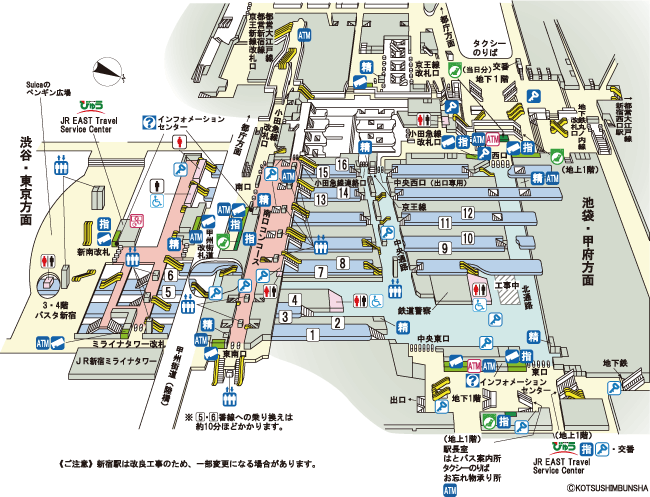
How higgledy-piggledy is Shinjuku? This is JR East's exploded view of just the JR section of the station and this is one individual's inadvertently hilarious attempt to annotate the JR East map so as to clarify the connections between the JR section of the station and the other sections.

That easiest way to slice through the labyrinth is to place the West Exit's taxi roundabout at the center and bottom of one's mental map, then draw radial compass lines toward all the other main points in the station, did not occur to me until sometime around 2005.

If I get a chance to read the Le Figaro piece, I would likely profit from a non-English language reading of locations in Japan. Almost all my views of this blessed land come via Japanese or English language sources -- with some vicarious readings of Italian views via Italian readers in Tokyo (Grazie tanto!).

That one has to venture outside the bilingual (Japanese-English) intellectual hegemony on Japan studies was clear a few months back in the disastrous interview Tokyo Metropolitan District governor Inose Naoki had with Ken Belson of The New York Times. Misunderstandings in the conduct and interpretation of that conversation seriously dented Tokyo's chances of landing the 2020 Olympic Games.

According to Belson:
At several points in the interview, Inose said that Japanese culture was unique and by implication superior, a widely held view in Japan. He noted that the political scientist Samuel P. Huntington wrote in his book "The Clash of Civilizations and the Remaking of World Order" that Japan was unlike any other culture.

Inose also pointed to polls that showed 70 percent of Tokyoites in favor of hosting the Summer Games, up from 47 percent last year. The well-received London Games, he said, have helped generate enthusiasm and confidence that Tokyo can host a similarly successful event.

Tokyo, he added, is exceptional because the Imperial Palace, which is largely off-limits to residents and visitors, forms the city's core while bustling activity surrounds it. "The central part of Tokyo has nothingness," he said. "This is a unique way that society achieved modernization."
The underlined sentence is the kind of vaulting non-sequitur that earns The New York Times the ire of Japan defenders. If Governor Inose did not say that Japanese culture is superior, one should not report that he did.

More interesting is the replication, without explanation, of the assertion (in bold) that the green oasis of the Imperial Palace grounds, much of which is impenetrable to the citizenry, is symbolic of this blessed land's unique passage to modernity.

If there was ever a statement that needed explanation, it was this one -- particular because the observation is not Japanese in origin. The improbability of the verdant and closed-off Imperial Palace grounds (the grounds are not all closed off, of course, the East Gardens being one of the truly great green public spaces in the 23 Wards) being the center of a metropolis is the signature observation in L'Empire des signes by Roland Barthes (Link - Fr).

Inose assumed that Belson, an educated Westerner with ties to Japan, would be familiar with Barthes' work. In referencing both Barthes and Huntington, Inose was demonstrating that "uniqueness," far from being a marker of Japanese prejudice and arrogance, was indeed the almost exact opposite, "unique" being the adjective to which non-Japanese thinkers, befuddled by the challenge Japan's culture and history presented to their world views, have repeatedly retreated in their hour of intellectual aphasia.

For those who are interested and do not read French, L'empire des signes has been translated into English (Link). As it is a part of the French literary criticism/semiotics tradition one will not often find the work on the syllabi of positivist tradition English language Japanese studies courses. Nevertheless, it is one of the canonical works in the Japanese intellectual tradition of the ways non-Japanese look at Japan.

Which is as twisted and non-intuitive as the maze of underground passages beneath Shinjuku Station.

Image: Sunrise over the towers of Shinjuku on 14 May 2012
Image courtesy: MTC


Tuesday, April 23, 2013

Yours, Now And Forever

I grimaced when I read the first half of the below editorial. The editors of The Yomiuri Shimbun are right: the Democratic Party of Japan and its leader Kaieda Banri have failed to revise their talking points and sharpen their rhetoric to reflect the new politico-economic environment:
Don't Kaieda and DPJ know how to say anything other than 'No'?

There was a stark contrast between Prime Minster Shinzo Abe and Democratic Party of Japan President Banri Kaieda during their debate in the Diet. Backed by the recent surge of stock prices and a high public approval rate, Abe looked confident--even relaxed--while Kaieda's attacks on him made no impact.

As long as the leader of the largest opposition party continues such a lackluster performance, Diet debates will have no vigor.

On Wednesday, Abe and opposition party leaders had their first debate under the second Abe Cabinet.

Kaieda emphasized the projected side-effects of Abenomics. He said the Abe administration's massive monetary easing would hurt people, especially those living on pensions, by raising the cost of living. He also expressed concern about the government's ongoing discussions on deregulation that could pave the way to increased job cuts at companies.

Abe responded by saying that the amount of pension benefits will go up as commodity prices rise, and stressed that inflation will eventually lead to wage increases.

"We have created 40,000 jobs in the past three months, something the DPJ-led administrations never achieved," Abe said.

Present counterproposals

Since the launch of the Abe administration, the excessive appreciation of the yen has been rectified, and stock prices have been hovering at high levels.

If Kaieda does nothing more than harp on his concerns about Abenomics, we can never expect constructive Diet debates. We expect the DPJ president to express his own views on how to end deflation and spur growth. In other words, Kaieda should present concrete counterproposals.

It was Abe who brought up the issue of the bill to rezone electoral districts in the House of Representatives by eliminating five single-seat constituencies without adding any. It seemed the prime minister was trying to take the upper hand in debating the topic. Abe, who is seeking to pass the bill ahead of other electoral reform measures, asked for Kaieda's cooperation.

Abe said: "The public has been demanding that we rectify disparities in the value of votes. As members of the legislature, don't we have the responsibility to meet this demand?"

Kaieda refused to go along, saying that the main promise [between the DPJ and the LDP] on electoral system reforms was to slash the number of seats. However, we have to say his remarks totally miss the point.

In November, a lower house electoral reform bill to eliminate five single-seat constituencies was enacted, and we have to remind Kaieda that the DPJ agreed on passing it. However, now the party opposes the rezoning bill, which would prepare an environment for the realization of the first bill, insisting that more drastic reform is necessary. It is apparent that the ruling parties would never agree to such an unreasonable demand from the DPJ.

The DPJ, saying that eliminating five single-seat constituencies is insufficient to rectify vote-value disparities, has submitted a bill to cut lower house seats by 30 in single-seat constituencies and 50 in proportional representation blocs. However, other opposition parties refused to go along with the DPJ's proposal.

Parties' divergent interests

The ruling parties have submitted the rezoning bill to a related lower house special committee. However, in protest of the move, the DPJ, Nippon Ishin no Kai (Japan Restoration Party), Your Party, the People's Life Party and the Social Democratic Party refused to participate in Diet deliberations on Wednesday.
(Link)

While I am no fan of the prime minister's policies, the points the Yomiuri's editors are making are sound. Kaieda and the DPJ are not playing politics at Abe's and the LDP's level. They are stuck recycling stale rhetoric from a decade ago. Looking at the most recent round of polls, the DPJ is perilously close to falling into secondary status alongside the Your Party of Watanabe Yoshimi.

However, Pravda-by-the Palace being the publication that it is, its editors could not complete an editorial without serving up a slice of sycophantic nonsense so preposterously thick as to crush their argument:
Such actions cannot be expected to work, and only give the impression to the public that the opposition parties are putting party interests before all else and ignoring the issue of rectifying vote-value disparities.
Because we all remember how ferociously The Yomiuri Shimbun criticized the LDP for its constant saying of "No" to anything the DPJ-led governments proposed; how the paper was up in arms about unrectified voting disparities giving unnatural permanent majorities to the LDP; and how the editors have never stopped haranguing the members of the LDP for their putting their own and their party's interests above those of the nation.

Because The Yomiuri Shimbun is an independent news organization, correct?

The same publication that a week ago published a story describing with glee the difficulties DPJ members of the Tokyo Metropolitan assembly face because they are unable find issues separating them from TMD Governor Inose Naoki -- the corollary being that the DPJ, being congenitally appreciative of good governance and unable to oppose just for opposition's sake, finds itself fighting for its survival with one hand tied behind its back. (Link)

Oh, to heck with it. The editorial board of the Yomiuri should save time-- theirs and ours -- and just fill the "From the Editor" space every day with a big "I ❤ You LDP, Now and Forever!"

Image courtesy: Chugoku Shimbun

Friday, November 30, 2012

The TMD Governor's Election As Bellweather

The constantly morphing scrum in advance of the December 4 cutoff date of the candidate lists for the House of Representatives election is leaving the voters simultaneously amused, annoyed and bored -- a state of affairs that would be hilarious if not for the facts that:

- whichever party or alliance comes out on top, it will have to deal with an uncontrollable House of Councillors (thank you, Michael Penn)

and

- the country is going to be tossed into the same maelstrom again in eight month's time, when the half of the House of Councillors seats are up for election.

In contrast to the national vote, where four parties of the right, right, center-right and left are battling for the bulk of votes, with micro-parties (sorry Your Party, you are on the way down) battling over the crumbs (the New Komeito voters being a largely fixed quantity) the contest for the governorship of the Tokyo Metropolitan District has resolved into a clear battle between two competing ideological alliances (with an obligatory minor cast of hopefuls and freaks, of course).

On the one side is the conservative alliance of the Liberal Democratic Party, the New Komeito and the Japan Restoration Association. They are all backing former Vice Governor Inose Naoki. On the other is the liberal alliance of the Communists, Socialists and the Party of the Future (Mirai no To) behind former Japan Bar Association President Utsunomiya Kenji. The conservatives here are a really conservative, seeking a retention in office of the man who has been the TMD's real governor, Ishihara Shintaro having been the Tocho's figurehead and dreamer-in-chief. The liberals are really liberal, in the pejorative sense: hopeful that correctness of thought takes precedence over experience.

Utsunomiya's campaign has a further shadow over it: the citizens of the TMD have little to complain about. The TMD's has flourished over the last decade, despite Ishihara's numerous boondoggles. By any measure, the TMD, where most of the country's thought leaders and foreign correspondents live, is the outlier among Japan's prefectures. It has enjoyed continued prosperity, continuous growth (more people live in the inner 23 wards now than at any time in history) and relative youth (Okinawans give birth to way more children but Tokyo is a magnet for the 20-35 cohort).

The Utsunomiya campaign picked up a nice endorsement yesterday from former prime minister Kan Naoto, a liberal (in the positive sense) champion. Kan, however, is facing a surprisingly tough race in his home district (Tokyo District #18 - 10 terms) -- an indication of a possible wipeout of the Democratic Party of Japan on December 16. In the 2005 postal reform election, Kan was the only DPJ member to either win or retain his/her seat in the TMD. If he is struggling, the outlook for the party is grim.

As regards the DPJ as a whole, it has opted out of participating in the TMD gubernatorial election, telling its supporters to make their own choice. An inability to either field its own candidate or line up behind one of the nine candidates (all of them men) is a bad sign. It is a passive parallel to the strategy the party is deploying the House of Representatives election: be the mild alternative, engaging the 40% to 45% of the electorate that remains non-aligned voters in a negative way, offering the DPJ as the default, middle-of-the-road choice.

Come December 16, the emotionally detached DPJ may find out what Texas humorist Jim Hightower meant when he said, "The middle of the road is for yellow lines and dead armadillos."

Thursday, November 22, 2012

That Other Election

On December 16, voters in the Tokyo Metropolitan District will be choosing not only their representatives in the Diet, but a replacement for former governor Ishihara Shintaro.

Contrary to my expectations, and happily so, Inose Naoki (Link -J) has declared himself a candidate. While Ishihara bathed in the klieg lights and, to be fair, wasted his golden years in the unpleasant business of attending events in all kinds of weather, clowning on demand and meeting awful people at all hours of the day, Inose has been toiling away, underappreciated, as the person keeping the lights on, the toilets flushing and the trains running.

Inose will be running with official support from the Liberal Democratic Party and the New Komeito. He is also expected to win support from the Your Party and the Japan Restoration Association. The DPJ, taking a look at the lay of the political landscape, has decided against burning a potential winning House of Representatives candidate or spending any money in the Tokyo race.

Inose's fellow candidates are not all pushovers and jokers -- yes, Dr. Nakamats, who proudly posts his IgNobel Prize as the first item on his profile page -- Link - J -- is running again. Matsuzawa Shigefumi (Link -J) is a former governor of Kanagawa, Japan's #2 prefecture. Sasagawa Takashi (Link - J) is a former Cabinet minister and chairman of the LDP General Council with deep ties to the old downtown establishment.

However, the other candidates lack Inose's gravitas and experience (and at 77, Sasagawa may be too old). They also lack significant party support.

The vote should be a rout.

The best and most unlikely buddy act in local administration is no more -- but the voters in the TMD can at least still cast a ballot for the guy who did all the heavy lifting.

Later - The NHK morning newscast, in an almost-but-not-quite-hilarious false dichotomy, asked the question, "What do the voters want, a continuation of the Ishihara administration, or a new face?"

Amusing because what the voters will be choosing to reject or not is not a continuation of the Ishihara administration but the continuation of the Inose administration, minus the Ishihara vanity project disasters (moving Tsukiji, the Tokyo Tomin Bank, the 2016 Olympics bid, buying the Senkakus...ad infinitum).

Thursday, October 25, 2012

Very Briefly On The Blinking One's Resignation As Governor Of The TMD

Way back a few months ago, Ishihara Shintaro, governor of the Tokyo Metropolitan District, started making noises about starting up a new "true conservative" political party -- because Japan obviously has too few national political parties. Ishihara flirted with Hiranuma Takeo (adopted son of executed Class A war criminal), Hashimoto Toru (the man from the mud who through gumption, brass and effort has become overlord of Japan's #3 city) and Kamei "Pavarotti and Leonardo" Shizuka, the now defenestrated leader of the People's New Party and a man who has never met a reform he could not oppose.

All this mutual batting of eyelashes between reactionaries came to naught, however. Hiranuma and Hashimoto in particular were charry of sharing the limelight with the flamboyant Ishihara.

As a consequence, Ishihara went to Plan B: buying three of the Senkaku Islands from their private owner.

That purchasing plan having gone sour a few weeks back with hardly any repercussions of note, Ishihara today went back to Plan A, the founding a new "true conservative" party -- a dream whose realization is so daunting Ishihara will give up his day job in order to pursue it.

Of course, had he ever been doing his day job, rather than farming out all but the ceremonial and lectern pounding parts to Inose Naoki (Link), he would never had had the time for all these extracurricular activities.

A mixed blessing have we in the TMD enjoyed these last 13 years. Voters normally vote for politicans expecting them to do their jobs. However, the voters of the TMD returned Ishihara to the the governorship three times precisely because he refused to do his job, and instead foisted it upon an unelected writer, researcher and critic who just so happened has been really, really interested in running a metropolis.

Now that the pretend governor is leaving the stage, how can we still enjoy the labors of the real one?

Friday, June 29, 2012

They Do Not Even Bother Hiding It Anymore

On June 27, the power companies of this blessed land (pax Okinawa) held their annual shareholders' meetings.

At the Kansai Electric Power Company (KEPCO) meeting, Osaka Mayor Hashimoto Toru, speaking as the representative of the company's largest shareholder, the City of Osaka, lambasted the company for pressuring the public into accepting the restart of the Oi #3 and #4 reactors and demanded an end to the company's reliance on nuclear power (E)

At the Tokyo Electric Power Company (TEPCO) meeting, Tokyo Metropolitan District Vice Governor Inose Naoki, speaking as the representative of the TMD, TEPCO's main shareholder, proposed specific cost cutting measures and urged the new management team to regain the public's trust.

If Hashimoto, who is busy establishing a political party, tearing Osaka's civil service to shreds and fathering (if not exactly raising) children at an impressive rate has time to attend KEPCO's meeting, where was TMD Governor Ishihara Shintaro? Like Hashimoto he had an open microphone, has a serious attitude problem, a gift for the cutting put-down, the nation's full attention and the unquestionable right to speak as the local utility's top shareholder.

Nevertheless he passed on the opportunity to display some serious umbrage, or conversely, go against character to offer some constructive criticism.

Say what one may about Ishihara, at least he had the sense to send to the meeting someone who cares the issues: Inose, his unelected and indispensible subordinate.

On more than one occasion I have called Inose the actual governor of the TMD. What is surprising and telling is that the major news outlets are becoming more bold in portraying Inose as such, at least in terms of imagery. (J)

The Ishihara/Inose partnership has been one of the most peculiar yet productive buddy-buddy acts in local administration. Ishihara is the proudly ignorant bombastic arch conservative writer of junk fiction, still riding on the coattails of his brother Yuji, the archetypal male lead actor of the high-growth era. Inose is the cerebral former 1960s leftist radical turned author of dense studies of the arcana of Japan's economic, bureaucratic and political failings.

Ishihara gets to do the running for office, the ribbon cuttings, the dreaming up of wild schemes (like his plan for the TMD to buy three of the Senkaku islands, a whim saved by Inose's setting up of a bank account where hyper-patriots could send their contributions to the cost of buying the islands) and the insulting of the members of the TMD assembly.

Inose gets to huddle with the bureacrats and planners, working how to provide for the present and the future of the world's richest metropolis, home to 13 million persons and 50 of the globe's 500 largest companies. That Inose never, ever has to beg for votes, think about please campaign contributors or attend single a boring opening ceremony makes his the almost perfect job.

So when one is asked how is it possible that the populace of the TMD, which is not particularly obsessed with the nationalist bugaboos that pump up Ishihara, nor thrilled about his pet megaprojects, has nevertheless elected him governor four times, it is perhaps that for at least the last three elections it has been confident that it is not really electing him the governor. Instead, the people of the TMD have been electing Ishihara the megalomanical circus manager, always dreaming up new, flashy acts, thinking outrageous thoughts out loud, whilst Inose sweats out the details in the big man's penumbra.

That Inose is either emerging from or being forced out of that penumbra begs the question of what happens when Ishihara leaves the arena. Inose has never indicated a wish to run for public office. He seems to lack the personality traits necessary to do so.

Any supporters for the creation of a position of Vice Governor for Life?


Later - Due to an HTML breakdown, the original final paragraphs of this post were somehow erased. The above text is reconstructed from memory.

Wednesday, March 28, 2012

Further Evidence That Inose Naoki Is The Actual Governor Of Tokyo

If the blinking one has time to jet off to Washington for this event at the Heritage Foundation...

The U.S.-Japan Alliance and
the Debate Over Japan's Role in Asia


The Honorable Shintaro Ishihara
Governor of Tokyo

A fixture on Japan's political scene, long-time Governor of Tokyo (1999-present) Shintaro Ishihara is far and away one of Japan's leading political figures... [Link]

...we can state with some degree of certainty that:

1) Ishihara Shintaro is more interested in drumming up interest for his new, "true conservative" party than running the world's richest city

2) The person keeping the lights on, the sewers flowing and the roads passable is Inose Naoki and not the Tokyo Metropolitan District's elected leader.

The latter of those two points is a damn good thing.

[Hyperbolic hyperbole alert: "...is far and away one of Japan's leading political figures"

"Far and away"?

What is wrong with "is one of Japan's leading political figures"?]

Tuesday, February 12, 2008

Tanakaism: The Final Days


On March 31, 2008 the Liberal Democratic Party will die.

Well, perhaps not the Liberal Democractic Party. But definitely a Liberal Democratic Party...the great, voracious beak of the octopus--the clownish, spiritually debilitating hogfest that has been the party's heart since a mawkish small-time construction company owner named Tanaka Kakuei bobbed, weaved, pocketed and disbursed his way around all the pre-war elites and grand poobahs to a place at the head of the table--the wealth-destroying bachannalia of concrete and cash so crass and transparent in its corruption that it made Abe Shinzō and the fantabulists look good by comparison.

To not appreciate the primacy of road building in the country is to not understand the country at all. The archipelago is draped in dense network of roads... a network not just of the roads themselves (and the bridges, the tunnels, the landslide-prevention measures) but of contractors, sub-contractors, subcontractors' subcontractors, former bureaucrats, part-time farmers, the postal savings system, the Ministry of Land and Infrastructure and thousands of politicians who have nothing else to do but live off the system -- that are The System.

When Inose Naoki wrote his Nihonkoku no Kenkyū (日本国の研究 - The Study of the Country Japan) he did not start with a description of the Iron Triangle of bureaucrats, industrialists and politicians. He did not talk about the lifelong employment system, about kaizen or about the prevalence of rote memorization in the schools. He did not talk about the kami, self-sacrifice, dependent behavior or the ideology of the Meiji.

He wrote about infuriating excellence of Japan's logging roads--roads without traffic, going nowhere, scarring the countryside--by design.

Over the last thirty-five years, nothing has been more important to a rural politician than the ability to dole out road construction contracts--indeed, for many politicians, securing of road construction contracts and getting reelected are the yin and the yang of government. One exists for the other--and for nothing else.

[Attending local social functions, the other mandatory activity of the rural politician, exists to prove to constituents that said politician is indeed still alive...which is not a joke, as we learned last year.]

The gasoline tax is the blood of the Tanakaist polity. So sure have politicians been of its power to motivate the base that they never even bothered to remove the zantei (interim, temporary) label from the levy. They knew, simply knew it would always be there--they indeed could not imagine political life without it.

When Koizumi Jun'ichirō set about saving the LDP by destroying it, he did so by siccing his two disrespectful, presumptuous attack dogs upon the road construction gang. His left hand loosed Inose upon the Dōro Kōdan (Japan Public Highway Corporation), forcing its breakup and the cleaning up of its finances. His right loosed Takenaka Heizō upon the Post Office, the piggy bank of the road construction state, forcing its breakup and privatization.

Since Koizumi's stepping down from the prime ministership, the road construction gang has been trying reassemble itself and get its hands back on the steering wheel. It got a huge boost of adrenaline in July of 2007 when Abe Shinzō's revisionist vision failed to entice the public into voting for the LDP. The stunning loss to Democratic Party leader Ozawa Ichirō's hoary and utterly insincere promises of transfers of wealth from the city to the countryside revived the hopes of the road construction partisans.

[Just an aside--does anyone else think that Tokyo Governor Ishihara Shintarō's promise to send 300 billion yen of Tokyo tax money to the hinterlands might have more to do with buying rural LDP member support for his son Nobuteru's run at the LDP party presidency than buying central government support for Ishihara Senior's quixotic bid to have Tokyo host the 2016 Olympics?]

Humpty Dumpty, however, is finding it hard to get back together again. Despite the full-court press of the traditional sanyaku (Koga Makoto is strangely absent from the debate) the LDP's road tribe could not get its act together in time to push the gasoline tax extension bill through the Diet. The party executive and local assemblymen staged a high-profile emergency meeting on January 23 to scare the Diet into voting for the extension...then, when that failed to have the expected effect, staged another emergency meeting on February 8, this time dragging in the prefectural governors, including the always-good-for-a-made-for-television-event Higashikokubaru Hideo of Miyazaki Prefecture.

To no avail.

The Tanaka Democracy has had an incredible run, staying a viable pantomime of electoral democracy well past the point where it descended into farce (when the both the population and the number of full-sized cars on the road are shrinking, how is it possible to argue that the country needs more and better roads?) The recent explosion in the number of talk shops, the new transparty alliances, the nervous runs for membership in the factions (I do not share all of Okumura Jun's faith in the resurgent significance of the factions. Frankly, I believe LDP politicians are joining factions for the same reason some people surf the Internet: it sure beats working), the hopped-up patriotism of the revisionists--all point to a deteriorating certainty in the ability of politicians to simply buy off the party's base.

It turns out the money is not there--Tanakaism has done to the peace-loving, low-tax Japanese state's finances what the military-media-industrial complex, outrageous defense expenditures and unending warfare have done to the finances of the United States. The gasoline tax, if it is saved, will be shoveled into the general fund, where it will be used to fill other holes than those found in road top surfaces. In the nebulous vastness of the general fund's flows--or, horror, of horrors, in a carbon-abatement levy--the link between one's local LDP politician and one's bank account will no longer be not crystal clear.

At which point, the LDP--Tanaka Kakuei's LDP--will be dead.