Let us keep this simple: the explanations Renho has offered for her resignation as leader of the Democratic Party make zero sense.
"The very best would be for a stronger DP that can be built by a new directorate"
NONSENSE - the DP has no obvious list of successors the current leadership group. The conservative wing, which should be the logical alternative, is depleted by defections to Koike Yuriko's Tokyoites First movement. The election of a left wing leader and the selection of a left directorate would cause the party to implode.
"I tried to think of a way of transform the centrifugal force into a centripetal force. I realized that this would not come from personnel changes but through a reexamination of myself."
NONSENSE - Please do not tell me you have been reading Wang Yangming's Instructions for Practical Living. Or any other Neo-Confucian philosophers, for that matter.
Oh, and another thing: you cannot have either a centripetal or a centrifugal force without a center. That center is/was you.
"I would like that a party be built that can respond to the insecurities the people are feeling"
NONSENSE - Where is the agent of change? Who is going to do this building of which you speak, if not you?
The real story, as outlined in this Business Journal article, is a simple matter: Renho cannot keep a fundamental campaign promise.
The Constitution allows for members of the House of Councillors to become prime minister. However, no prime minister of the postwar era has ever been elected from the upper house. This is in part due to a logjam-breaking provision of the Constitution: when the two houses of the Diet hold elections for PM and each elects a different Diet member, the choice of the House of Representatives becomes the PM.
This traditional and technical preeminence of the House of Representatives prompted Renho to promised that in the event of a general election she would resign from the House of Councillors to run for a House of Representatives seat. Not out of a technical necessity, just a political one.
Hence the emergence of a new problem: for which HoR district seat would she run? It would have to be a safe DP seat; the party would suffer a huge loss of face if the party leader were defeated in her district race. If there were not one available, a sitting DP member would have to give up his/her seat to accommodate Renho's candidacy.
Unfortunately, the current map of Tokyo's electoral districts has no open, reasonable district for a Renho run for a House of Representatives seat. Furthermore, after the loss of DP seats in the July 2 assembly elections, Renho has none of the authority necessary to tell any DP HoR Tokyo district hopeful to move aside for the good of the party.
Renho had tried horse trading for a new mantle of authority in the party. She found, however, that not even offering up the resignation of her eminense grise Noda Yoshihiko, the party secretary-general, bought her a winnable district in Tokyo.
Facing a climb down from her promise to take the fight to the LDP in the House of Representatives, Renho decided to cut her losses by folding up her tent now.
At least, that is the way it looks.
Showing posts with label Tokyo Metropolitan District. Show all posts
Showing posts with label Tokyo Metropolitan District. Show all posts
Thursday, July 27, 2017
Tuesday, September 01, 2015
Edifice Complex Time

Is this for real?
Mitsubishi Real Estate has announced plans to construct a new office tower north of Tokyo Station. It will be the tallest building in Japan, surpassing the current record holder, the Abeno Harukas of Osaka, by a whopping 90 meters. The building will also be way, way taller than the longtime standard measure of bigness, Tokyo Tower.
And yet only 61 floors. Kind of...a waste. (Link)
Two items of note:
1) The artist's rendition has the Shuto Expressway de-elevated -- brought down to street level -- and Nihombashi, the central measuring point of Edo Japan, standing in the sunshine for the first time since 1963 (arrow in the above).
If this change is for real and not just wishful thinking by the artist the project, despite its gargantuan proportions, will draw cheers. Getting rid of the elevated Shuto Expressway, built out over the river in order to avoid property acquisition issues, has been an essential dream of preservationists and urban specialists, not to mention Bank of Japan officials who have resented the Expressway's ruining of their neighborhood.
Of course the shade provided by the expressway has kept water temperatures in the river cooler, not a bad thing in a time of climate change, warm water discharge from domestic use and urban heat island effects...
2) As a markets indicator, the announcement is a real downer. The near completion of giant buildings traditionally presages a crash in stock and real estate markets.
The developer hopes to start construction of the building in 2023 with completion in fiscal year 2027.
So mark your calendars. And watch your wallets.
Image courtesy: Yomiuri Shimbun
Tuesday, August 19, 2014
A Morning Eye
Glaring at me this morning.

Wing and abdomen of an Omizuao (Actias artemis) resting on my front door this morning. The full image is:

Image courtesies: MTC

Wing and abdomen of an Omizuao (Actias artemis) resting on my front door this morning. The full image is:

Image courtesies: MTC
Friday, May 16, 2014
Untitled (2014)

How I Wish
How I Were You Were Here
We're Just Two Lost Souls Living in a Fish Bowl
Year After Year
Runnin' 'Round on the Same Old Ground
Or Have We Found The Same Old Fears
Wish You Were Here...
-- Pink Floyd, "Wish You Were Here" (1975)
At times I wonder whether wireless communications and social media have not made longing obsolete, and that the sentiment is now reversed -- that we now more than ever wish those with whom we interact to Not Be Here, at least the here where we are now.
Photo image: Setagaya City, Tokyo Metropolitan District on 15 May 2014.
Photo credit: MTC
Sunday, February 09, 2014
What Could Have Been - The Tokyo Governor's Election Edition

Campaign flyers for Tokyo Metropolitan District Governor's election. Left: Hosokawa Morihiro. Right: Tamogami Toshio. Click on image to open in large format.
Well let me tell you 'bout the way she looked
The way she'd act and the colour of her hair
Her voice was soft and cool
Her eyes were clear and bright
But she's not there.
- Rod Argent, "She's Not There" (1964)
This morning, election morning, the residents of the Tokyo Metropolitan District will be waking up to a city covered with a record-breaking but rapidly melting mass of snow. Fitting is it that a brief, intense and yet somehow empty gubernatorial campaign season ends with the metropole stuck beneath in a cold, damp white blanket.
Former Minister of Health, Labour and Welfare Masuzoe Yo'ichi seems guaranteed victory. He managed to campaign without controversy, on what seemed to be the unchallenging proposition, "Yes, I am good enough." And "good enough" seems indeed good enough to prevail, if enough of the electorate tramps out in the snow to the election centers.
Former Prime Minister Hosokawa Morihiro ran on the premise of "Utsunomiya Kenji, the anti-nuclear candidate, is too uninspiring to win" -- which might be true. However, Hosokawa turned out to be even less inspiring Utsunomiya or indeed any reasonably animate human being. Despite the electric jolt of having former prime minister Koizumi Jun'ichiro as buzz creator, Hosokawa's campaign was pretty much dead on arrival. As Okumura Jun pungently put it, "at least the Vasa sailed 1300 meters before it sank, much better than Hosokawa's candidacy." - Link).
Utsunomiya Kenji's candidacy needed more time. This seems weird for a candidate who did not stop running for the governorship even after losing to Inose Naoki in a landslide. In the year after finishing a distant second, Utsunomiya made 130 public appearances, as if he knew he was going to get another shot at the governorship soon. Of all the candidates, only Utsunomiya was ready from the git-go, his posters appearing in my mailbox the first day of the campaign season. As the campaign season progressed and voters could take a look at him his candidacy became more credible -- especially in contrast to Hosokawa's.
However, the presence of two strong anti-nuclear candidates, one supported by the traditional left parties, one not, divides the progressive and nuclear-phobic vote, meaning Utsunomiya seems destined to finish second again.
The candidature of former Air Self Defense Forces Chief of Staff Tamogami Toshio has been a travesty from beginning to end. The man has no business running for a local assembly seat, much less the governorship of the world's mightiest megalopolis. The news media, which should have buried him on the first day under a mountain of ugly facts about him and his followers, instead have at times seemed gleeful enablers of his candidacy. He will end up with an entirely revolting number of votes, most of which will come from voters who know next to nothing about him.
The voters of Tokyo, of course, have a right to feel robbed. In the build up to former governor Inose Naoki's resignation, the parties and the news media speculated about a whole raft of potential candidates, pretty much any of whom could have prevailed against the current core quartet. On the Liberal Democrat Party side, the potential nominees included Environment Minister Ishihara Nobuteru (whose home was literally around the corner from mine way back when in Suginami-ku), Education Minister Shimomura Hakubun (like he would ever give up that portfolio), former Finance Ministry bureaucrat/Koizumi assassin/Mr. Masuzoe and self-image train wreck Katayama Satsuki and former multiple Winter and Summer Olympian Hashimoto Seiko (I am sure Senator Hashimoto much prefers being where she has been, marching at the head of the Japan delegation at the Sochi games). On the Democratic Party of Japan side there was discussion of nominating of Nagatsuma Akira, the bureaucracy's bête noire.
Of December's would be candidates, there was one potential matchup that would have really sizzled. If only the Abe Shinzo LDP had put its reputation on the line by following up on the rumors and nominating Koike Yuriko to be its champion, with the Democrats responding in kind with Ren Ho. That would have been a battle for the ages, pitting sharp looks with sharp minds and even sharper tongues -- and one worthy of the prize that is Tokyo.
Monday, February 03, 2014
Tamogami Toshio Live, Live (And Freaking Me Out)
Working journalist MP is tweeting from inside the Foreign Correspondent's Club of Japan Tamogami Toshio press conference. Sitting down in a random spot, he finds that his table companions are:
Nishiyama Yujiro - a former candidate for governor, whose proposals included disaster drills with all 13 million residents of Tokyo participating simultaneously -- stopping their cars, blocking all access to the Internet. See him try to explain this idea in what was to be his free NHK broadcast gubernatorial election video. (Link - J video)
Motegi Hiromichi - arch-conservative commentator, author of such works as Do Not Be Afraid Of Radiation! and Elementary Schools Do Not Need English!. Watch him explain how the U.S. caused World War II (Link - J) at an event where current FCCJ member and former the Times, FT and NYT bureau chief Henry Stokes was also a featured speaker.
Nishimura Koyu - Advertising writer turned polemicist. Most recent work an article appearing on the website of the Society for the Dissemination of Historical Truth entitled, "The Truth of the 'Comfort Women' Intelligence Warfare." (Link)
Oh, MP was also surprised to see Dewi Sukarno in the Tamogami entourage
Why do the things that I predict have to come true?
Later - Also as predicted, MP reports that Tamogami supporter Nishiyama, claiming to be a journalist, grabs microphone to ask The General a question.
Tamogami Toshio, Live

The news slowsThe candidacy of former Chief of Staff of the Air Self Defense Forces Tamogami Toshio for the post of governor of Tokyo has been a thing of wonder. First that the general, who lives a very comfortable life off not only his taxpayer-funded pension but also off the revenues generated by his, and this is the organization's real name, “Fight Hard Japan! - All Nation Action Committee” (Ganbare Nippon - Zenkoku Kodo Iinkai) -- the umbrella under which all of Japan's xenophobes and paranoids seem to seek shelter -- is not the smartest in terms of personal cash flow. That he should come out of retirement to take on the job of running the Tokyo Metropolitan District, a place crammed with the very sort of folks his followers want expelled from Japan or locked up in prison, in his first attempt to ever run for anything (the other three main candidates having run and won election to some kind of office in the past) challenges the boundaries of "hubris" and "chutzpah" (the closest Japanese-language equivalent being jishin no kajo, an "excess of confidence").
People forget
The shares crash, hopes are dashed
People forget
Forget they're hiding.
Behind an eminence front
An eminence front - it's a put-on
Come and join the party
Dress to kill
- Pete Townsend, "Eminence Front" (1982)
Second, that the Japanese news media as a whole, not just scared-stiff folks at NHK News (Link) but everyone, has been handling Tamogami with kid gloves. Seemingly The General's email, Facebook and Twitter army of savages has scared the daylights anyone who might deign to ask him about his
Today, however, Tamogami will appear at a press conference at the Foreign Correspondent's Club of Japan (Link). He will be facing a room full of folks who are rather harder to terrify than Japan's news media producers and distributors. To be sure, there will be ringers in the room -- Tamogami would never put in an appearance anywhere where the crowd is not at least salted, if not completed stuffed, with revisionists ready to sing his praises. These folks will try to grab the microphone and eat up the clock with powder puff and leading questions.
If the non-Japan journalists show up prepped and ready -- and if the moderator cuts off the ringers at the git go -- then this shichimencho may finally feel the fork he has up until now avoid having stuck in him.
We will see how Tamogami responds to a sticking. My bet is that the results will be...unattractive.
Friday, November 08, 2013
Come Visit Us - Tokyo Vs. Kanagawa
A study in the contrasting whimsies of adjoining prefectures.
The Tokyo Metropolitan District, via World Order
(best in wide screen view)
Kanagawa Prefecture, via AKB 48
It is an unfair competition. Tokyo has its mountainous interior (not depicted) while Kanagawa has both the Tanzawa Range and the Shonan Beach scene with hotspots Kamakura/Zushi, the Miura Peninsula and Manazuru.
While Governor Kuroiwa Yuji's performance in the Kanagawa Prefecture video does not dispell my impression of him as a complete dufus, gained from having had to listen to him hold forth at the bar during his television anchor years, I can entertain the possibility that he is a not-entirely-uncool complete dufus.
Tips of the hat to tips to Michael Rofe and Eleanor Warnock for the links.
Friday, July 19, 2013
Entre La France Et Le Japon

I would so very much love to read this article on Shinjuku Station. Hélas, it is behind a paywall.
It would be refreshing to see Shinjuku Eki through an outsider's eyes again. I would also very much like to learn how the station is a troubling mirror of Japan.
I confess...due to various reasons, I could not negotiate Shinjuku Station during my first decade of residence in the Tokyo Metropolitan District.
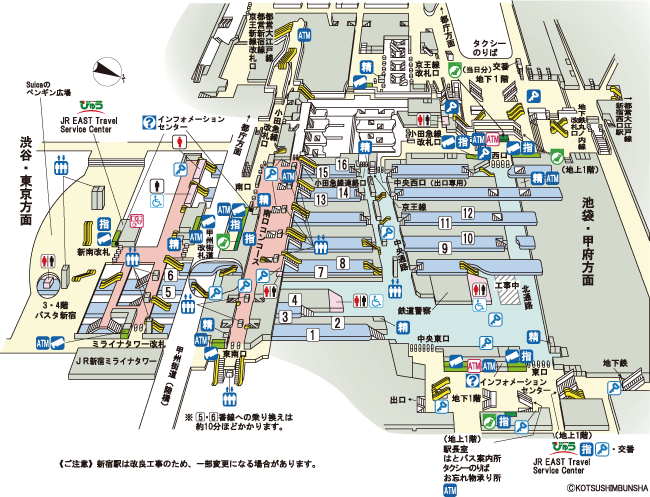
How higgledy-piggledy is Shinjuku? This is JR East's exploded view of just the JR section of the station and this is one individual's inadvertently hilarious attempt to annotate the JR East map so as to clarify the connections between the JR section of the station and the other sections.
That easiest way to slice through the labyrinth is to place the West Exit's taxi roundabout at the center and bottom of one's mental map, then draw radial compass lines toward all the other main points in the station, did not occur to me until sometime around 2005.
If I get a chance to read the Le Figaro piece, I would likely profit from a non-English language reading of locations in Japan. Almost all my views of this blessed land come via Japanese or English language sources -- with some vicarious readings of Italian views via Italian readers in Tokyo (Grazie tanto!).
That one has to venture outside the bilingual (Japanese-English) intellectual hegemony on Japan studies was clear a few months back in the disastrous interview Tokyo Metropolitan District governor Inose Naoki had with Ken Belson of The New York Times. Misunderstandings in the conduct and interpretation of that conversation seriously dented Tokyo's chances of landing the 2020 Olympic Games.
According to Belson:
At several points in the interview, Inose said that Japanese culture was unique and by implication superior, a widely held view in Japan. He noted that the political scientist Samuel P. Huntington wrote in his book "The Clash of Civilizations and the Remaking of World Order" that Japan was unlike any other culture.The underlined sentence is the kind of vaulting non-sequitur that earns The New York Times the ire of Japan defenders. If Governor Inose did not say that Japanese culture is superior, one should not report that he did.
Inose also pointed to polls that showed 70 percent of Tokyoites in favor of hosting the Summer Games, up from 47 percent last year. The well-received London Games, he said, have helped generate enthusiasm and confidence that Tokyo can host a similarly successful event.
Tokyo, he added, is exceptional because the Imperial Palace, which is largely off-limits to residents and visitors, forms the city's core while bustling activity surrounds it. "The central part of Tokyo has nothingness," he said. "This is a unique way that society achieved modernization."
More interesting is the replication, without explanation, of the assertion (in bold) that the green oasis of the Imperial Palace grounds, much of which is impenetrable to the citizenry, is symbolic of this blessed land's unique passage to modernity.
If there was ever a statement that needed explanation, it was this one -- particular because the observation is not Japanese in origin. The improbability of the verdant and closed-off Imperial Palace grounds (the grounds are not all closed off, of course, the East Gardens being one of the truly great green public spaces in the 23 Wards) being the center of a metropolis is the signature observation in L'Empire des signes by Roland Barthes (Link - Fr).
Inose assumed that Belson, an educated Westerner with ties to Japan, would be familiar with Barthes' work. In referencing both Barthes and Huntington, Inose was demonstrating that "uniqueness," far from being a marker of Japanese prejudice and arrogance, was indeed the almost exact opposite, "unique" being the adjective to which non-Japanese thinkers, befuddled by the challenge Japan's culture and history presented to their world views, have repeatedly retreated in their hour of intellectual aphasia.
For those who are interested and do not read French, L'empire des signes has been translated into English (Link). As it is a part of the French literary criticism/semiotics tradition one will not often find the work on the syllabi of positivist tradition English language Japanese studies courses. Nevertheless, it is one of the canonical works in the Japanese intellectual tradition of the ways non-Japanese look at Japan.
Which is as twisted and non-intuitive as the maze of underground passages beneath Shinjuku Station.
Image: Sunrise over the towers of Shinjuku on 14 May 2012
Image courtesy: MTC
Wednesday, June 12, 2013
Skilled At Improvisation?

There is a reasonable debate about what the Japan Restoration Party (Nippon Ishin no Kai) represents. For most commentators the JRP is a haven for the detritus that the Liberal Democratic Party coughed up as unpalatable (for the latest on that score - Link). For others it is the vehicle for a refreshing form of anti-politics. This was certainly the view former LiveDoor CEO Horie Takafumi expressed last Wednesday. (Link)
I was firmly in the former camp. After Sunday, I am not so sure.
On Sunday, Your Party candidate for the Tokyo Metropolitan Government assembly Fujii Kaoru was plugging the crowds outside of Hikarigaoka Station in Nerima City. Dressed in a white suit (a trademark, it seems: Fujii is a dentist) she roved back and forth about the plaza, cheerfully seeking out passersby for a mutual bow or a handshake.
By mutual agreement or through mutual antagonism, Fujii had to quit the scene at noon, awkwardly ripping her microphone and headset off her head as she did. For even as she was gamely trying to engage the potential voters (who are, understandably, not terribly interested in the upcoming June 23 assembly election) a young woman with a keyboard and a bass player set up next to her, launching, in their first number, into as swinging a version of Duke Ellington's Satin Doll as one will ever hear.
So what? A Sunday afternoon concert sent the politician packing.
Well, no.
The young woman on the keys, giving the Duke his due and more? She was Matsuoka Rika, the JRP's Nerima candidate for the Tokyo assembly.
How long Matsuoka held court on the plaza, delivering cool jazz to the multitudes on sunny, lazy afternoon, I do not know. All I know is that four and a half hours later, when I came back to the station, she was still playing, calling out "Hello, good people of Nerima Ward. I'm the Nippon Ishin no Kai’s Matsuoka Rika!" every so often -- but letting the music do most of the talking.
Now I have seen my share of campaign stop performances…but this one was one for the history books.
Whether Matsuoka's unorthodox approach to campaigning comes at the encouragement of open-minded JRP executives -- "Go ahead, play. Do what works for you!" -- or out of a personal "Oh, well, what the hell" defiance of the odds, the JRP having fallen, according to Kyodo's latest poll, to fourth place among the parties with 4.8% of the voters supporting it (and to only 1.5% support in the latest NHK poll) -- the result was a refreshing departure from the usual practice of politics here.
That the candidate Matsuoka pounded out of the plaza was the one from the newly arch-enemy Your Party (Link) made the notes sound all the sweeter.
Later - Broken links in the above have been fixed.
Photo: Nippon Ishin no Kai candidate Matsuoka Rika. Nerima City, Tokyo Metropolitan District on June 9, 2013.
Photo courtesy: MTC
Wednesday, July 18, 2012
Not A Keeper, For Anybody, But Still A Loss
Nakatsugawa Hirosato, a third term Democratic Party of Japan member from the House of Representatives, Tokyo Bloc, has just turned in his resignation papers to Acting President Tarutoko Shinji. He was one of the 19 Representatives who voted against the bill raising the consumption tax to 10% who nevertheless elected to remain inside the DPJ. He is the second of that group to since change his mind and submit a letter of resignation.
Unlike his predecessor Kato Gaku, Nakatsugawa is a proportional seat member. Also unlike Kato, Nakatsugawa is choosing to serve out the rest of his term as an independent. (J)
Which makes little sense, career-wise. True, by voting against the Cabinet, Nakatsukawa guaranteed that the party leadership will not be putting his name on the party list the next time a House of Representatives election is held. Unless he is planning on retiring from politics all together, he has to find either a party to take him (Which is not very likely, for if there were a party in need of him, he would not be coming out as an independent, would he?) or a district where he can run, with campaign funding coming from Amaterasu-knows-where.
His reasons for leaving the DPJ are equally peculiar. He attributes his decision to the passage of the consumption tax bill (Which happened, what, 24 days ago?) and the prime minister's not firing Japan's Ambassador to China Niwa Uichiro for Niwa's having tut-tutted about Ishihara Shintaro's plan to have the Tokyo Metropolitan District buy three of the Senkaku Islands.
This indicates that Nakatsugawa maybe thinks he has a future in the TMD's or a Tokyo municipality's right wing politics, after his term as a Representative ends.
With Nakatsugawa's resignation, the number of Diet members who have resigned from the DPJ since the consumption tax vote now stands at 55 -- 39 from the House of Representatives and 16 from the House of Councillors.
Tuesday, May 22, 2012
Sky Tree Downs Averted
In a few minutes' time the Tokyo Sky Tree, the world's tallest free-standing tower, opens for business. I must confess I am royally sick of the whole circus surrounding what is, in grossest fact, just a tower from which to beam out digital broadcast signals, the 1958 vintage Tokyo Tower being too short (333 m) for the job.
I am sick of the pun on the height of the Sky Tree, 634 meters = 6 Mutsu + 3 san + 4 shi = Musashi, the name of the ancient province where much of modern Tokyo is now located (J). I am sick of the product tie-ins. I am sick of the uniforms of the information girls. I am sick of the cost to ride up to the second observation level: 3000 yen, or US$37.85 at current rates. I am sick of everyone's ignoring the reality that compared to the Burj Al-Khalifa, the Tokyo Sky Tree is a pipsqueak.
Leave it up to the cartoonist at the Tokyo Shimbun to find a new, refreshing angle to look at the opening, one that can make even a grump like me smile:

In the first panel, citizens are looking up with safety glasses at the ring eclipse that appeared in the skies above Tokyo on May 21.
In the second, the people are looking up with cameras, binoculars and the naked eye at the Sky Tree, which opens for business today, May 22.
In the third panel, Prime Minister Noda Yoshihiko remarks to Democratic Party of Japan Secretary-General Koshi'ishi Azuma, "The citizens of Japan have come alive, haven't they?" Koshi'ishi cannot for the life of him understand what has the PM thinking this way.
The hook in this instance is in the title on the left of the panels. It reads:
The song, by composer Nakamura Hachidai and lyricist Ei Rosuke, was a huge hit for the singer Sakamoto Kyu in 1961. It begins with what is probably the third best known opening line of any Japanese song, after the national anthem and "Sakura, sakura":
In the song, the young man is trying not to cry but ends up doing so because he is all alone. However, he vows to keep looking up -- just as the whole of the country was, hoping for a better tomorrow.
Here is Sakamoto singing and whistling the song in 1983 (You Tube).
Hence Prime Minister Noda's conclusion, after two straight day of people looking up: "Hey, the hope is back!"
Of course, the song has a tragic coda. Sakamoto died in the JAL 123 air disaster of August 12, 1985 -- still the worst single-plane air accident in history. The 747, crammed with passengers heading home for the Obon holidays, lost its the hydraulic steering system a few minutes after takeoff, becoming a veering, swerving uncontrolled mass of terror. After 44 minutes of out-of-control flight, the plane plowed into a mountainside in Gunma Prefecture, killing 520 passengers and crew.
I am sick of the pun on the height of the Sky Tree, 634 meters = 6 Mutsu + 3 san + 4 shi = Musashi, the name of the ancient province where much of modern Tokyo is now located (J). I am sick of the product tie-ins. I am sick of the uniforms of the information girls. I am sick of the cost to ride up to the second observation level: 3000 yen, or US$37.85 at current rates. I am sick of everyone's ignoring the reality that compared to the Burj Al-Khalifa, the Tokyo Sky Tree is a pipsqueak.
Leave it up to the cartoonist at the Tokyo Shimbun to find a new, refreshing angle to look at the opening, one that can make even a grump like me smile:

In the first panel, citizens are looking up with safety glasses at the ring eclipse that appeared in the skies above Tokyo on May 21.
In the second, the people are looking up with cameras, binoculars and the naked eye at the Sky Tree, which opens for business today, May 22.
In the third panel, Prime Minister Noda Yoshihiko remarks to Democratic Party of Japan Secretary-General Koshi'ishi Azuma, "The citizens of Japan have come alive, haven't they?" Koshi'ishi cannot for the life of him understand what has the PM thinking this way.
The hook in this instance is in the title on the left of the panels. It reads:
「2日だけのぅつむかない日々」The hook is the term utsumuku,"to look down," "to keep one's eyes down." The second half of the word, muku, and the images in the first two panels, take the reader on a mental leap to what is probably the best known Japanese song in the English-speaking world, "Sukiyaki" -- the only Japanese-language tune to ever make it into the Top Ten of Billboard's music charts, this in July 1963.
Futsuka dake no utsumukanai hibi.
"Just two days when people are not looking at the ground as they normally do."
The song, by composer Nakamura Hachidai and lyricist Ei Rosuke, was a huge hit for the singer Sakamoto Kyu in 1961. It begins with what is probably the third best known opening line of any Japanese song, after the national anthem and "Sakura, sakura":
上を向いて、歩こう。。。The song, written after the first burst of Japanese economic growth and on the heels of the "doubling of incomes in 10 years" economic strategy announced by Prime Minister Ikeda Hayato, typifies the hopeful attitude of the times.
Ue o muite, aruko...
"Let me be walking, looking up..."
In the song, the young man is trying not to cry but ends up doing so because he is all alone. However, he vows to keep looking up -- just as the whole of the country was, hoping for a better tomorrow.
Here is Sakamoto singing and whistling the song in 1983 (You Tube).
Hence Prime Minister Noda's conclusion, after two straight day of people looking up: "Hey, the hope is back!"
Of course, the song has a tragic coda. Sakamoto died in the JAL 123 air disaster of August 12, 1985 -- still the worst single-plane air accident in history. The 747, crammed with passengers heading home for the Obon holidays, lost its the hydraulic steering system a few minutes after takeoff, becoming a veering, swerving uncontrolled mass of terror. After 44 minutes of out-of-control flight, the plane plowed into a mountainside in Gunma Prefecture, killing 520 passengers and crew.
Wednesday, May 16, 2012
This Morning

Yesterday's rains have washed away every hint of whipped up dirt (the same storm that produced the tornadoes left tiny half-moons of soil on my windows, once the drops had evaporated), pollen and what little industrial pollution (mostly diesel exhaust) as besmirches the air. Mt. Fuji, the snow of its ridges now melted away, seems just a arm's length away.
Sometimes, living in the Tokyo Metropolitan District is really not all that bad.
Mt. Fuji over the rooftops. May 16, 2012, 5:30 a.m.
Photo credit: MTC
Wednesday, March 28, 2012
Further Evidence That Inose Naoki Is The Actual Governor Of Tokyo
If the blinking one has time to jet off to Washington for this event at the Heritage Foundation...
...we can state with some degree of certainty that:
1) Ishihara Shintaro is more interested in drumming up interest for his new, "true conservative" party than running the world's richest city
2) The person keeping the lights on, the sewers flowing and the roads passable is Inose Naoki and not the Tokyo Metropolitan District's elected leader.
The latter of those two points is a damn good thing.
[Hyperbolic hyperbole alert: "...is far and away one of Japan's leading political figures"
"Far and away"?
What is wrong with "is one of Japan's leading political figures"?]
The U.S.-Japan Alliance and
A fixture on Japan's political scene, long-time Governor of Tokyo (1999-present) Shintaro Ishihara is far and away one of Japan's leading political figures... [Link]
the Debate Over Japan's Role in Asia
The Honorable Shintaro Ishihara
Governor of Tokyo
...we can state with some degree of certainty that:
1) Ishihara Shintaro is more interested in drumming up interest for his new, "true conservative" party than running the world's richest city
2) The person keeping the lights on, the sewers flowing and the roads passable is Inose Naoki and not the Tokyo Metropolitan District's elected leader.
The latter of those two points is a damn good thing.
[Hyperbolic hyperbole alert: "...is far and away one of Japan's leading political figures"
"Far and away"?
What is wrong with "is one of Japan's leading political figures"?]
Friday, March 16, 2012
Fewer Than Two Continued - On Death And Dying
Where the new figures for household size in the Tokyo Metropolitan District intersect with the prevailing zeitgeist in two ways.
The first is the reporting of the increasing number, as if it were a surprise, of famous persons dying alone (kodokushi) and not being found for several days or even weeks.
The first really shocking case was of the former porn actress, television talent, then later blogger and AIDS activist Iijima Ai, who was found dead in her home three weeks after her last blog post in December 2008. The 2009 discovery of the body of longtime film and television superstar Ohara Reiko in her home two weeks after anyone last heard from her further shocked the country. Newscaster and television talent Yamaguchi Mie was found dead alone last year under similar circumstances.
Of course, with the greater number of persons living alone, that the number of persons dying alone should be rising should not surprising. Given the anonymity of the big cities and the hyper-sensitivity over respecting a person's privacy, that persons are not being found dead for days or weeks should also not be surprising.
That the number of persons dying alone at home has not, until recently, been a societal obsession can in part be traced to the incredible rates of hospitalization of the very ill and very old, with over 82% of deaths occurring in a hospital and an addition 3% in special homes for the aged (J - page 9).
Iijima, Ohara and Yamaguchi were 36, 62 and 51 years of age respectively at the time of their deaths. Both Ohara and Yamaguchi had spent many years prior to their deaths caring for aged and incapacitated parents.
It is in the latter situation that the new figures on the size of households gives folks the heeby-jeebies, though in the case of Ohara and Yamaguchi, the parents each had been caring for had either been moved to an elder care facility or died.
In recent weeks there have been a spate of stories about caregivers dying, leaving their disabled or senile charges to die of starvation, thirst or cold. The most shocking was a case in mid-February of a 45 year-old woman dying, leaving her four year-old mentally retarded son to die a few days later of an as yet unrevealed cause, despite visits to the home by what were supposed to be help providers. In more recent days, news organizations have been reporting on couples or parent-child homes where the deaths of the caregiver have left the other, incapacitated resident to die, either slowly or quickly, from lack of care. Despite the fact that these pairs of individuals are not technically dying alone, these types of double deaths are being classed kodokushi.
With Japanese enjoying, if that can be the term, extended lifespans, and the chances of one member of a two-person household being seriously incapacitated in some way increasing, the number of these kinds of double deaths is sure to increase unless civil society or local government develop ways on keeping tabs on caregivers and their charges. A great deal of help is currently available. With the society as a whole aging, however, the capacity for society or local governments to continue to provide help services will diminish.
Some companies, such as the ALSOK corporation, advertise home surveillance cameras for younger relatives to keep tabs on the status of their elders. The concept seems way too creepy and invasive to come into common usage, however. This may change. Indeed, the installation of cameras might come to be seen as a natural part of the aging process -- that once you are past a certain age, you will never have a moment's privacy again, even in your own home.
Fewer Than Two

This is for all the lonely peopleIf you are in the Tokyo Metropolitan district, and you are alone, you are not alone. Indeed, you are in the whopping majority.
Thinking that life has passed them by
Don't give up
Until you drink from the silver cup
And ride that highway in the sky
This is for all the single people
Thinking that life has left them dry
Don't give up
Until you drink from the silver cup
You never know until you try- America, "Lonely People" (1974)*
The TMD released the results of its survey of households yesterday. As of January 1 of this year, Tokyo had 12,686,067 residents living in 6,368,485 households, an average of 1.99 residents per household. Considering the number of families with children in the TMD, the balancing number of persons registered as living alone is simply immense -- over 60% of all households registered.
The Mainichi Shimbun provides a nice graph of the crash in the number of persons per registered household since 1957, the first year the survey was conducted.
 TMD Governor Ishihara Shintaro, ever the one to come up with the conservate morality play view of a situation, remarked, "I am shocked. It a matter of grave concern. It's truly unhealthy. I feel as though the family unit has fallen to pieces."
If so, then our dear governor (How is it possible that he has won election four times?) should be worried about our neighbors to the north, with all their cows, corn and sunflowers, for the next in line is Hokkaido, with 2.06 residents per household. (J)
The TMD being the great vampire squid of Japan's prefectures, it still managed to eke out a 0.31% increase in its population, the 16th straight year of population growth, despite its shrinking household size (J). It also has remained relatively youthful, with persons in their 30s being the largest age cohort and the percentage of those over 65 years of age still a low (for Japan) 21% of the population. (J)
So all the ongoing creative destruction, with old neighborhoods and commercial properties being demolished and being replaced by high-rise and low-rise condominium and rental units is not necessarily cheap financing leading developers to run amok.
* Yes, I know that the song is an appeal to rebith through faith in Jesus Christ. However, it was either this or "Eleanor Rigby."
Photo credit: MTC
Saturday, March 10, 2012
Keeping It All In Perspective
The past few days and indeed the last few weeks have seen the churning up of a massive effort to recall and reflect upon the triple disaster of March 11, 2011, an effort in which I have been a willing and enthusiastic participant.
However, let us remember that today is March 10, the 67th anniversary of the incendiary bombing of Tokyo's low city. In the encyclopedia of horror that was World War II, the March 10, 1945 bombing of Tokyo was just another, particularly heinous chapter. As far as I can reckon, in terms of number of persons killed in a single day, the March 10 bombing was surpassed in recent times only by the 1976 Tangshan Earthquake, the 2004 Boxing Day Tsunami and the 2010 Haiti earthquake.
Five times as many were killed or went missing that night as in the event we will all be talking about tomorrow.
Perhaps these two days together will become a time of reflection – of how the powers of nature and our follies can defeat our best efforts and prey upon our worst tendencies – here at the juncture of the seasons, when the cold bite of winter cedes the land to the warm smile of spring.
Agnus Dei, qui tollis peccata mundi, miserere nobis...
Wednesday, October 19, 2011
An Indefensible Decision
I do not side with Communists very often as I do not believe, as they seem to, that nearly every one of Japan's problems can be solved by providing more day care centers for working mothers (not that providing more day care centers would help solve some problems, mind you).
However yesterday, the Communists in the Tokyo Metropolitan District Assembly were dead on when they tried to stop the passage of a resolution on an official invitation from the TMD Assembly to the International Olympic Committee for the TMD to be the host for the 2020 Summer Games (ja).
With the Democratic Party of Japan, the Liberal Democratic Party and the New Komeito, who are at each other's throats in the assembly -- the other major item of business yesterday was a no-confidence motion against the Speaker of the Assembly, Wada Muneharu of the DPJ, sponsored by the latter two parties -- all voting for the measure, the Communists' principled stand was doomed to failure. Nevertheless the Communists tried to appeal to their colleagues' sense of reason, arguing that the money spent on mounting a bid would be far better spent on bolstering Tokyo's disaster preparedness than on what is no more than a recurring vanity project of the ailing Governor Ishihara Shintaro.
Local public opinion polls generally show an even split on whether or not Tokyo should reprise its bid for an Olympic Games. The question, however, is always put to respondents in a vacuum, without ever acquainting the respondents with the likely costs associated with hosting an Olympics. If the cost estimates were laid out, the overwhelming majority of Tokyoites would likely scream "No! Never!"
Just to add insult to injury, the resolution states that Tokyo's holding the Games nine years after the triple disaster in the Tohoku will be a celebration of the nation's recovery and the sign that Japan is a safe place once again. If you think I am making this up, here is the link (ja).
I do not care if this bunch was just elected in April -- recall the whole blinking lot of them, Communists excluded.
Thursday, May 08, 2008
Over Mitōsan to Makiyoseyama
Mitōsan (三頭山 - 1524 m) is the tallest of the three "celebrated mountains of the Okutama Region" in the Tokyo Metropolitan District, punctuating the border between the TMD and northern Yamanashi Prefecture. Its base can be reached either by a 30 minute bus ride from from Okutama Station on the Ōme Line or a 55 minute bus ride out of Itsukaichi Station on the Itsukaichi Line.
 The Mugiyama Ukihashi (the floating footbridge)
across the Okutama Reservoir
Okutama Township, Tokyo Metropolitan District
May 6, 2008
On the Nukazasuyama trail at altitudes starting around 1000 meters one can see an increasingly rare sight: stands of living pine trees. The higher elevations are less hospitable to the pine sawyer beetle and the pine wood nematode, the vector and cause of the pine wilt disease that has wiped out all untended red pines and black pines (MTC photo - Yugawara, 3 January 2008) at lower altitudes over the last few decades.
 Healthy red pine (akamatsu - Pinus densiflora) stand at 1100 meters
Okutama Township, Tokyo Metropolitan District
May 6, 2008
In my posts I frequently mock traditionalists who claim life was better in the past, before Japan accepted Western things. Here is a rare instance where the traditionalists are right. Pine wilt is an introduced disease, indigenous to North America. The nefarious nematode seems to have hitched a ride in the soil of trees imported to Japan.
 Konara (Quercus serrata) forest
Okutama Township, Tokyo Metropolitan District
May 6, 2008
Cold is one of the few natural weapons against the spread of pine wilt disease. As global temperatures rise, these pines will come into the range of the beetle and the nematode.
In the future the only places one may see Japan's celebrated pines could be public parks, private gardens and ukiyoe.
 View of the Tsurukawa Valley in Yamanashi Prefecture from Makiyoseyama (1188 m)
Hinohara Township, Tokyo Metropolitan District
May 6, 2008
Wednesday, April 16, 2008
Tokyo Rising Yet Again
Among the many interesting figures highlighted in the April 15 population statistics release of the Ministry of Internal Affairs and Communications (MIC) is a landmark in the Tokyo Metropolitan District's march to national dominance.
As of October 1 last year the TMD's population had risen to 10% (with a little rounding help) of Japan's total population.
The concentration has historical antecedents. According to the linked pdf document, Tokyo's proportion of the total population rose to 11.1% in the period 1965 to 1969, then began to decline. It fell below a statistical 10.0% twenty-eight years ago, as the great mai homu and manshon boom of the Seventies and Eighties and then the skyrocketing of urban land prices under the late 1980's property bubble drove population out of Tokyo into the surrounding Kanagawa, Saitama and Chiba Prefectures. The failure of the financial system to cleanse itself and the grinding down of property values perpetuated the fall in the TMD's relative standing. Little new housing was built as land owners awaited the real estate rebound that never came. Fewer came to try their fortune in Tokyo. Births dropped as couples chose to have fewer children.
The TMD's proportion of the total bottomed out at 9.4% in 1998--the year of the Takushoku Bank and Yamaichi Securities failures and the "Japan Premium" in the debt markets, when the national mood was at its nadir.
During the past decade of economic recovery population has been swirling back population into the TMD. In addition, within the 23 central wards of the TMD natural population growth--i.e., births outnumbering deaths--continues to significantly contribute to population growth as well (these figures not in yesterday's MIC report but in the TMD government's own population report, introduced here). On the aggregate within the TMD, the natural rate of population growth is only just a shade above zero at 0.07% (Easy-going Okinawa remains the land of the breeders, with a 0.54% natural growth rate).
The concentration of the population into a very small number of megacities continues apace. According to the MIC figures, the total population of the Tokyo metro area ( 東京圏 -- i.e., the TMD and the three prefectures surrounding) was 34,827,000--a thumping 27.3% of Japan's total population. The proportion of Japanese living in the top five prefectures by population--the TMD, Kanagawa, Osaka, Aichi and Saitama--is 35.1%, while the proportion of those living in the top 3 urban concentrations--the Tokyo, Aichi and Osaka greater metro areas--is a wild 50.6% of the total national population.
So where are you going to site your retail business? Or invest, if you need workers? Or live, if you want to assure yourself of services as you grow old and as the total national population declines? *
And despite the ingestion of 99,000 new residents from October 2006 to October 2007, in addition to the 12,659,000 that were already there, you still can, if you need to, get away from them all--without ever leaving the TMD.

--------------------------
* Janne Morén will be pleased, I'm sure, by this string of rhetorical questions.
As of October 1 last year the TMD's population had risen to 10% (with a little rounding help) of Japan's total population.
The concentration has historical antecedents. According to the linked pdf document, Tokyo's proportion of the total population rose to 11.1% in the period 1965 to 1969, then began to decline. It fell below a statistical 10.0% twenty-eight years ago, as the great mai homu and manshon boom of the Seventies and Eighties and then the skyrocketing of urban land prices under the late 1980's property bubble drove population out of Tokyo into the surrounding Kanagawa, Saitama and Chiba Prefectures. The failure of the financial system to cleanse itself and the grinding down of property values perpetuated the fall in the TMD's relative standing. Little new housing was built as land owners awaited the real estate rebound that never came. Fewer came to try their fortune in Tokyo. Births dropped as couples chose to have fewer children.
The TMD's proportion of the total bottomed out at 9.4% in 1998--the year of the Takushoku Bank and Yamaichi Securities failures and the "Japan Premium" in the debt markets, when the national mood was at its nadir.
During the past decade of economic recovery population has been swirling back population into the TMD. In addition, within the 23 central wards of the TMD natural population growth--i.e., births outnumbering deaths--continues to significantly contribute to population growth as well (these figures not in yesterday's MIC report but in the TMD government's own population report, introduced here). On the aggregate within the TMD, the natural rate of population growth is only just a shade above zero at 0.07% (Easy-going Okinawa remains the land of the breeders, with a 0.54% natural growth rate).
The concentration of the population into a very small number of megacities continues apace. According to the MIC figures, the total population of the Tokyo metro area ( 東京圏 -- i.e., the TMD and the three prefectures surrounding) was 34,827,000--a thumping 27.3% of Japan's total population. The proportion of Japanese living in the top five prefectures by population--the TMD, Kanagawa, Osaka, Aichi and Saitama--is 35.1%, while the proportion of those living in the top 3 urban concentrations--the Tokyo, Aichi and Osaka greater metro areas--is a wild 50.6% of the total national population.
So where are you going to site your retail business? Or invest, if you need workers? Or live, if you want to assure yourself of services as you grow old and as the total national population declines? *
And despite the ingestion of 99,000 new residents from October 2006 to October 2007, in addition to the 12,659,000 that were already there, you still can, if you need to, get away from them all--without ever leaving the TMD.
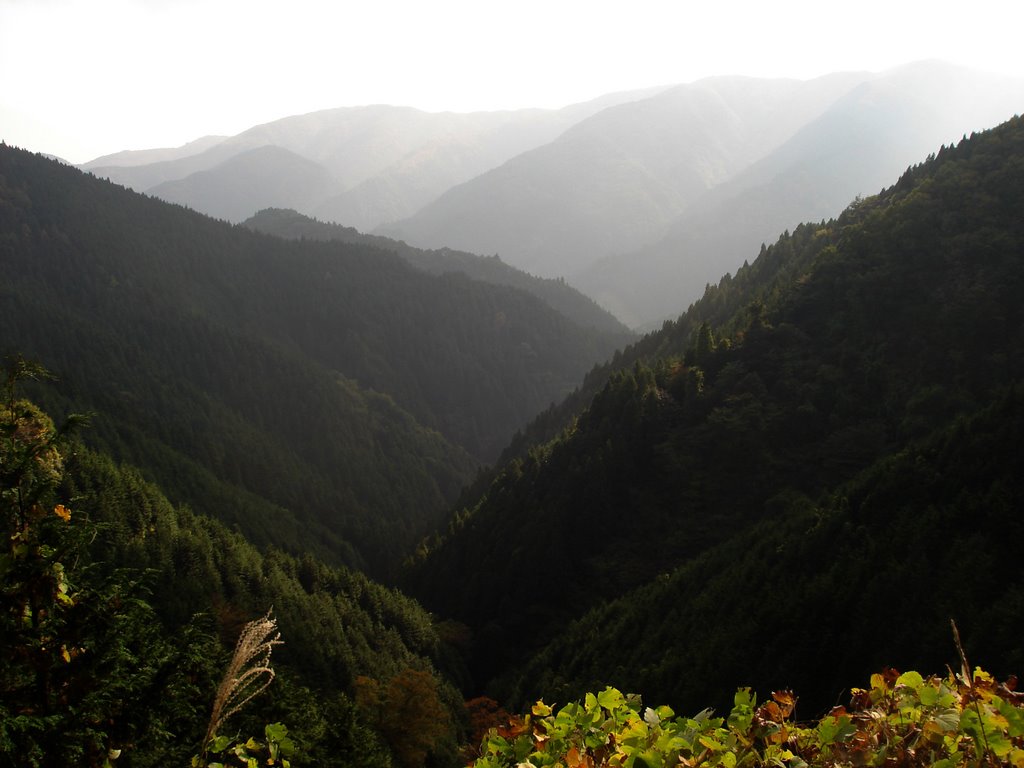
The Minami Akikawa Valley
Hinohara Township, Tokyo Metropolitan District
November 5, 2006
--------------------------
* Janne Morén will be pleased, I'm sure, by this string of rhetorical questions.
Subscribe to:
Posts (Atom)