Elaine Kurtenbach and I recently had a conversation about the Olympic logo and stadium belly flops. As a much appreciated courtesy, she inserted a snippet from our talk in her eventual article. (Link)
However, I take exception to the thesis announced in the title, that the succession of egg-on-the-face embarrassments is the result of a particular Japanese mode of behavior or set of behaviors.
No.
Indifference, laziness, buck-passing, box checking and blunt ignorance are not Japanese traits, nor are they the traits of Japanese bureaucracy and the Liberal Democratic Party. An insinuation that something essential about Japan has been exposed by this farce is poppycock.
Tokyo 2020 shows the world the weaknesses of one person: Prime Minister Abe Shinzo. Effective recruitment and deployment of talented advisors and officers are the prerequisites of good administration. In naming the persons he did to the chairmanship and vice chairmanship of the organizing committee, Abe guaranteed the committee's inability to function.
What we are left to speculate upon is whether failure -- albeit failure down the line, not right at the git-go -- may indeed may have been Abe's intent.
Showing posts with label image of Japan. Show all posts
Showing posts with label image of Japan. Show all posts
Saturday, September 12, 2015
Sunday, April 12, 2015
Very Kind Of Him #57 - The Flip Side Of My Remarks
Jeffrey Kingston of Temple University Japan has quoted me copiously in an opinion article published in The Japan Times (Link: Abe gets negative reviews ahead of U.S. visit). The quotations are certain to make me persona non grata in the Kantei.
I am grateful for Professor Kingston's quoting me. The quotes are verbatim.
However, I disagree with characterization that my overall assessment of Abe is negative.
Prime Minister Abe Shinzo is not really the majority of the population's idea of a dream date. The PM lacks most of the commonly recognized personality traits and qualities of a successful politician. Nevertheless, his Cabinet is the most reliably popular one for three decades. Abe is also fully back from the political Siberia his illness banished him to in September 2007. For four years he wandered the halls or slumped in his seat in the upper reaches of the House of Representatives, a weird ghostly figure. His resurrection and return should be the stuff of legends.
Abe has also fulfilled the proposition I set forth in February 2013: that he and his team will provide Japan with stable government (Video and Slides). The political opposition remains, three years out from the Noda Yoshihiko Self-Destruct Dissolution, an afterthought, a mosquito buzzing around the ruling coalition -- annoying but easily crushed. Heck, the opposition could not even snatch the Hokkaido governorship in today's first round of the Unified Local elections. (Link - J)
Abe, of course, has not just kept the opposition down and irrelevant: he has outmaneuvered and marginalized almost every potential political rival inside the LDP. The last possible holdout against "Abe's Way Or The Highway," LDP General Council Chair Nikai Toshihiro, a frequent critic of several key Abe administration policies, declared in an article published this week that "all of the holders of the top leadership posts of the LDP" is in support of Abe's reelection as party president this fall" -- meaning himself included. (Link - J)
As for "Abe Magic" and the "Abe Paradox" in the article -- again, correctly recorded -- these simple phenomena observable in the public polling data. They are also two manifestations of a single astonishing achievement: the conjuring up of a sense of inevitability to Abe's continued rule despite his inability to convince the majority of the voters to support whatever it is he is planning to do. Are the voters so starved for stability in the prime minister's spot that they are willing to say they support a Cabinet whose policies they do not like?
Seemingly.
Not at lot has gone really right in Abe's second stint. The economy is still weak; the monetary carpet bombing of the land with yen has not resulted in zero inflation; the collective self defense proposals are a spaghetti bowl of promises (and way behind schedule); Okinawa is in open revolt.
However, it is year three, Abe is still here and he is sticking to his much delayed agenda. He is letting all the hardships, bad news (the Algerian gasworks attack; the Hiroshima landslides; the murder of Goto Kenji) and missed targets roll off his back. Of course, a PM with a majority in the House of Councillors and a supermajority in the House of Representatives should be invincible. Abe's successors, from both LDP and Democratic Party of Japan, have shown how it is possible to fail in this blessed land's top office despite controlling more than the requisite number of seats in both Houses.
Abe succeeds despite himself. That is not negative. It is amazing.
I am grateful for Professor Kingston's quoting me. The quotes are verbatim.
However, I disagree with characterization that my overall assessment of Abe is negative.
Prime Minister Abe Shinzo is not really the majority of the population's idea of a dream date. The PM lacks most of the commonly recognized personality traits and qualities of a successful politician. Nevertheless, his Cabinet is the most reliably popular one for three decades. Abe is also fully back from the political Siberia his illness banished him to in September 2007. For four years he wandered the halls or slumped in his seat in the upper reaches of the House of Representatives, a weird ghostly figure. His resurrection and return should be the stuff of legends.
Abe has also fulfilled the proposition I set forth in February 2013: that he and his team will provide Japan with stable government (Video and Slides). The political opposition remains, three years out from the Noda Yoshihiko Self-Destruct Dissolution, an afterthought, a mosquito buzzing around the ruling coalition -- annoying but easily crushed. Heck, the opposition could not even snatch the Hokkaido governorship in today's first round of the Unified Local elections. (Link - J)
Abe, of course, has not just kept the opposition down and irrelevant: he has outmaneuvered and marginalized almost every potential political rival inside the LDP. The last possible holdout against "Abe's Way Or The Highway," LDP General Council Chair Nikai Toshihiro, a frequent critic of several key Abe administration policies, declared in an article published this week that "all of the holders of the top leadership posts of the LDP" is in support of Abe's reelection as party president this fall" -- meaning himself included. (Link - J)
As for "Abe Magic" and the "Abe Paradox" in the article -- again, correctly recorded -- these simple phenomena observable in the public polling data. They are also two manifestations of a single astonishing achievement: the conjuring up of a sense of inevitability to Abe's continued rule despite his inability to convince the majority of the voters to support whatever it is he is planning to do. Are the voters so starved for stability in the prime minister's spot that they are willing to say they support a Cabinet whose policies they do not like?
Seemingly.
Not at lot has gone really right in Abe's second stint. The economy is still weak; the monetary carpet bombing of the land with yen has not resulted in zero inflation; the collective self defense proposals are a spaghetti bowl of promises (and way behind schedule); Okinawa is in open revolt.
However, it is year three, Abe is still here and he is sticking to his much delayed agenda. He is letting all the hardships, bad news (the Algerian gasworks attack; the Hiroshima landslides; the murder of Goto Kenji) and missed targets roll off his back. Of course, a PM with a majority in the House of Councillors and a supermajority in the House of Representatives should be invincible. Abe's successors, from both LDP and Democratic Party of Japan, have shown how it is possible to fail in this blessed land's top office despite controlling more than the requisite number of seats in both Houses.
Abe succeeds despite himself. That is not negative. It is amazing.
Thursday, April 09, 2015
Three Fine Things In The Background
.jpg)
Three very fine things giving a frisson when looking at the images broadcast of Their Imperial Majesties' visit to the war memorials in the Republic of Palau:
1) That it is Muraki Atsuko, there on the left in the above screen shot from NHK, who is the master of ceremonies. Muraki is one of the very few victims of a prosecutorial frame-up to ever to win full exoneration and restitution, with the prosecutor who fabricated the evidence against her going to prison in her stead. (Link)
2) That Muraki is not just some flunkey or monomaniacal freak but a straight arrow, high-achieving, dedicated human being in what can only be described an awesome marriage whom the prime minister can take pride in having appointed to the highest office available to her in what was then only the second appointment of a woman as a vice minister. (Link)
3) That it is the Vice Minister of Health, Labour and Welfare presiding at the commemoration events at the newly refurbished memorial on the island of Peliliu, not the Vice Minister of Foreign Affairs -- making it crystal clear once again that it is the MHLW, not MOFA, that is in control of war memory in Japan.
Tuesday, November 04, 2014
Ozawa Ichiro And Japanese Politics

It's here!
Dr. Mulgan's long-awaited political biography of the most important Japanese politician of the last 25 years (yes, more important than even the Celebrated Mr. K) quietly entered the marketplace on October 27.
Yes, you should buy it. In my review, which I will post after I finish the book, I will outline some of the ways the book illuminates some of the least understood aspects of the present Abe administration.
Monday, September 22, 2014
Oh, The Persons You Will Talk To!
This was the scene in the Liberal Democratic Party cafeteria on Friday, the first of the "Whale Meat Fridays" demanded by General Council Chair Nikai Toshihiro and other scientific pelagic whaling-supporting party members.

In the center is Nikai, a representative of the Wakayama district that has in it the infamous town of Taiji, where the residents conduct coastal harvests of dolphins, porpoises and small whales not covered by the International Whaling Commission ban. He is holding aloft a hunk of sei whale (iwashi kujira - Balaenoptera borealis) a species which can only be harvest on the deep ocean. The meat has been deep fried Tatsuta style -- one of the two ways whale was being served on Friday (the other was in a whale meat curry). Former Defense Minister Onodera Itsunori (Miyagi, another whaling prefecture) is among the other politicians visible preparing to have their Sei.
"Whale in an irreplaceable part of Japan's food culture. If foreigners come [to this cafeteria] we will shower them with whale!" crowed Nikai. (Link)
Friday's very public eating of Sei whale conflates and confuses coastal whaling, which is traditional for communities with very little flat, arable land like Taiji or Chiba Prefecture's Wadaura -- and which I support -- and industrial pelagic whaling, which has no traditional basis and is a ward of the government -- a point conceded in the Yomiuri Shimbun's pro-pelagic whaling editorial of yesterday (Link).
Because it is my nature to never leave any dishonest and poorly thought out thing well enough alone, I decided to have a bit of fun on Twitter at the expense of Nikai -- whom I like immensely -- and the other politicians pictured.
A cheap shot, perhaps. However, given the absurd bravura of Nikai's lofting of his whale-laden fork, a not entirely inappropriate cuffing of the chin, metaphorically.
Well, since having loosed the above, you can imagine the number and variety of folks of all persuasions have been blessing me with their opinions. Or perhaps you cannot. Anyway, it has been a lot of folks, some of whom did not see the humor intended.

In the center is Nikai, a representative of the Wakayama district that has in it the infamous town of Taiji, where the residents conduct coastal harvests of dolphins, porpoises and small whales not covered by the International Whaling Commission ban. He is holding aloft a hunk of sei whale (iwashi kujira - Balaenoptera borealis) a species which can only be harvest on the deep ocean. The meat has been deep fried Tatsuta style -- one of the two ways whale was being served on Friday (the other was in a whale meat curry). Former Defense Minister Onodera Itsunori (Miyagi, another whaling prefecture) is among the other politicians visible preparing to have their Sei.
"Whale in an irreplaceable part of Japan's food culture. If foreigners come [to this cafeteria] we will shower them with whale!" crowed Nikai. (Link)
Friday's very public eating of Sei whale conflates and confuses coastal whaling, which is traditional for communities with very little flat, arable land like Taiji or Chiba Prefecture's Wadaura -- and which I support -- and industrial pelagic whaling, which has no traditional basis and is a ward of the government -- a point conceded in the Yomiuri Shimbun's pro-pelagic whaling editorial of yesterday (Link).
Because it is my nature to never leave any dishonest and poorly thought out thing well enough alone, I decided to have a bit of fun on Twitter at the expense of Nikai -- whom I like immensely -- and the other politicians pictured.
Because nothing says, "Traditional Japanese culture" quite like eating whale in a curry or deep-fried using a fork pic.twitter.com/w1dKvgzLIl
— Michael Thomas Cucek (@MichaelTCucek) September 20, 2014A cheap shot, perhaps. However, given the absurd bravura of Nikai's lofting of his whale-laden fork, a not entirely inappropriate cuffing of the chin, metaphorically.
Well, since having loosed the above, you can imagine the number and variety of folks of all persuasions have been blessing me with their opinions. Or perhaps you cannot. Anyway, it has been a lot of folks, some of whom did not see the humor intended.
Wednesday, January 29, 2014
Not That Many Dolphins Killed
Trending this morning is a figure, 22,000, for the number of small cetaceans (dolphins and small whales) harvested by Japanese hunters each year (Link).
This figure is inflated. The real figure is certainly less than 10,000, probably fewer than 3,000.
Until the triple disaster of 11 March 2011, the bulk of the nation's dolphin killings were carried out by hunters working out of ports in Iwate Prefecture, with smaller numbers of killings carried out by boats departing from Miyagi and Hokkaido ports. The targets of these hunts were Dall's porpoises (Ishi iruka - Phocoenoides dalli), a small oceanic species. The hunt was conducted well offshore (meaning virtually no photographs or video record exist of it) with harpoons.
Below is the table, the most recent one available (Calendar Year 2010) of the total number of kills of various species of dolphins and small whales -- the latter term being something of a misnomer in the case of the Baird's Beaked Whale (Tsuchikujira - Berardius baidii) which is as big as the IWC-moratorium restricted Minke Whale (Minke kujira - Balaenoptera acutorostrata)*.
 Click on above image to open in a larger window.
(Source)
According to these government figures, the total number of small cetaceans killed in 2010 was 6,615. As the report explains the Dall's porpoise kill number is an estimate, based on the total weight of meat processed divided by a general figure of about 50kg of meat per porpoise. The number of dolphins killed outside outside the Dall's porpoise hunt was 1,696, with the bulk of that, 1,629 kills, being done by Wakayama hunters, almost all whom were probably were homeported in the infamous town of Taiji.
2010 was a particular bad year for small cetacean hunting. However, even in 2009, the last good year on record, the total number of small cetaceans killed was 10,501, with the difference coming almost entirely from the Dall's porpoise hunt. This figure is significantly less than the total number of kills allowed under the quotas of the Ministry of Agriculture, Forestry and Fisheries. MAFF's 2013-2014 quotas for all small cetaceans combined, the lowest total ever, is 17,217. (Link - J)
When the tsunami wiped out the fishing gear and ports of Iwate and Miyagi, the Dall's porpoise hunt vanished (the tsunami also ended the Miyagi-based Baird's Beaked Whale hunt). The Dall's hunt has since struggled to reestablish itself -- see page 45-2 of this Japanese language only report from the Fisheries Research Agency. An enterprising journalist might want to ask the Reconstruction Minister what proportion of Tohoku reconstruction funds have been consecrated, if any, to reestablishing the Dall's porpoise meat industry.
With the Iwate hunt moribund, Japan's dolphin industry must rely on the Wakayama hunt for meat. There is, however, no evidence that Wakayama hunters have stepped up the pace of their activities. If there were a crisis in supply one would at least expect MAFF officials to increase the quota number for the species (bottlenose, striped, Risso's, pan-tropical) hunted by Wakayama hunters. While MAFF did revise the Wakayama quota upward last year, the rise was risible, with the total number of kills permitted in 2013~2014 season still below the number permitted in 2011~2012:
Assuming -- and it is an immense assumption -- that the Wakayama hunters managed to use up all their quota, and the hunters in prefectures outside the Tohoku used up theirs, the total number of small cetaceans hunted this fiscal year would be 4,177.
To get some sense of how unlikely that is, the MAFF quota for Hokkaido harpooners is 1,221 Dall porpoises in 2013-14. In 2010, the last recorded year of the Hokkaido hunt, the number of porpoises taken was 116. Shizuoka hunters are permitted 250 kills under this year's quota -- yet no Shizuoka landings have been reported for over a decade.
The 22,000 figure in the CNN essay is clearly wrong. Likely as not, it is wrong by an order of magnitude.
Later - This post has been revised to include data from previous years's quotas for the Wakayama dolphin hunts.
-----------------------
* Virtually all contemporary images and video of cetaceans being butchered come from the Baird's Beaked Whale hunt run out of Wadaura in Chiba Prefecture. This is due both to the community's relative proximity to Tokyo and its willingness to serve as a showcase for Japan's bid to resume small-scale coastal commercial whaling for Minke Whale.
This figure is inflated. The real figure is certainly less than 10,000, probably fewer than 3,000.
Until the triple disaster of 11 March 2011, the bulk of the nation's dolphin killings were carried out by hunters working out of ports in Iwate Prefecture, with smaller numbers of killings carried out by boats departing from Miyagi and Hokkaido ports. The targets of these hunts were Dall's porpoises (Ishi iruka - Phocoenoides dalli), a small oceanic species. The hunt was conducted well offshore (meaning virtually no photographs or video record exist of it) with harpoons.
Below is the table, the most recent one available (Calendar Year 2010) of the total number of kills of various species of dolphins and small whales -- the latter term being something of a misnomer in the case of the Baird's Beaked Whale (Tsuchikujira - Berardius baidii) which is as big as the IWC-moratorium restricted Minke Whale (Minke kujira - Balaenoptera acutorostrata)*.
(Source)
According to these government figures, the total number of small cetaceans killed in 2010 was 6,615. As the report explains the Dall's porpoise kill number is an estimate, based on the total weight of meat processed divided by a general figure of about 50kg of meat per porpoise. The number of dolphins killed outside outside the Dall's porpoise hunt was 1,696, with the bulk of that, 1,629 kills, being done by Wakayama hunters, almost all whom were probably were homeported in the infamous town of Taiji.
2010 was a particular bad year for small cetacean hunting. However, even in 2009, the last good year on record, the total number of small cetaceans killed was 10,501, with the difference coming almost entirely from the Dall's porpoise hunt. This figure is significantly less than the total number of kills allowed under the quotas of the Ministry of Agriculture, Forestry and Fisheries. MAFF's 2013-2014 quotas for all small cetaceans combined, the lowest total ever, is 17,217. (Link - J)
When the tsunami wiped out the fishing gear and ports of Iwate and Miyagi, the Dall's porpoise hunt vanished (the tsunami also ended the Miyagi-based Baird's Beaked Whale hunt). The Dall's hunt has since struggled to reestablish itself -- see page 45-2 of this Japanese language only report from the Fisheries Research Agency. An enterprising journalist might want to ask the Reconstruction Minister what proportion of Tohoku reconstruction funds have been consecrated, if any, to reestablishing the Dall's porpoise meat industry.
With the Iwate hunt moribund, Japan's dolphin industry must rely on the Wakayama hunt for meat. There is, however, no evidence that Wakayama hunters have stepped up the pace of their activities. If there were a crisis in supply one would at least expect MAFF officials to increase the quota number for the species (bottlenose, striped, Risso's, pan-tropical) hunted by Wakayama hunters. While MAFF did revise the Wakayama quota upward last year, the rise was risible, with the total number of kills permitted in 2013~2014 season still below the number permitted in 2011~2012:
MAFF quotas for small cetaceans, Wakayama Prefecture hunts(Sources: Link - J and Link - J)
Season / total kills permitted
2010~2011 / 2,760
2011~2012 / 2,674
2012~2013 / 2,589
2013~2014 / 2,604
Assuming -- and it is an immense assumption -- that the Wakayama hunters managed to use up all their quota, and the hunters in prefectures outside the Tohoku used up theirs, the total number of small cetaceans hunted this fiscal year would be 4,177.
To get some sense of how unlikely that is, the MAFF quota for Hokkaido harpooners is 1,221 Dall porpoises in 2013-14. In 2010, the last recorded year of the Hokkaido hunt, the number of porpoises taken was 116. Shizuoka hunters are permitted 250 kills under this year's quota -- yet no Shizuoka landings have been reported for over a decade.
The 22,000 figure in the CNN essay is clearly wrong. Likely as not, it is wrong by an order of magnitude.
Later - This post has been revised to include data from previous years's quotas for the Wakayama dolphin hunts.
-----------------------
* Virtually all contemporary images and video of cetaceans being butchered come from the Baird's Beaked Whale hunt run out of Wadaura in Chiba Prefecture. This is due both to the community's relative proximity to Tokyo and its willingness to serve as a showcase for Japan's bid to resume small-scale coastal commercial whaling for Minke Whale.
Wednesday, October 30, 2013
The Official Secrets Bill - The New York Times Gets In The Act
Here.
While the ideological cant of the gaiatsu is not unappreciated, a quibble about the title: to my knowledge pretty much all secrecy legislation is illiberal.
While the ideological cant of the gaiatsu is not unappreciated, a quibble about the title: to my knowledge pretty much all secrecy legislation is illiberal.
Thursday, October 24, 2013
Stories I Wish I Were Writing
Companies I wish I had time to look into and write about, given how they seem to be making interesting statements about Japan's retail markets:
ErgoBaby - How could a 10 year old company, headquartered in the famed entrepreneurial hub of Kapalani, Maui, take over Japan's market for a consumer product, wiping out all domestic competition* using only Internet sales and word-of-mouth marketing, without U.S. trade lobby help or anyone noticing?
Kaldi - Japan's biggest coffee roaster and import foods retailer, whose dark-wood interior stores are designed to mimic the packed stalls of Mideast and Southeast Asian markets, seems to have only women employees. There must be men who work for the company -- according to the website (which features as many typos as your typical first run Shisaku post) the company president is a man -- but has anyone ever seen one?
--------------------------
* I recently conducted an informal survey at a local festival. In the course of 45 minutes I saw 21 babies in carriers. One was in a BabyBjorn, three in no-name knock-offs. The other 17 were in Ergobaby carriers. What was surprising was not the small number of competing carriers but that I counted any competitors at all -- Ergobaby's market dominance is usually total.
ErgoBaby - How could a 10 year old company, headquartered in the famed entrepreneurial hub of Kapalani, Maui, take over Japan's market for a consumer product, wiping out all domestic competition* using only Internet sales and word-of-mouth marketing, without U.S. trade lobby help or anyone noticing?
Kaldi - Japan's biggest coffee roaster and import foods retailer, whose dark-wood interior stores are designed to mimic the packed stalls of Mideast and Southeast Asian markets, seems to have only women employees. There must be men who work for the company -- according to the website (which features as many typos as your typical first run Shisaku post) the company president is a man -- but has anyone ever seen one?
--------------------------
* I recently conducted an informal survey at a local festival. In the course of 45 minutes I saw 21 babies in carriers. One was in a BabyBjorn, three in no-name knock-offs. The other 17 were in Ergobaby carriers. What was surprising was not the small number of competing carriers but that I counted any competitors at all -- Ergobaby's market dominance is usually total.
Monday, October 21, 2013
Lawrence Repeta On the Official Secrets Bill
Last Friday I published an unhappy look at the official secrets bill the ruling coalition intends to vote into law this Diet session. On Saturday, Professor Lawrence Repeta of Meiji University published a serious examination of the bill in the context of bureaucratic implementation of existing secrecy laws. (Link)
The inescapable conclusion: the pending Official Secrets bill is absolutely wrong for this blessed land. The country lacks most of the institutional and juridical frameworks and habits necessary to prevent an abuse of the power to declare certain information an official secret. Oh certainly, bureaucrats could detoxify situation by simply voluntarily foregoing the invocation of the law. How likely is that sort of benign neglect, though, when the new law creates a mechanism for bureaucrats to hide, then erase, any wrongdoing or error?
The inescapable conclusion: the pending Official Secrets bill is absolutely wrong for this blessed land. The country lacks most of the institutional and juridical frameworks and habits necessary to prevent an abuse of the power to declare certain information an official secret. Oh certainly, bureaucrats could detoxify situation by simply voluntarily foregoing the invocation of the law. How likely is that sort of benign neglect, though, when the new law creates a mechanism for bureaucrats to hide, then erase, any wrongdoing or error?
Sunday, October 20, 2013
Come Fly With Me
I normally rail against the citation of articles quoting anonymous sources, particularly from the major domestic news organizations. In this blessed land, anonymous sources are usually being either coy, abusive or mendacious. Coy in the sense that every informed reader of the news article knows who the source is. Abusive in that the source is a policy entrepreneur using the journalist's supposed autonomy as a shield for floating as a fact what is indeed only a proposition. Mendacious in that what is being said is flatly untrue, but having been published and incepted as a part of the detritus of discourse cannot be traced to any particular liar in government, the parties or industry.
Anonymous sourcing makes antennae up in the "stay alert, you are being manipulated" mode my default news reading and viewing position -- which is unfortunate.
However, there are times that the only way a tale can get told is when anonymous, protected persons spill the beans. The Reuters story on the politics behind JAL's decision to buy Airbus aircraft "Insight: Japan politics looms over ANA's choice between Airbus, Boeing" is one such tale. Nobody with a career or even just a job can offer details or comment upon the way passenger aircraft purchase decisions really get made. For that, one needs someone talking from behind a mask.
Anonymous sourcing makes antennae up in the "stay alert, you are being manipulated" mode my default news reading and viewing position -- which is unfortunate.
However, there are times that the only way a tale can get told is when anonymous, protected persons spill the beans. The Reuters story on the politics behind JAL's decision to buy Airbus aircraft "Insight: Japan politics looms over ANA's choice between Airbus, Boeing" is one such tale. Nobody with a career or even just a job can offer details or comment upon the way passenger aircraft purchase decisions really get made. For that, one needs someone talking from behind a mask.
Thursday, October 10, 2013
OSIIOIIDI *
* Oh Sure, It Is OK If I Do It
What the Democratic Party of Japan-led coalition government did was ask the Imperial Household Agency to arrange a brief private chat at the Imperial Palace between His Majesty and then Vice-President of China Xi Jinping. The Agency initially rejected the government's request based upon an internal rule that all requests for Imperial audiences must be made at least 30 days in advance. The Hatoyama government had put in its application 19 days prior to the proposed meeting date. Backed by the DPJ's then Secretary-General and China Best Friend Ozawa Ichiro, the government persisted (or insisted, depending upon your politics). In the face of pressure, the Agency relented, agreeing to arrange an audience.
The government's pushing for a reversal of the Agency's decision unleashed a storm of protest from both the opposition LDP and right wing activists, an uproar abetted by Grand Steward Haketa Shingo's unprecedented public complaints about the government's actions. (Link)
Despite the acrimony, including the ultra-rightists protesting in front of the Palace (Link), the meeting went off without a hitch, with Japan emerging a big symbolic winner.
Fast forward four years. An LDP-led coalition government rules Japan. Ishiba is now Secretary-General of the LDP.
In an agreement signed in May, the Abe government confirmed its readiness to send Japan's now 79 year-old monarch and his equally frail spouse on a state visit to the healthful confines of India (Link) a visit that K. V. Kesavan alerts us, begins on November 30. (Link)
India...kind of far away...maybe kind of arduous...
Last month, Grand Steward Kazaoka Noriyuki questioned the propriety of the government's urging Princess Hisako to travel to Buenos Aires in order to shore up the Tokyo bid for the 2020 Olympics. Chief Cabinet Secretary Suga Yoshihide gave Kazaoka a public tongue lashing for having the gall to try to divine what their Imperial Majesties were thinking about the Princess' trip. (Link)
Princess Hisako's participation led to questions from all quarters regarding the use of the Imperial institution to political ends (Link). In a development that will likely leave some scratching their heads (aren't Japan's right wingers a cabal?) arch-nationalist cartoonist Kobayashi Yoshinori blew his top -- mocking the government's official explanation that the Princess was only attending in order to thank the international community for its contributions to disaster relief and recovery in the Tohoku region. In Kobayashi's view, to see the dispatch of the Princess as anything but use of the Imperial House for political gain would be inane. (Link)
Kobayashi's being a stickler about keeping the Imperial Family above politics comes as something of a surprise. Then again, Kobayashi has been of late marching to the beat of his own drummer.
As it turns out, the decision to have Princess Hisako address the IOC congress was a masterstroke. Unlike the terrifying sing-song and presumably English-language presentations by eye candy like fencer Ota Yuki and gymnast Tanaka Rie, Princess Hisako, a Cambridge graduate and translator before she married Prince Takamado (the Prince, in his charming, off-kilter way, proposed marriage to her in English) marched through the text of her opening speech both in more-than-acceptable French and then The Queen's English.
The political taint of Princess Hisako's dispatch to Buenos Aires pales, of course, besides the government decision to have their Imperial Majesties preside over the first official commemoration of the anniversary of the end of the Allied Occupation. That celebration, fraught from the outset by the slap to the face it delivers to Okinawa (Link) descended into farce when the hopped up hyper-patriot almost exclusively LDP and Japan Restoration Party attendees hooted out a triple “Long live the Emperor!” (Tenno heika banzai!) at the clearly uncomfortable Imperial Couple. (Link)
The hypocrisy of the LDP as regards use of the Imperial House for political ends, as demonstrated by Ishiba’s dudgeon over an afternoon courtesy call at the Palace (so uncool) versus nothing but smiles about a state visit to India (What problem? I do not see any problem) is emblematic of a greater trend. Having the budget under the DPJ government stay the same size but emphasize temporary support for citizens over the permanent laying of concrete ? That's baramaki ("pork barrel politics"). Passing huge supplementary spending bills and reconstituting the funding for the wasteful Construction State? That is setting up the basic conditions for economic expansion. The DPJ's prime minister not visiting Yasukuni? The mark of a squirming, China-coddling, disloyal mindset. Prime Minister Abe's not visiting Yasukuni? The mark of a mature, realistic ethos in the LDP and the Cabinet.
For issue after issue -- expansionist monetary and fiscal policy, ambitious plans for a greater acceptance of women in the workplace, delays in restarting nuclear power plants, tossing the interests of the agriculture sector to the wolves in Trans Pacific Partnership negotiations -- the progressive policies are being promoted and instituted by what is the regressive party, and indeed the most regressive members of that party. Give the DPJ power, and these same policy initiatives would be hacked down from behind by the very persons currently implementing and promoting them.
So the LDP's electoral slogan "Japan, Let's Take It Back" (Nippon o, torimodosu!)? Not really descriptive of the Abe government's and the LDP's current trajectory.
I have a suggestion:
私としては、このような政府の行為は日本国憲法の要請である天皇陛下の政治的利用の禁止に抵触するものであり、断じて容認できないと考え、次期通常国会をはじめとするあらゆる場において、憲法第三条に定められた内閣の責任を追及していく覚悟です。That was Liberal Democratic Party Policy Research Council Chairman Ishiba Shigeru, writing in his blog on December 15, 2009 about what was clearly in his mind a heinous abuse of the constitutional status and royal person of Japan's fragile 75 year-old monarch.
"For me, this kind of government action represents an infringement of the ban upon the political use of the Emperor, as set down in the Constitution. I simply cannot accept it, I am prepared, as a first order of business, to pursue, in the next regular Diet session, the Cabinet's responsibility for this infringement under Article 3 of the Constitution -- and pursue it everywhere else as well!"
What the Democratic Party of Japan-led coalition government did was ask the Imperial Household Agency to arrange a brief private chat at the Imperial Palace between His Majesty and then Vice-President of China Xi Jinping. The Agency initially rejected the government's request based upon an internal rule that all requests for Imperial audiences must be made at least 30 days in advance. The Hatoyama government had put in its application 19 days prior to the proposed meeting date. Backed by the DPJ's then Secretary-General and China Best Friend Ozawa Ichiro, the government persisted (or insisted, depending upon your politics). In the face of pressure, the Agency relented, agreeing to arrange an audience.
The government's pushing for a reversal of the Agency's decision unleashed a storm of protest from both the opposition LDP and right wing activists, an uproar abetted by Grand Steward Haketa Shingo's unprecedented public complaints about the government's actions. (Link)
Despite the acrimony, including the ultra-rightists protesting in front of the Palace (Link), the meeting went off without a hitch, with Japan emerging a big symbolic winner.
Fast forward four years. An LDP-led coalition government rules Japan. Ishiba is now Secretary-General of the LDP.
In an agreement signed in May, the Abe government confirmed its readiness to send Japan's now 79 year-old monarch and his equally frail spouse on a state visit to the healthful confines of India (Link) a visit that K. V. Kesavan alerts us, begins on November 30. (Link)
India...kind of far away...maybe kind of arduous...
Last month, Grand Steward Kazaoka Noriyuki questioned the propriety of the government's urging Princess Hisako to travel to Buenos Aires in order to shore up the Tokyo bid for the 2020 Olympics. Chief Cabinet Secretary Suga Yoshihide gave Kazaoka a public tongue lashing for having the gall to try to divine what their Imperial Majesties were thinking about the Princess' trip. (Link)
Princess Hisako's participation led to questions from all quarters regarding the use of the Imperial institution to political ends (Link). In a development that will likely leave some scratching their heads (aren't Japan's right wingers a cabal?) arch-nationalist cartoonist Kobayashi Yoshinori blew his top -- mocking the government's official explanation that the Princess was only attending in order to thank the international community for its contributions to disaster relief and recovery in the Tohoku region. In Kobayashi's view, to see the dispatch of the Princess as anything but use of the Imperial House for political gain would be inane. (Link)
Kobayashi's being a stickler about keeping the Imperial Family above politics comes as something of a surprise. Then again, Kobayashi has been of late marching to the beat of his own drummer.
As it turns out, the decision to have Princess Hisako address the IOC congress was a masterstroke. Unlike the terrifying sing-song and presumably English-language presentations by eye candy like fencer Ota Yuki and gymnast Tanaka Rie, Princess Hisako, a Cambridge graduate and translator before she married Prince Takamado (the Prince, in his charming, off-kilter way, proposed marriage to her in English) marched through the text of her opening speech both in more-than-acceptable French and then The Queen's English.
The political taint of Princess Hisako's dispatch to Buenos Aires pales, of course, besides the government decision to have their Imperial Majesties preside over the first official commemoration of the anniversary of the end of the Allied Occupation. That celebration, fraught from the outset by the slap to the face it delivers to Okinawa (Link) descended into farce when the hopped up hyper-patriot almost exclusively LDP and Japan Restoration Party attendees hooted out a triple “Long live the Emperor!” (Tenno heika banzai!) at the clearly uncomfortable Imperial Couple. (Link)
The hypocrisy of the LDP as regards use of the Imperial House for political ends, as demonstrated by Ishiba’s dudgeon over an afternoon courtesy call at the Palace (so uncool) versus nothing but smiles about a state visit to India (What problem? I do not see any problem) is emblematic of a greater trend. Having the budget under the DPJ government stay the same size but emphasize temporary support for citizens over the permanent laying of concrete ? That's baramaki ("pork barrel politics"). Passing huge supplementary spending bills and reconstituting the funding for the wasteful Construction State? That is setting up the basic conditions for economic expansion. The DPJ's prime minister not visiting Yasukuni? The mark of a squirming, China-coddling, disloyal mindset. Prime Minister Abe's not visiting Yasukuni? The mark of a mature, realistic ethos in the LDP and the Cabinet.
For issue after issue -- expansionist monetary and fiscal policy, ambitious plans for a greater acceptance of women in the workplace, delays in restarting nuclear power plants, tossing the interests of the agriculture sector to the wolves in Trans Pacific Partnership negotiations -- the progressive policies are being promoted and instituted by what is the regressive party, and indeed the most regressive members of that party. Give the DPJ power, and these same policy initiatives would be hacked down from behind by the very persons currently implementing and promoting them.
So the LDP's electoral slogan "Japan, Let's Take It Back" (Nippon o, torimodosu!)? Not really descriptive of the Abe government's and the LDP's current trajectory.
I have a suggestion:
"Hypocrisy? Just Let Us Get Away With It!"
Wednesday, October 09, 2013
In Business - Cars And Cancer Insurance
Two recent offerings worth a look:
- Dr. Mike Smitka putting a torch to the idea that Japan will be playing to its strengths if Japanese companies push forward in developing innovative hybrid and electric car technologies (taking a swipe along the way at the larger fallacy of engineers, bureaucrats and lobbyists being able to identify and nurture technogies with real potential economic impact). (Link)
- Why behind closed doors discussions about liberalization of Japan's insurance markets bog down in fighting about what to do about a single company and its almost worthless (for the consumer -- it a gold mine for the company) product. It's about money and fear -- lots and lots of both. (Link)
- Dr. Mike Smitka putting a torch to the idea that Japan will be playing to its strengths if Japanese companies push forward in developing innovative hybrid and electric car technologies (taking a swipe along the way at the larger fallacy of engineers, bureaucrats and lobbyists being able to identify and nurture technogies with real potential economic impact). (Link)
- Why behind closed doors discussions about liberalization of Japan's insurance markets bog down in fighting about what to do about a single company and its almost worthless (for the consumer -- it a gold mine for the company) product. It's about money and fear -- lots and lots of both. (Link)
Friday, October 04, 2013
Honours Deserved And Given

On Tuesday, just before lunch time, Murata Natsue, a 40 year old employee of her father's real estate company, was sitting in the front seat of a van at a railway crossing. Her father was at the wheel of the van. Directly in front of them, a 74 yeard old man collapsed onto the railway tracks. Against her father's wishes, Natsue leapt out of the van, scrambled under the crossing bar and spun the old man around 90 degrees, so that he was lying in the railbed where the train could not hit him. At that moment the train arrived, striking and killing her. (Link)
Murata Natsue's sacrifice, made in saving the life of an elderly stranger, has stunned the nation.
This morning the Cabinet, in its first meeting since the accident, produced a Cabinet Decision (kakugi kettei) posthumously awarding Murata the Medal of Honour with Red Ribbon (pictured above) -- the nation's highest award for lifesaving, given to those who saved others at no thought for themselves. (Link - J)
Whatever one might want to say about this Abe Cabinet, one cannot say it is insensitive and slow to respond to the sacrifices made by ordinary citizens. The family of a most unlikely heroine did not have to wait for the nation's highest authorities to recognize and pay homage to her courage and selflessness. Many a Cabinet of the past, when faced with such an extraordinary occurence, would likely have shuffled papers, deciding only to "assiduously study" (shikkari to kento suru) the appropriateness of national honours.
Later - The Yomiuri Shimbun's online English-language service files its report. (Link)
Later still (Monday) - Chief Cabinet Secretary Suga Yoshihide visited with the Murata family at the funeral home prior to the start of last night's wake. He brought with him a special proclamation from Prime Minister Abe Shinzo, who is in Indonesia for the APEC summit. Kanagawa Prefecture Governor Kuroiwa Yuji and Yokohama City mayor Hayashi Fumiko showed up in person to pay their respects. (Link - J)
Wednesday, October 02, 2013
Signs Of The Apocalypse #6
My being able to read through an entire William Pesek opinion piece. (Link)
Normally, just the essay title and Mr. Pesek's name under it are enough to send me to rushing to click the "Back" button on my browser. Today, however, I managed to stick around all the way to the end.
I cannot agree with Pesek's determination that Abe Shinzo's speeches in New York represent a transportation to an illusory plane of personal grandeur. Authorship would argue against such an explanation. Since Abe did not himself write the speeches, the particular language cannot be a reflection of his thinking.
The overall structure -- well ok, the lack thereof -- the disconnectness, the random recitation of anecdotes and the shallow grazing from the pop culture trough in the New York speeches -- that, by contrast, is the Abe we all know and love.
Rather than hubris, Abe's speeches to the New York Stock Exchange and the Hudson Institute seem to have represented more desperate pleas to be liked, to be considered one of the cool kids.
Regardless, that I managed to read Pesek's take on Japanese events without consequent health difficulties or a speedy departure is a bad sign for the future of life on this small blue planet.
Normally, just the essay title and Mr. Pesek's name under it are enough to send me to rushing to click the "Back" button on my browser. Today, however, I managed to stick around all the way to the end.
I cannot agree with Pesek's determination that Abe Shinzo's speeches in New York represent a transportation to an illusory plane of personal grandeur. Authorship would argue against such an explanation. Since Abe did not himself write the speeches, the particular language cannot be a reflection of his thinking.
The overall structure -- well ok, the lack thereof -- the disconnectness, the random recitation of anecdotes and the shallow grazing from the pop culture trough in the New York speeches -- that, by contrast, is the Abe we all know and love.
Rather than hubris, Abe's speeches to the New York Stock Exchange and the Hudson Institute seem to have represented more desperate pleas to be liked, to be considered one of the cool kids.
Regardless, that I managed to read Pesek's take on Japanese events without consequent health difficulties or a speedy departure is a bad sign for the future of life on this small blue planet.
Tuesday, September 24, 2013
Just One Of Those Things Making Life A Little Less Simple
Just for the record, Dr. Campbell (Link), the Nippon Professional Baseball league's record for most home runs in a season has been held by a foreigner since 1964* -- O Sadaharu being a citizen of the Republic of China.
O's retentions of the citizenship of a lost state -- his father hails not from Taiwan but from Zhejiang -- was the reason he could not play at the Kokutai (the national sports festival takes its once-in-a-half-century's turn in Tokyo starting on September 28 - Link - J) despite being a hero at Koshien.
The sublimation of O's citizenship -- what, the first person awarded a Kokumin Eiyosho is not a kokumin? -- and later players' dutiful protection of the record makes for an interesting study of the notion of ethnicity, loyalty and gradations within insider/outsider divisions.
-------------
* Why has no one seen it fit an interview Nomura Katsuya, the Japanese player O took the record from? If there is anyone in this blessed land with an otherwise unspeakable opinion and willingness to express it, it's Nomura.
O's retentions of the citizenship of a lost state -- his father hails not from Taiwan but from Zhejiang -- was the reason he could not play at the Kokutai (the national sports festival takes its once-in-a-half-century's turn in Tokyo starting on September 28 - Link - J) despite being a hero at Koshien.
The sublimation of O's citizenship -- what, the first person awarded a Kokumin Eiyosho is not a kokumin? -- and later players' dutiful protection of the record makes for an interesting study of the notion of ethnicity, loyalty and gradations within insider/outsider divisions.
-------------
* Why has no one seen it fit an interview Nomura Katsuya, the Japanese player O took the record from? If there is anyone in this blessed land with an otherwise unspeakable opinion and willingness to express it, it's Nomura.
Saturday, July 20, 2013
Into The Skies
Today is the long-awaited, much publicized big day -- and I am not referring to my having completed another orbit around the sun. Today Miyazaki Hayao's magnum opus Kaze Tachinu opens nationwide.

How big the hype over Miyazaki's and Studio Ghibli's first biopic? Nippon Television has been showing most of the Ghibli canon for the past two years in preparation for this opening -- broadcast rights which likely cost the network a fortune. The marketing beat has been in a steady crescendo over this time, reminding us that a cinematic event is coming. Just type the word "wind" (kaze) into Google Search and the auto-complete suggests tachinu. If you have your computer configured like mine, the screen, without even hitting the return button, displays the poster for the film and the list of theaters and show times.
Miyazaki has pulled out all the stops. The film is of immense length: 126 minutes of hand-drawn animation. It tackles huge, challenging subjects: the 1923 Great Kanto Eartquake, the Great Depression and the march to global war. In addition to securing for the nth time a score by Hisaishi Jo, Japan's greatest living composer, Miyazaki roped in Matsutoya Yumi (a.k.a. Yuming) to provide the theme song. He coaxed his colorist of 50 years to come out of retirement for this one last film.
And the subject of the first Miyazaki film about a real person: the life of Horikoshi Jiro, the designer of the Mitsubishi A6M, the Zero fighter.
Whaaaaaaaat?
Miyazaki, who responded to the mad glee of the Iraq War with Howl's Moving Castle? Who emptied every tearduct with the traumatic Grave of the Fireflies? Who had his gallant fighter pilot condemned to living life as a pig in Porco Rosso -- is now releasing a film about a weapons platform designer?
Oh no, have the historical revisionists gotten to Miyazaki too?
Of course not. We can be sure that whatever Kaze Tachinu is, it will be damn complex and ambiguous, offering no easy answers -- to anything.
And absolutely great.

How big the hype over Miyazaki's and Studio Ghibli's first biopic? Nippon Television has been showing most of the Ghibli canon for the past two years in preparation for this opening -- broadcast rights which likely cost the network a fortune. The marketing beat has been in a steady crescendo over this time, reminding us that a cinematic event is coming. Just type the word "wind" (kaze) into Google Search and the auto-complete suggests tachinu. If you have your computer configured like mine, the screen, without even hitting the return button, displays the poster for the film and the list of theaters and show times.
Miyazaki has pulled out all the stops. The film is of immense length: 126 minutes of hand-drawn animation. It tackles huge, challenging subjects: the 1923 Great Kanto Eartquake, the Great Depression and the march to global war. In addition to securing for the nth time a score by Hisaishi Jo, Japan's greatest living composer, Miyazaki roped in Matsutoya Yumi (a.k.a. Yuming) to provide the theme song. He coaxed his colorist of 50 years to come out of retirement for this one last film.
And the subject of the first Miyazaki film about a real person: the life of Horikoshi Jiro, the designer of the Mitsubishi A6M, the Zero fighter.
Whaaaaaaaat?
Miyazaki, who responded to the mad glee of the Iraq War with Howl's Moving Castle? Who emptied every tearduct with the traumatic Grave of the Fireflies? Who had his gallant fighter pilot condemned to living life as a pig in Porco Rosso -- is now releasing a film about a weapons platform designer?
Oh no, have the historical revisionists gotten to Miyazaki too?
Of course not. We can be sure that whatever Kaze Tachinu is, it will be damn complex and ambiguous, offering no easy answers -- to anything.
And absolutely great.
Friday, July 19, 2013
Entre La France Et Le Japon

I would so very much love to read this article on Shinjuku Station. Hélas, it is behind a paywall.
It would be refreshing to see Shinjuku Eki through an outsider's eyes again. I would also very much like to learn how the station is a troubling mirror of Japan.
I confess...due to various reasons, I could not negotiate Shinjuku Station during my first decade of residence in the Tokyo Metropolitan District.
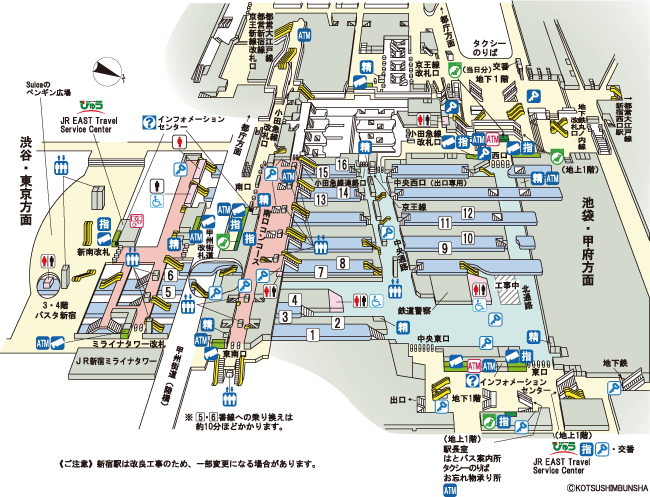
How higgledy-piggledy is Shinjuku? This is JR East's exploded view of just the JR section of the station and this is one individual's inadvertently hilarious attempt to annotate the JR East map so as to clarify the connections between the JR section of the station and the other sections.
That easiest way to slice through the labyrinth is to place the West Exit's taxi roundabout at the center and bottom of one's mental map, then draw radial compass lines toward all the other main points in the station, did not occur to me until sometime around 2005.
If I get a chance to read the Le Figaro piece, I would likely profit from a non-English language reading of locations in Japan. Almost all my views of this blessed land come via Japanese or English language sources -- with some vicarious readings of Italian views via Italian readers in Tokyo (Grazie tanto!).
That one has to venture outside the bilingual (Japanese-English) intellectual hegemony on Japan studies was clear a few months back in the disastrous interview Tokyo Metropolitan District governor Inose Naoki had with Ken Belson of The New York Times. Misunderstandings in the conduct and interpretation of that conversation seriously dented Tokyo's chances of landing the 2020 Olympic Games.
According to Belson:
At several points in the interview, Inose said that Japanese culture was unique and by implication superior, a widely held view in Japan. He noted that the political scientist Samuel P. Huntington wrote in his book "The Clash of Civilizations and the Remaking of World Order" that Japan was unlike any other culture.The underlined sentence is the kind of vaulting non-sequitur that earns The New York Times the ire of Japan defenders. If Governor Inose did not say that Japanese culture is superior, one should not report that he did.
Inose also pointed to polls that showed 70 percent of Tokyoites in favor of hosting the Summer Games, up from 47 percent last year. The well-received London Games, he said, have helped generate enthusiasm and confidence that Tokyo can host a similarly successful event.
Tokyo, he added, is exceptional because the Imperial Palace, which is largely off-limits to residents and visitors, forms the city's core while bustling activity surrounds it. "The central part of Tokyo has nothingness," he said. "This is a unique way that society achieved modernization."
More interesting is the replication, without explanation, of the assertion (in bold) that the green oasis of the Imperial Palace grounds, much of which is impenetrable to the citizenry, is symbolic of this blessed land's unique passage to modernity.
If there was ever a statement that needed explanation, it was this one -- particular because the observation is not Japanese in origin. The improbability of the verdant and closed-off Imperial Palace grounds (the grounds are not all closed off, of course, the East Gardens being one of the truly great green public spaces in the 23 Wards) being the center of a metropolis is the signature observation in L'Empire des signes by Roland Barthes (Link - Fr).
Inose assumed that Belson, an educated Westerner with ties to Japan, would be familiar with Barthes' work. In referencing both Barthes and Huntington, Inose was demonstrating that "uniqueness," far from being a marker of Japanese prejudice and arrogance, was indeed the almost exact opposite, "unique" being the adjective to which non-Japanese thinkers, befuddled by the challenge Japan's culture and history presented to their world views, have repeatedly retreated in their hour of intellectual aphasia.
For those who are interested and do not read French, L'empire des signes has been translated into English (Link). As it is a part of the French literary criticism/semiotics tradition one will not often find the work on the syllabi of positivist tradition English language Japanese studies courses. Nevertheless, it is one of the canonical works in the Japanese intellectual tradition of the ways non-Japanese look at Japan.
Which is as twisted and non-intuitive as the maze of underground passages beneath Shinjuku Station.
Image: Sunrise over the towers of Shinjuku on 14 May 2012
Image courtesy: MTC
Thursday, July 18, 2013
And Meanwhile, On The International Stage
Newsflash: a Japanese citizen, educated in Canada, spoke in English for an hour yesterday.
When asked about the ordeal, she replied that the experience was not very different from regular speech. (Link - J)
Hat tip to moderator Michael Penn for forwarding the Yomiuri Shimbun's account of Green Breeze party leader Tanioka Kuniko's unbelievable feat.
When asked about the ordeal, she replied that the experience was not very different from regular speech. (Link - J)
Hat tip to moderator Michael Penn for forwarding the Yomiuri Shimbun's account of Green Breeze party leader Tanioka Kuniko's unbelievable feat.
Friday, July 12, 2013
Failure To Atone
Pew Research's Global Attitudes Project has published its latest global survey of Asia Pacific attitudes toward Japan and Japan's government. (Link)
The results are pretty much as one would expect...and pretty depressing. Chinese and South Korean citizens and their respective governments are locked in a feedback loop of anti-Japanese hatred (I would write antipathy, but why equivocate?) from which no easy exit is visible...nor any exit at all, really. Prime Minister Abe is seen unfavorably in equal measure in the two countries -- 85% unfavorably -- at very high levels of certainty (only 6% of Chinese and 2% of South Koreans do not feel they know enough to make a call on Abe).
Were I Abe (and boy are you ever not him - Ed.) I would look at these results, look at my August schedule, shrug and pencil in my Yasukuni visit. "Look at these numbers. Seriously, how much worse could it get?" he could ask -- and he would be right.
Do check out Joelle Metcalfe's article that first alerted me as to the publication of the Pew Research findings. (Link)
The results are pretty much as one would expect...and pretty depressing. Chinese and South Korean citizens and their respective governments are locked in a feedback loop of anti-Japanese hatred (I would write antipathy, but why equivocate?) from which no easy exit is visible...nor any exit at all, really. Prime Minister Abe is seen unfavorably in equal measure in the two countries -- 85% unfavorably -- at very high levels of certainty (only 6% of Chinese and 2% of South Koreans do not feel they know enough to make a call on Abe).
Were I Abe (and boy are you ever not him - Ed.) I would look at these results, look at my August schedule, shrug and pencil in my Yasukuni visit. "Look at these numbers. Seriously, how much worse could it get?" he could ask -- and he would be right.
Do check out Joelle Metcalfe's article that first alerted me as to the publication of the Pew Research findings. (Link)
Wednesday, July 10, 2013
Oh, How To Play This One!

Judging from the responses when searching Google News in Japanese, the domestic media has not yet reported on this story:
Fourth star for Harry Harris
Pensecola News Journal
Pensacola becomes the home of lots of military brass, and this area also produces its share of high-ranking officers.
Harry B. Harris Jr., a 1974 graduate of Booker T. Washington High School, has been nominated by President Barack Obama for his fourth star as a Navy admiral, the Pentagon announced on Tuesday.
With the promotion, Harris, a vice admiral who is now assistant to the chairman of the Joint Chiefs of Staff, is scheduled to be assigned to command the U.S. Pacific Fleet, the Navy said.
As commander of the Pacific Fleet, Harris will oversee the world’s largest sea operation, encompassing more than half the Earth’s surface and including about 1,100 aircraft, 200 ships and submarines and roughly 140,000 military and civilian personnel.
Harris, 56, is the son of a Navy enlisted man and a Japanese woman who worked for the military as a civilian translator...
(Link)
So after the local mediaverse gets off its duff, how will this country's bloodline-conscious interpret a hafu's taking over as proconsul for the Indo-Pacific?
Wow, do I ever see the opportunity for misunderstandings here...oh, and a lot of images of excruciatingly bad gift swaps too.
It is just after 4:30 in the morning. What are the chances that NHK has a camera crew in Harris's mother's nominal furusato right now, interviewing seniors who would rather be watering their plants?
Tip of the hat to Paul Giarra for the link.
Later - Yes, I agree. It will be interesting to see this news is parsed in China.
Subscribe to:
Posts (Atom)