Just a quick glance at the numbers of foreign residents in Japan and naturalizations, in honor of the The Economist article on the immigration and childbirth expansion programs. (Link)
Number of foreign residents in Japan
June 2013
by country
Total 2,049,123
China 647,230
South Korea/DPRK 526,575
Philippines 206,769
Brazil 185,644
Vietnam 61,920
U.S.A.49,216
Peru 48,976
Thailand 40,699
Taiwan 29,466 (new category)
Nepal 27,584
Indonesia 26,171
% change in number of citizens residing in Japan since 2008
by country
Total -4.4%
China +0.5%
South Korea/DPRK -9.6%
Philippines +6.9%
Brazil -40.0%
Vietnam +52.8%
U.S.A. -4.8%
Peru -12.6%
Thailand +11.3%
Taiwan N.A.
Nepal +139.0%
Indonesia -0.0%
Source: http://www.moj.go.jp/content/000116174.pdf
Pretty stunning, that Brazil number, yes? Coupled with the figure for Peru, evidence that the ethnicity-based immigration policy has been an utter, humiliating failure.
And on the issue of ethnicity-based immigration
Number of naturalizations in 2013 (% change since 2009)
"Return naturalization" (kika) 8,646 (-41.5%)
All other naturalizations 1,030 (-34.5%)
Source: http://www.moj.go.jp/MINJI/toukei_t_minj03.html
I know what you are thinking.
"You mean if one excludes the special ethnicity based citizenship pathway, Japan has been adding about 1,000 citizens per year via immigration? And by all methods of naturalizations, the total number of added citizens is around 10,000? And both forms of naturalizations have declined by more than 30% over the last five years? And the natural change in Japan's population (births - deaths) in 2013 was -244,000?"
(Link)
"Bwahahahahahahahahahaha!"
Showing posts with label population shifts. Show all posts
Showing posts with label population shifts. Show all posts
Saturday, May 31, 2014
Friday, April 20, 2012
Raising Children In the Land Of the Rising Sun
Dear me, the threatened longer CFR version of this New York Times op-ed looks as though it is going to be a total, alarmist, misleading waste of time.
In this blessed land, the government has experimented with codifying generous leave rights for women and now men. It conducted a successful crash program to build day care centers in the 1990s (contrary to the conventional wisdom, waiting lists for day care center spaces are an extremely limited and localized phenomenon). As a part of an economic stimulus program, it has experimented with direct payments of subsidies to parents of children, without means testing (50% of which ended up, due to the law of unintended consequences and personal asset management advice printed in women's magazines, in bank savings accounts -- precisely where the government did not want its stimulus money to go).
The one salient fact that has seemingly never sunk into policy makers heads is that married women now are having children at the same rate they were four decades ago. The difference is that women are marrying in their thirties, meaning that their window of fertility is smaller. The issue is getting men and women to marry young, either by setting up their own households or by living with their inlaws in large houses.
If the government can also find ways of making the finding of jobs more secure -- which means encouraging flexible employment practices and the eradication of the bias against who choose or must suffer job mobility -- above and beyond the considerable efforts it has tried to make, then the birthrate "crisis" would ease.
Due to what has gone on over the last 30 years, this blessed land's population is set to drop no matter what -- last year's drop of more than a quarter of a million citizens serving as a wake up call of dramatic falls lying ahead (E). Making young people feel safe about marrying young would, however, ease the decline.
Mind the Baby GapEspecially since the very same paper published the below op-ed five weeks ago.
by Steven Philip Kramer
Although overpopulation plagues much of the developing world, many developed societies are now suffering from the opposite problem: birthrates so low that each generation is smaller than the previous one. Much of southern and eastern Europe, as well as Austria, Germany, Russia and the developed nations of Southeast Asia, have alarmingly low fertility rates, with women having, on average, fewer than 1.5 children each, well below the replacement level.
At the same time, life expectancies in those places have reached record highs. As a result, the dependency ratio — the ratio of the working population to the nonworking population — has become increasingly unfavorable, and it is projected to get more so. Making matters worse is that economic growth gets harder to achieve as workers age and their ranks dwindle; aging societies will have a tough time succeeding in an era of rapid technological change.
Population decline poses a danger to the developed world. Yet there is nothing inevitable about it. History shows that governments can raise birthrates close to replacement levels if they adopt the right policies. France and Sweden, for example, have crafted thoughtful, comprehensive and consistent policy responses that have largely reversed their declining birthrates over the long run.
France was the first country to experience a declining birthrate in the 19th century. French leaders blamed the country’s defeat in 1940 on its stagnating demographic, economic and social development. If France was to regain its status, it needed a new dynamism — more social justice, a stronger economy and faster population growth. So France tried to plan itself out of industrial underdevelopment and demographic decay, and it did so through, above all, a generous program of financial support for families with children.
Sweden suffered from extremely low birthrates in the 1930s. When the Social Democrats came to power at the height of the Great Depression, one of their economic strategists was Gunnar Myrdal, who in 1934, with his wife Alva, wrote a best-selling book on the population crisis. It argued that if Sweden was to boost its birthrates, women had to be able to both raise children and have careers — a revolutionary idea at the time...
(Link)
The Fertility ImplosionEach country has its unique combination of reasons for its fertility collapse. A willy-nilly reproduction (pun unintended) of the French or the Swedish models, without taking into account the the cultural, institutional, economic, immigration policy, ethnic profile and country size and location aspects bracketing those models, is playing with fire.
by David Brooks
When you look at pictures from the Arab spring, you see these gigantic crowds of young men, and it confirms the impression that the Muslim Middle East has a gigantic youth bulge — hundreds of millions of young people with little to do. But that view is becoming obsolete. As Nicholas Eberstadt and Apoorva Shah of the American Enterprise Institute point out, over the past three decades, the Arab world has undergone a little noticed demographic implosion. Arab adults are having many fewer kids.
Usually, high religious observance and low income go along with high birthrates. But, according to the United States Census Bureau, Iran now has a similar birth rate to New England — which is the least fertile region in the U.S.
The speed of the change is breathtaking. A woman in Oman today has 5.6 fewer babies than a woman in Oman 30 years ago. Morocco, Syria and Saudi Arabia have seen fertility-rate declines of nearly 60 percent, and in Iran it’s more than 70 percent. These are among the fastest declines in recorded history.
The Iranian regime is aware of how the rapidly aging population and the lack of young people entering the work force could lead to long-term decline. But there’s not much they have been able to do about it. Maybe Iranians are pessimistic about the future. Maybe Iranian parents just want smaller families.
As Eberstadt is careful to note, demographics is not necessarily destiny. You can have fast economic development with low fertility or high fertility (South Korea and Taiwan did it a few decades ago). But, over the long term, it’s better to have a growing work force, not one that’s shrinking compared with the number of retirees.
If you look around the world, you see many other nations facing demographic headwinds. If the 20th century was the century of the population explosion, the 21st century, as Eberstadt notes, is looking like the century of the fertility implosion...
(Link)
In this blessed land, the government has experimented with codifying generous leave rights for women and now men. It conducted a successful crash program to build day care centers in the 1990s (contrary to the conventional wisdom, waiting lists for day care center spaces are an extremely limited and localized phenomenon). As a part of an economic stimulus program, it has experimented with direct payments of subsidies to parents of children, without means testing (50% of which ended up, due to the law of unintended consequences and personal asset management advice printed in women's magazines, in bank savings accounts -- precisely where the government did not want its stimulus money to go).
The one salient fact that has seemingly never sunk into policy makers heads is that married women now are having children at the same rate they were four decades ago. The difference is that women are marrying in their thirties, meaning that their window of fertility is smaller. The issue is getting men and women to marry young, either by setting up their own households or by living with their inlaws in large houses.
If the government can also find ways of making the finding of jobs more secure -- which means encouraging flexible employment practices and the eradication of the bias against who choose or must suffer job mobility -- above and beyond the considerable efforts it has tried to make, then the birthrate "crisis" would ease.
Due to what has gone on over the last 30 years, this blessed land's population is set to drop no matter what -- last year's drop of more than a quarter of a million citizens serving as a wake up call of dramatic falls lying ahead (E). Making young people feel safe about marrying young would, however, ease the decline.
Wednesday, April 16, 2008
Tokyo Rising Yet Again
Among the many interesting figures highlighted in the April 15 population statistics release of the Ministry of Internal Affairs and Communications (MIC) is a landmark in the Tokyo Metropolitan District's march to national dominance.
As of October 1 last year the TMD's population had risen to 10% (with a little rounding help) of Japan's total population.
The concentration has historical antecedents. According to the linked pdf document, Tokyo's proportion of the total population rose to 11.1% in the period 1965 to 1969, then began to decline. It fell below a statistical 10.0% twenty-eight years ago, as the great mai homu and manshon boom of the Seventies and Eighties and then the skyrocketing of urban land prices under the late 1980's property bubble drove population out of Tokyo into the surrounding Kanagawa, Saitama and Chiba Prefectures. The failure of the financial system to cleanse itself and the grinding down of property values perpetuated the fall in the TMD's relative standing. Little new housing was built as land owners awaited the real estate rebound that never came. Fewer came to try their fortune in Tokyo. Births dropped as couples chose to have fewer children.
The TMD's proportion of the total bottomed out at 9.4% in 1998--the year of the Takushoku Bank and Yamaichi Securities failures and the "Japan Premium" in the debt markets, when the national mood was at its nadir.
During the past decade of economic recovery population has been swirling back population into the TMD. In addition, within the 23 central wards of the TMD natural population growth--i.e., births outnumbering deaths--continues to significantly contribute to population growth as well (these figures not in yesterday's MIC report but in the TMD government's own population report, introduced here). On the aggregate within the TMD, the natural rate of population growth is only just a shade above zero at 0.07% (Easy-going Okinawa remains the land of the breeders, with a 0.54% natural growth rate).
The concentration of the population into a very small number of megacities continues apace. According to the MIC figures, the total population of the Tokyo metro area ( 東京圏 -- i.e., the TMD and the three prefectures surrounding) was 34,827,000--a thumping 27.3% of Japan's total population. The proportion of Japanese living in the top five prefectures by population--the TMD, Kanagawa, Osaka, Aichi and Saitama--is 35.1%, while the proportion of those living in the top 3 urban concentrations--the Tokyo, Aichi and Osaka greater metro areas--is a wild 50.6% of the total national population.
So where are you going to site your retail business? Or invest, if you need workers? Or live, if you want to assure yourself of services as you grow old and as the total national population declines? *
And despite the ingestion of 99,000 new residents from October 2006 to October 2007, in addition to the 12,659,000 that were already there, you still can, if you need to, get away from them all--without ever leaving the TMD.

--------------------------
* Janne Morén will be pleased, I'm sure, by this string of rhetorical questions.
As of October 1 last year the TMD's population had risen to 10% (with a little rounding help) of Japan's total population.
The concentration has historical antecedents. According to the linked pdf document, Tokyo's proportion of the total population rose to 11.1% in the period 1965 to 1969, then began to decline. It fell below a statistical 10.0% twenty-eight years ago, as the great mai homu and manshon boom of the Seventies and Eighties and then the skyrocketing of urban land prices under the late 1980's property bubble drove population out of Tokyo into the surrounding Kanagawa, Saitama and Chiba Prefectures. The failure of the financial system to cleanse itself and the grinding down of property values perpetuated the fall in the TMD's relative standing. Little new housing was built as land owners awaited the real estate rebound that never came. Fewer came to try their fortune in Tokyo. Births dropped as couples chose to have fewer children.
The TMD's proportion of the total bottomed out at 9.4% in 1998--the year of the Takushoku Bank and Yamaichi Securities failures and the "Japan Premium" in the debt markets, when the national mood was at its nadir.
During the past decade of economic recovery population has been swirling back population into the TMD. In addition, within the 23 central wards of the TMD natural population growth--i.e., births outnumbering deaths--continues to significantly contribute to population growth as well (these figures not in yesterday's MIC report but in the TMD government's own population report, introduced here). On the aggregate within the TMD, the natural rate of population growth is only just a shade above zero at 0.07% (Easy-going Okinawa remains the land of the breeders, with a 0.54% natural growth rate).
The concentration of the population into a very small number of megacities continues apace. According to the MIC figures, the total population of the Tokyo metro area ( 東京圏 -- i.e., the TMD and the three prefectures surrounding) was 34,827,000--a thumping 27.3% of Japan's total population. The proportion of Japanese living in the top five prefectures by population--the TMD, Kanagawa, Osaka, Aichi and Saitama--is 35.1%, while the proportion of those living in the top 3 urban concentrations--the Tokyo, Aichi and Osaka greater metro areas--is a wild 50.6% of the total national population.
So where are you going to site your retail business? Or invest, if you need workers? Or live, if you want to assure yourself of services as you grow old and as the total national population declines? *
And despite the ingestion of 99,000 new residents from October 2006 to October 2007, in addition to the 12,659,000 that were already there, you still can, if you need to, get away from them all--without ever leaving the TMD.

The Minami Akikawa Valley
Hinohara Township, Tokyo Metropolitan District
November 5, 2006
--------------------------
* Janne Morén will be pleased, I'm sure, by this string of rhetorical questions.
Friday, March 28, 2008
Tokyo Still Rising
The rise of the metropole continues...
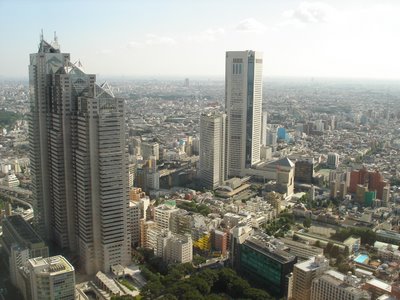 According to the General Affairs Bureau of the Tokyo Metropolitan Goverment, the population of the Tokyo Metropolitan District was 0.89 % higher on January 1st of this year than a year earlier. This marks the 12th straight year of increase and the move of a million persons into the TMD over the last decade.
Furthermore, the rate of increase grew greater the closer one drew to the center of the TMD. In the core 23 wards, where 2/3 of the population lives, the rate of population growth was 1%. In the central Minato and Chuō wards the annual rates of population growth were a stunning 5.33% and 2.94%, respectively.
The Tokyo Shimbun report on the TMD population increase can be found here.
I do not know about you, but upon reading this report, my first instinct was to immediately demand more road construction in the countryside.
-------------------
Looking southwest from Tokyo Metropolitan Government Building
Shinjuku Ward, Tokyo Metropolitan District
August 19, 2006
Photo courtesy: MTC
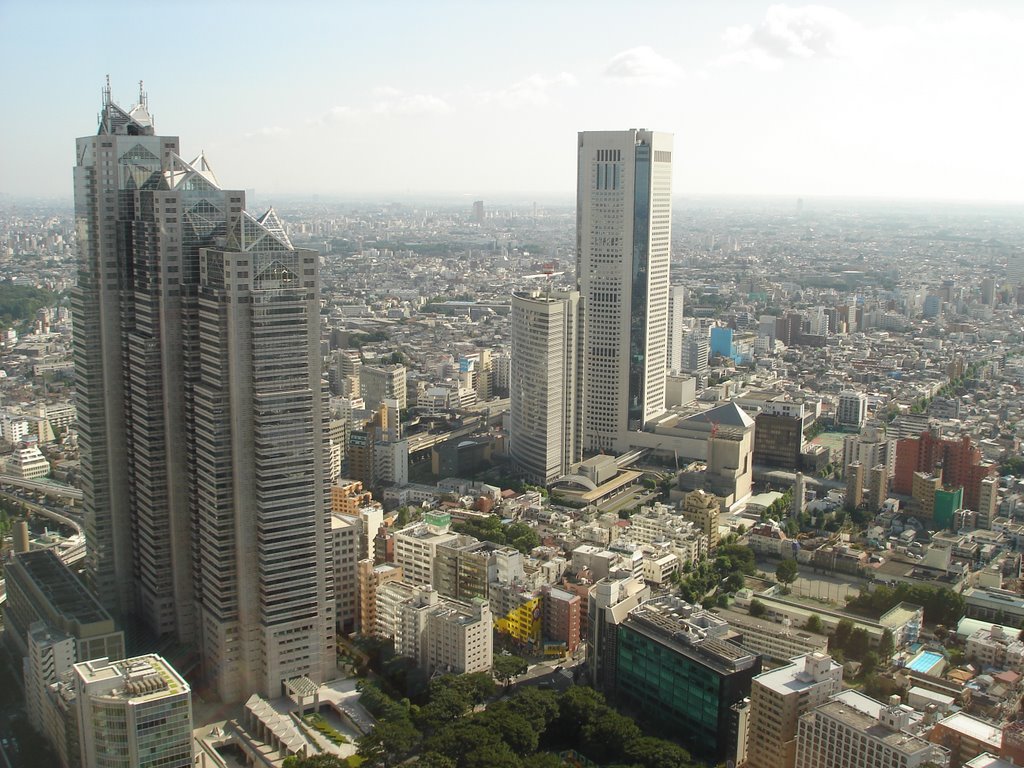 According to the General Affairs Bureau of the Tokyo Metropolitan Goverment, the population of the Tokyo Metropolitan District was 0.89 % higher on January 1st of this year than a year earlier. This marks the 12th straight year of increase and the move of a million persons into the TMD over the last decade.
Furthermore, the rate of increase grew greater the closer one drew to the center of the TMD. In the core 23 wards, where 2/3 of the population lives, the rate of population growth was 1%. In the central Minato and Chuō wards the annual rates of population growth were a stunning 5.33% and 2.94%, respectively.
The Tokyo Shimbun report on the TMD population increase can be found here.
I do not know about you, but upon reading this report, my first instinct was to immediately demand more road construction in the countryside.
-------------------
Looking southwest from Tokyo Metropolitan Government Building
Shinjuku Ward, Tokyo Metropolitan District
August 19, 2006
Photo courtesy: MTC
Subscribe to:
Posts (Atom)