You may recall Suzuki Nobuyuki, the radical right winger who managed to capture 74,000 votes in the Tokyo Metropolitan District on July 21 (introduced here, with the look at how he might have been a sponsored spoiler candidate here).
The frighteningly well-spoken Suzuki holds forth in a new video report from Michael Penn: "Japan Grapples With The Rise Of Hate Groups."
If you have 12 minutes, it is worth a watch.
I would take exception to the statement in the report that the noisy, threatening ultra-right is a new phenomenon. All kinds of things were yelled out at political events in the 1960's (the audio to the video of the assassination of Socialist Party leader Inejiro Asanuma demonstrates how out of control the audience was - Link). However, it is true that threats of death and other violence have been beyond the pale for the past 40 years.
I also worry about misinterpretation of the statement that Prime Minister Abe Shinzo shares many of the ideological beliefs of the radical fringe. Rather than sharing ideology, it is probably better to say that Abe-san and his friends in business, academia, and the media have same the data points and talking points in their arsenals as one finds in the speeches and online drivel produced by the fringe groups and politicians like Suzuki.
The claims of radical parties like Suzuki's Restoration New Wind and organizations like former air self defense forces general Tamogami Toshio's Ganbare Nippon are outlandish in their paranoia. They would not have any attraction, though, if they did not in some way provide a template for understanding actual events. The intrusion of Chinese coast guard ships into the territorial waters around the Senkaku Islands (Link) or the erection of monuments to the comfort women -- the women (and some boys) trafficked by the brothel network established to serve the troops and officers of the Imperial Army -- on public land in the United States (Link) provide Japanese hate groups all the evidence they need of a vast global anti-Japanese conspiracy encircling and strangling the nation. These groups do on their own then layer on farcical claims, perhaps out of theatricality, perhaps as ornamentation in order to disguise the poverty of their intellectual wares.
That the relationship between Chinese and South Korean patriots and right wing fringe groups in Japan is symbiotic, each side providing the other with the justification for festering hatred and provocation (possibly providing a comfortable living for some of the participants) rarely makes the news anywhere.
Showing posts with label sanctions. Show all posts
Showing posts with label sanctions. Show all posts
Tuesday, September 10, 2013
Saturday, June 14, 2008
The Trafficking of Human Beings
In my heart of hearts, I believe the DPRK government was not lying in September 2002. One way or another, eight of the 13 Japanese citizens believed kidnapped by North Korean agents in the 1970s died long ago. Intellectually, I can accept the possibility that one or two may still be alive, either in a reeducation camp or a mental facility. However, my heart tells me it is unlikely to be so.
I am also not sure whether or not the DPRK turned over the remains of Yokota Megumi. However, I am fairly sure that running DNA tests on cremated bits of bone and ash was a futile exercise (hence my problems with this report).
Ever since Kim Jong-il tossed caution to the winds and not only confessed to the kidnappings but also, incomprehensibly, let the kidnapped and their families leave the DPRK (the marked, inexcusable exception being the daughter of Yokota Megumi, of course) the families and their ultra-right defenders have been overstaying their welcome as the nation's official sufferers-in-chief. The Japanese government's shift to a hardline, intransigent stance over the abductees crippled efforts to rein in the DPRK's nuclear program--with predictable results.
[Not that Japanese intransigence would have mattered much in the long run. In the long run, the the DPRK regime could not shake itself of the belief it needed an atomic capability as a deterrent. Somehow possessing tens of thousands of fanatical commandos trained in guerilla warfare techniques and enough artillery tubes to flatten Seoul under a hailstorm of fire and steel were not deterrent enough. ]
A reopened investigation into the fates of the abductees holds risks. At best, it will not find much in addition to what has already presented. At worst, new information will be "discovered," the facts of which will likely be so awful as to send the relationship spiraling back into the abyss.
The "reinvestigation-for-loosened-sactions" deal is nevertheless a good start -- one that perhaps only a deeply wounded Fukuda Administration could have ever accepted.
What is more intriguing is the possibility that the DPRK may have offered to hand over
1) the surviving Yodo hijackers and
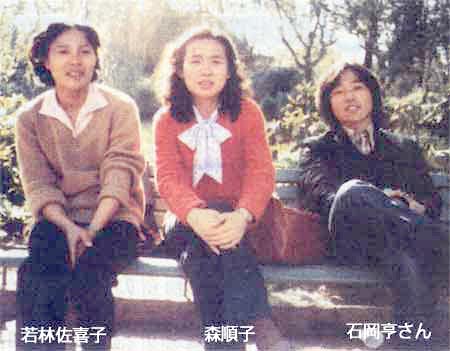
2) their spouses who lured Ishioka Tōru (yes, it's the mind-bending Spain photo) and Arimoto Keiko to their doom.
[An aside - The press and the government are Yokota Megumi freaks--practically by statute. The Ishioka-Arimoto tragedy is the more compelling one, however. Leftist idealism and naiveté made the victims complicit in their own capture and stupidity made their families possibly complicit in what one must assume were their murders and the murder of their infant. ]
Apart from the still-at-large perpetrators of the 20 March 1995 Sarin gas attack on Tokyo's subway system (oh where oh where did they go?) the Yodo hijackers plus Mori Junko and Wakabayashi Sakiko are the National Police Agency's most wanted criminals. There is nothing the NPA would love so much as the chance to put them all behind bars for the rest of their natural lives.
That there is serious talk about the DPRK and Japan cutting a deal over the Yodo hijackers demonstrates that both sides are willing to place huge bets on the future.
And that is a very, very interesting development indeed.
I am also not sure whether or not the DPRK turned over the remains of Yokota Megumi. However, I am fairly sure that running DNA tests on cremated bits of bone and ash was a futile exercise (hence my problems with this report).
Ever since Kim Jong-il tossed caution to the winds and not only confessed to the kidnappings but also, incomprehensibly, let the kidnapped and their families leave the DPRK (the marked, inexcusable exception being the daughter of Yokota Megumi, of course) the families and their ultra-right defenders have been overstaying their welcome as the nation's official sufferers-in-chief. The Japanese government's shift to a hardline, intransigent stance over the abductees crippled efforts to rein in the DPRK's nuclear program--with predictable results.
[Not that Japanese intransigence would have mattered much in the long run. In the long run, the the DPRK regime could not shake itself of the belief it needed an atomic capability as a deterrent. Somehow possessing tens of thousands of fanatical commandos trained in guerilla warfare techniques and enough artillery tubes to flatten Seoul under a hailstorm of fire and steel were not deterrent enough. ]
A reopened investigation into the fates of the abductees holds risks. At best, it will not find much in addition to what has already presented. At worst, new information will be "discovered," the facts of which will likely be so awful as to send the relationship spiraling back into the abyss.
The "reinvestigation-for-loosened-sactions" deal is nevertheless a good start -- one that perhaps only a deeply wounded Fukuda Administration could have ever accepted.
What is more intriguing is the possibility that the DPRK may have offered to hand over
1) the surviving Yodo hijackers and
2) their spouses who lured Ishioka Tōru (yes, it's the mind-bending Spain photo) and Arimoto Keiko to their doom.
[An aside - The press and the government are Yokota Megumi freaks--practically by statute. The Ishioka-Arimoto tragedy is the more compelling one, however. Leftist idealism and naiveté made the victims complicit in their own capture and stupidity made their families possibly complicit in what one must assume were their murders and the murder of their infant. ]
Apart from the still-at-large perpetrators of the 20 March 1995 Sarin gas attack on Tokyo's subway system (oh where oh where did they go?) the Yodo hijackers plus Mori Junko and Wakabayashi Sakiko are the National Police Agency's most wanted criminals. There is nothing the NPA would love so much as the chance to put them all behind bars for the rest of their natural lives.
That there is serious talk about the DPRK and Japan cutting a deal over the Yodo hijackers demonstrates that both sides are willing to place huge bets on the future.
And that is a very, very interesting development indeed.
Subscribe to:
Posts (Atom)