Tuesday, October 03, 2006

Amaterasu, guide us!

Lest we be cast into the seas of fire!

It works like clockwork, doesn't it? I write a post about how sick I am of the racchi mondai's overwhelming the Japanese government's capacity to negotiate with the DPRK.

Eight hours later, the other shoe drops.

North Korea says will conduct nuclear test
Reuters

SEOUL - An increasingly isolated North Korea said on Tuesday it would conduct its first-ever nuclear test, blaming a U.S. "threat of nuclear war and sanctions" for forcing its hand.

(...)

"The U.S. extreme threat of a nuclear war and sanctions and pressure compel the DPRK (North Korea) to conduct a nuclear test, an essential process for bolstering nuclear deterrent, as a corresponding measure for defense," the statement said.

(...)

Japan's new prime minister, Shinzo Abe, said any nuclear test by North Korea would be unacceptable.


Yep, just like stunning success of containing the nuclear program of the Islamic Republic of Iran, all you have to do to keep the DPRK in line is set unreasonble, humiliating preconditions for any negotiation and keep racheting up the pressure through sanctions and international isolation.

Works every time.

Please, count me out

Tonight, barring a miracle, those who dare watch television (as a recovering TV addict who has gone cold turkey I will be either swimming, cooking or riding a train at the time)--you will have a chance to witness what looks like a visit to the Marianas Trench of bathos.


What we all really need to see--a dramatic recreation (guaranteed to be tasteful, believable and not at all maudlin) of the life of Yokota Megumi.


Can the families of the abducted please give the rest of us a break? It is bad enough that they get not only a cabinet-level post and one of the Special Advisor to the Prime Minister posts dedicated to their hopeless cause...but they also are the first non-politicians the new prime minister deigns to meet.

However horribly the government of Japan treated the families of the abducted--and they were treated horribly, do doubt about it--do the rest of us have to have our noses ground into the dirt over it? [No, not really--we could just not watch the program when it airs on Nippon Television (Channel 4) at 21:00 tonight]

Do the surviving family members realize how far beyond the pale they have pushed their complaint? I am so sick of the stranglehold the families and their handlers have on any aspect of North Korea-related policy I am finding myself--Amaterasu help me--in agreement with Gregory Clark.

Eeek!

Monday, October 02, 2006

Standing on their Heads

The editors of the Sankei Shimbun, seeing their beloved champions wounded and bleeding from the sarcastic darts of the Mainichi Shimbun, sing a new, stirring patriotic ode to the "beautiful Japanese" as it is not being taught to elementary school children.

Today's lament: how the limitation on the number of kanji is anti-democratic.


小学生の英語 国語こそ知的活動の基礎

...

言語というものが、単にコミュニケーションの道具だけでなく、知識を習得し、物を考え、ある民族の精神の骨格を形成するのになくてはならぬ手立てであることを、もう一度深く考えてみるのによいきっかけとなった。

戦後の国語政策は知識や情報の大衆化・民主化を目指すという旗印の下、ひたすらその平易化が図られてきた。漢字制限はその最たるもので、小学生の6年間でわずかに1006字しか教えられていない。

 これでは漢字仮名交じり文を基本とする国語文を十分に読む力が養えるはずがない。抽象的思考に使える言葉はほとんどが漢字語彙(ごい)であり、それを漢字制限によって抑制すれば精密で論理的な思考力が身に付くはずもない。美しい詩文や物語に触れて、豊かな情緒を涵養(かんよう)することもままならない。

Before attempting a direct translation, let's have a go at the low hanging fruit.

Call me snide and immature, but if you are going to publish a lament decrying the hopelessness of introducing children to the complexities of certain abstract concepts because the children are not familiar with the kanji of the technical terms then YOU HAD BETTER NOT USE FURIGANA TO SHOW THE PRONUNCIATION OF NOT ONE BUT TWO TECHNICAL TERMS USED IN THAT SAME SENTENCE.

OK, breathe, breathe...maybe irony is a cultural affect. On to the next thought.

Let us see if the statement holds any water (i.e., let us see if we can spot the politics, shall we?)


English for Elementary Students: Our National Language is the Basis of Intellectual Activity

[cut]

Language is not just a tool for communication. It is the acquisition of knowledge, the way of thinking about things, a means without which a certain ethnic group cannot formulate the framework of its ethos. This has become a good chance for us to once more to try to think deeply on this matter.

Under the banner of popularizing and democratizing knowledge and information, education policy in the postwar era has been engaged in singleminded vulgarization. The limitations on the number of kanji embodies this for only 1006 kanji are taught in the first 6 years of elementary school.

It is unlikely that texts of sentences using mixtures of kanji and kana can foster reading abilities. The words of abstract thinking are almost all in the kanji lexicon (LEH-ku-sih-KON). If the restrictions on the number of kanji one can use become a limitation, then the ability to think with precision is not likely to develop. One will not appreciate beautiful poetic language or stories. The fostering of hearty enrapture (en-RAHP-chur) will not take place.

Oh, Amaterasu...where to begin...

[I know that last sentence is weak. I am open to suggestions about other ways to translate 豊かな情緒を涵養(かんよう)することもままならない]

Amaterasu, yes!

About this minzoku (ethnic group) ethos business...which minzoku are you referring to here? All of them, or one in particular--an early 20th centurey construct that sort of excludes zainichi chosenjin, Ainu and Okinawans? Or are we elevating Osaka-ben to a cultural determinant--along with pairing off to tell jokes and an inexplicable longing to leap into fetid rivers? Oh, I know the editors could have been using minzoku to mean just "a people"--but come on, this is the Sankei Shimbun here.

And then there is that funny little problem with kanji...you know what I mean. It is like kan (pause) ji --the "writing" of the "Han" people.

Funny thing is, of course, Japanese are not Han. Not even close.

So kanji--the writing of the Han--really is not Japanese. It is sort of a "borrowed ethos" with a lot of ugly compromises.

Hysterically, of course, kana--the bad guys in the Sankei's version of events--ARE Japanese--they were created by Japanese--in order make comprehensible...the...abstract meanings contained in the imported Chinese...kanji.

And what's more a lot of what is considered "beautiful Japanese"---like the poems in the Kokinshū or the Genji monogatari--they are all in nothing but kana.

Ergo: learning English in elementary school is...oh forget it.

Friday, September 29, 2006

The Great Communicator

The PM is in trouble with the language police again...and it is only Day 3 of his term as prime minister.

Abe was mocked for bubbling away in the eager-to-please, peppy language of a schoolboy at his first press conference, including the incredible (almost Bushesque) stuffing of 31 iterations of the phrase "shikkari to " into only 23 minutes.

Now he is getting the verbal switch across his posterior for his incredible katakana eigō explosion today during his first Policy Speech to the Diet.

The Mainichi Shimbun lovingly documents the devastation--and makes the obvious point:

安倍首相:カタカナ言葉は109回 小泉首相の4倍

 安倍晋三首相の所信表明演説は政策面でカタカナ言葉が目立つ。「オープンな経済社会」に「イノベーション(技術革新)の創造」と明記するように、具体的な数値目標の代わりにカタカナ言葉を多用することで、斬新なイメージをアピールする狙いもありそうだ。しかし「美しい国、日本」を掲げ、伝統や歴史を重視する保守色の濃い内容に比べると、ちぐはぐな印象も否めない。

[interim translation]
Prime Minister Abe Shinzō: 109 uses of loans words--4 times the rate of Prime Minister Koizumi

Prime Minister Abe Shinzō, in his policy speech to the Diet, made conspicuous use of English loan words as regards policy. In specifying "An ōpun economic society" for the "creation of inobēshon" and similar statements, it seemed that his goal in using the loan words was create an appealing sense of novelty rather in order to avoid having to spell out concrete numerical targets. However, when one compares to the contents of Beautiful Country, Japan, with its deeply conservative emphasis on tradition and history, one could not help feeling that the PM was a talking at cross-purposes with himself.
Maybe the prime minister could get a little tutorial in "beautiful Japanese" from his Minister of Education, Culture, Sports, Science and Technology.

Just Don't Do It

The Gadfly on the Wall believes that the appointment of Yosano Kaoru and Machimura Nobutaka to the Tax Committee will result in a raising of the consumption tax.

I am not so sure.

I do not think that Yosano Kaoru is in the pocket of the Ministry of Finance. In the final months of the Koizumi Administration, he was arrayed against the more happy-go-lucky stance of Financial Services Minister Takenaka Heizo, LDP Secretary General Takebe Tsutomu and the then Chairman of the Policy Research Council Nakagawa Hidenao.

However, Yosano's stance was tactical, not strategic. With Tanigaki Sadakazu an effective check on Finance Ministry influence and Bank of Japan Governor Fukui Toshihiko sidelined by the Murakami investment scandal, the pro-fiscal budget balance team needed help. Yosano, who has a nose for going where he is wanted, found himself playing alongside the hard-money, balanced budget side.

With Yosano on the tax hot seat, I think he will play a different game. He is not a fool--he knows that the consumption tax is regressive and will bite the elderly on fixed incomes hardest, followed by young couples just starting out. Yosano knows that trying to balance the difference between revenues and expenditures on the backs of retirees and the young families is a recipe for electoral meltdown.

Even though he is neither one of the top party leaders nor a member of the Cabinet, with his head in a noose awaiting the outcome of the July 2007 elections, Yosano is still very sensitive about electoral failure. He is the oldest of the Koizumi children. He was in the political wilderness, sitting around, talking about politics but not practicing it much. Then Koizumi magic came along and gave Yosano the power him to reclaim his downtown district from the Democratic usurper Kaieda Banri.

The government has given assurances of no consumption tax rises before next fall as a political bouquet to the electorate. I think with the rise in personal incomes from rising wages, land sales and stock sales--and continued rises in revenues from corporate tax receipts (unless, of course, the government decides to give away the store to the corporations), the debate over a rise in the consumption tax will be pushed out into 2008.

Thursday, September 28, 2006

And so it begins...

小学校の英語「必修化の必要ない」 伊吹文科相
asahi.com

2006年09月27日22時06分 - 新学習指導要領の焦点の一つになっている小学校での英語必修化について、伊吹文部科学相は27日、「私は必修化する必要は全くないと思う。美しい日本語ができないのに、外国の言葉をやったってダメ」と話し、否定的な見解を示した。

[Interim translation] As regards the compulsory teaching of English in elementary schools--a point of contention in the new curriculum guidelines--Minister of Education, Science and Technology Ibuki Bunmei said on the 27th, "I don't believe it entirely necessary for it to be compulsory. If you cannot express yourself in beautiful Japanese, it is wrong to have done so in a foreign tongue." In saying this, he revealed his negative position.

Minister Ibuki,

As one who attended elementary and middle schools where half the classes were taught in English using American textbooks--and half were taught in French using French government-approved textbooks--and thank Dieu for it, for otherwise I would have never learned world history, geography or mathematics [the American math texts asked so little of our minds we referred to "English math" as "math for idiots"]--I can assure you that being made to learn a second language from an early age has not got one goddamned thing to do with the facility (I can see now I am going to be sick of the association of utsukushii with Nihon by November) with which one expresses oneself in one's mother tongue.

Sir.

Oh, and by the way, if you are going to be railing against the use of loan words, perhaps you could sidle on over to the Kantei and tell the PM how goddamn ugly (and stupid) Takaichi Sanae's "inobēshon tantō daijin" title sounds.

Just a suggestion.

Sir.

Wednesday, September 27, 2006

Synchronicities

A week ago, I noted in passing a Sankei article about the resurgence of Japanese-made films in the domestic theatrical release market.

It turns out that Bruce Wallace of the LA Times had dropped an article on exactly the same subject on his editor's desk 10 days earlier.

The paper did not run the story until this past Sunday.

Bad editor! Run Mr. Wallace's stories immediately in the future!

In the same vein (and on the same day) the Tokyo Shimbun published an article on a subject Okumura Jun of GlobalTalk 21 and I (of Shisaku, I guess) have both been carping on for a while: the increasing prominence of legacy LDP leaders (including all the candidates for the LDP party presidency this time around) who were neither born in nor attended schools in the districts they represent.

Take Abe Shinzō, for example. His local support group lauds him as the ninth prime minister from the former han of Chōshū, "the cradle of prime ministers". Except, of course, from nursery school to the day he left college, Abe was enrolled in Seikei Gakuen/Daigaku in Kichijōji. Abe took to calling himself a "man of Chōshū" only when he ran for his father's seat in the Diet.

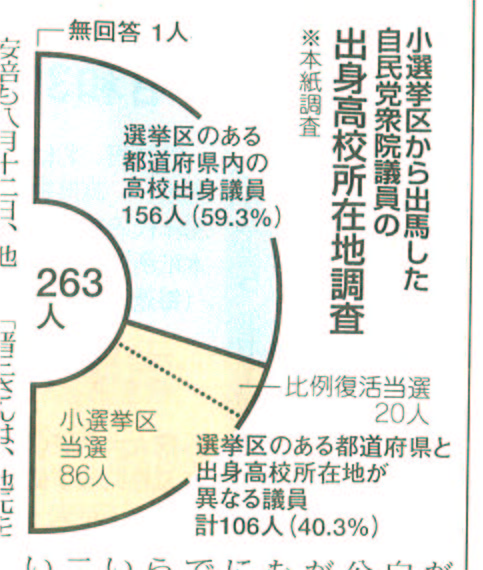
On Sunday, the Tokyo Shimbun printed the following graphic:
Of the 263 LDP district Representatives or LDP district candidates who lost in the district elections but "rose from the dead" thanks to the party lists for at-large seats, 59.3% attended high school in the district they represent or ran in and 40.3% did not (one stubborn old cuss would not reveal where he/she attended high school).

Now for a society in motion like Japan was in the 1960s and 70s, with mass migration underway to the urban centers, a 60-40 split is not unreasonable. However, for a party that purports to be conservative and even traditionalist, having 40% of its members without furusato memories to call upon is a bit rich.

Tuesday, September 26, 2006

All right, who spiked the punchbowl?

Japan has a Special Advisor on Press Relations - the equivalent of a Press Secretary. How the heck is that going to work out with the responsibilities heretofore associated with the Chief Cabinet Secretary?

Not one but two persons in charge of North Korean abductions.

But on the bright side, Japan has an Arabic- and English-speaking Prime Minister's Special Advisor on Security Affairs with a degree from Cairo University and a background in television broadcasting. That she is an attractive woman with gobs of Cabinet experience under her belt is just icing on the cake.

Damage Assessment

What I got absolutely right:

* LDP Secretary General - Nakagawa Hidenao
* Special Advisor on North Korean Abductions - Nakayama Kyōko
* Defense Agency - Kyūma Fumio
* Ōbuchi Yūko would not get a post
* That of all his very visible women supporters in the Diet (referred to in the popular literature as The Cheerleaders) Takaichi Sanae would get a Cabinet post
* Two members of the House of Councillors would be named to the Cabinet – (Aoki Mikio gave this one away, so it does not really count)

What I got sort of right:

* Shiozaki Yasuhisa was in line for a power position
* Yamamoto Yūji would be in charge of income disparities
* Aso Tarō was one of three candidates for Foreign Ministry post
* Nikai Toshihirō would be in a sensitive post requiring a dove
* The Minister for the Environment would be a throwaway position
* Hakuo Yanagisawa, Nakagawa Shōichi, Ishihara Nobuteru and Shimomura Hakubun would get significant posts-just not the ones I predicted
* As noted previously, a faction head would be named Chairman of the General Council and a Koizumi Cabinet member would be made Chairman of the Policy Research Council
* The Minister of Justice would be some old guy no one has ever heard of (in Japanese politics, 62 is not old)
* There would be one Cabinet member who is not a politician (not that Ota Hiroko has not been a fixture in government for years)

What I got completely wrong:

* Yosano Kaoru would be in the Cabinet
* The Komeito would want the Health, Labor and Welfare portfolio back – the party is quite happy to keep control of the Ministry of Environmental Desecration
* Yamamoto Ichita – would get something for his pains. What a waste of a summer!

What I cannot believe:

* Omi Kōji is in the Cabinet again. Heck, I did not even know he was still alive and kicking
* That Abe could squeeze all the factions except one into the Cabinet, a top party post or in the Kantei—oh, and of course, it's not like he stacked the deck or anything with all these peculiar “Minister of State” positions, the five Special Advisors to the Prime Minister and a trio of non-active-bureaucrat Deputy Chief Cabinet Secretaries

Note on correction: This post originally said that Abe managed to get all the factions into the Cabinet. That was not correct--the Tanigaki faction got stiffed.

So long, you lovable freak

Many articles and television segments have been waxing nostalgic about Koizumi Jun'ichirō, thanking him for all his hard work and all the fun times he has given us these past five years.

I would like to take a moment to thank another member of the Cabinet--one whose fundamental cluelessness has been a constant source of wonder and comic material.

I speak, of course, of the beloved and now-ex Minister of Finance, Tanigaki Sadakazu--a man who in four years of trying really hard, honest, never did get the hang of that "money and markets and budgets" thing.

True to his nature, he could not leave the stage without uttering another stunning remark, indicating the Out-To-Lunch sign shall remain ever upon the door of his office.

Abe must push reform to gain market trust-Tanigaki
Reuters

TOKYO, Sept 26 - Sadakazu Tanigaki, who resigned as Japan's finance minister along with other cabinet members ahead of the appointment of a new cabinet on Tuesday, called on the new administration to push fiscal reforms to gain credibility from markets in order to keep interest rates from rising sharply.

Shinzo Abe, who was chosen as head of the ruling Liberal Democratic Party last week, is set to succeed Prime Minister Junichiro Koizumi after receiving confirmation in the post by parliament later on Tuesday.

"Not that many people have talked about this, but one of key achievements by the Koizumi administration was showing the path of fiscal reforms for next 10 years or so, which kept interest rates low," Tanigaki told a news conference.

"I want the Abe cabinet to gain credibility from markets on its stance on fiscal consolidation by having perspectives for medium to long-term (strategies), rather than worrying about short-term issues," he added.
Wow, that is a most...interesting assessment of Koizumi fiscal policy.

Uh...Tanigaki-san...there is a reason why "Not that many people have talked about" the Koizumi path of fiscal reform for the next 10 years or so which kept interest rates low.

It has something to do with that other thing you had problems with..you know, the "reality" thing--and the significant differences dividing the real (what the voter demands), the unreal (what the politician promises) and the surreal (your take on the matter).