Showing posts with label income inequality. Show all posts

Tuesday, July 29, 2014

That Real Wages Falling Means Abenomics Is Failing Thing

Two days ago the Financial Times published an exegesis upon the most recent Nihon Keizai Shimbun's public opinion poll -- the one that everyone is talking about (Link). Entitled "Shinzo Abe faces rising disenchantment in Japan" the Jonathan Soble article features the following graph:


Source: Financial Times

Now if I were an Abe government flack, rather than trying to ignore this graph or, when confronted with it, try to explain the fall in real wages away ("There will of course be a period of adjustment...but after a while we will see real wages rise again...") I would put the graph on the first page of every presentation on the future course of Japan's economic reforms. "Look," I would tell everyone, "the currency devaluation of Abenomics and consumption tax increase of Nodanomics, implemented in April --- see where the real wage curve suddenly falls like a stone off a cliff? --are doing exactly what they were expected to do. This is not a picture of Abenomics failing; this is picture of Abenomics and Nodanomics WORKING!"

"Now the executives of Japan's multinationals can bank their currency devaluation boosted profits, leading to consumption to fall off a cliff too -- or they can buckle down and start raising national incomes by either paying more to existing workers, hiring more workers, engage in some capital expenditure or distribute the profits among shareholders. So I say to you top executives of Japan's largest companines, I know that a lot of you top executives are timid, self-pitying and avaricious tyrants -- not all of you, mind you, but a lot of you -- who will do what is right for the company books but is wrong for the nation and its people. Hear me, your country needs you NOW!"

Abe Shinzo has indeed been engaging in this kind of "moral suasion" as the IMF put it in April (Link). He just needs to do it more, twisting the arms of his best corporate buddies until they scream out serious, inflation-indexed or more raises in wages. Would it not be impressive if, let us say, Akimoto Yasushi, one of Abe's closest advisors on "Cool Japan" promotion strategy (Link) were to announce a 3.6% raise in the wages of every member of the AKB48 empire? Because, let us face it, the Akimoto stable's corporate image is in need of a buffing right about now (Link). Or how about a similar increase in the wages of JR Central employees before Abe Best Friend Forever Kasai Yoshiyuki wipes out every bit of corporate wealth those employees have created in a farcical, sure-to-have-to-be-bailed-out bid to build an electricity-snarfling hyperspeed subway (86% below ground) from Tokyo to Nagoya? (Link)

Oh, yes. Prime Minister Abe could also push up the real wages curve by using his big ruling party majorities in both Houses of the Diet to pass legislation further increasing the wages paid to bureaucrats and other government employees, reversing decades of wage and benefit cuts. Poaching a few corporate hotshots and putting them to work on the nation's problems would further foster the impression that in this blessed land there is a competition for talent, one for which Japan corporate heads will have to start loosening the purse strings or face being blindsided by defection.

Friday, November 09, 2012

Just For The Effect

Even by the low standards of this blessed land's news media, the last night's NHK News Watch 9 (Nyusu uocchi nain) broadcast was an abomination.

The opening was a long feature on the start of the Chinese Communist Party's 18th Congress. After a segment on the leadership transition came a segment on the yawning divide between the rich and the poor, with a special focus on wealthy CCP cadres. The segment had three interviews, one with the owner-manager of an equestrian center, where the membership and registration fees are understandably many times times the annual salary of an urban worker, a South China businessman looking for an apartment in Hong Kong and a Hong Kong real estate agent who claimed that 30% of his customers are CCP cadres.

In the first interview, the owner-manager revealed that he had sent his daughter to study in the United States because he wanted her to know what it is like to live in a free country. In the second interview, the South China businessman said he was looking for a way to get himself and his family and money out of China because of the incredible corruption. He also said that hoped he could bring his two daughters aged 7 and 9 (?) to Hong Kong next year.

As I watched this segment, I thought to myself, "This is insane. I know that Japanese news media burn sources and interviewees -- but this is endangering the persons being interviewed and their families."

At the end of the segment, the extremely likable Okoshi Kensuke (Link - J) informed viewers that in the course of NHK's airing of the segment, censors in China had cut off the live feed.

This morning, competing major news organizations had features on the cutoff of the NHK broadcast. TBS broadcast images of a television set showing the NHK broadcast suddenly going black (Video - J). If the bug in the corner of the TBS segment is to be believed, the video of the cutoff of the NHK broadcast was produced by TBS for its late night news broadcast News 23 -- meaning that NHK had alerted its competitors in advance of its intent to air a segment on the extreme wealth of CCP cadres and the discontents of even the well-off members of society, with one goal being the testing of the censor's patience.

It is inconceivable that wealthy Chinese citizens would allow themselves to be interviewed on camera criticizing China's lack of freedom and its corruption, especially for a program to be broadcast by Japan's national news network. This would indicate that deception, either of the persons being interviewed or NHK, had featured prominently in the production of the segment. In the most hopeful case, the persons in the interviews were actors hired by video freelancers, who then provided the faked interviews to NHK. This scenario would, however, be contrary to NHK's modus operandi, which is to do everything, even technical development, in house.

Whatever the veracity of the contents of the program segment, the airing of the segment in the hopes that the censors would indeed cut off the feed, creating a new story to report, represents a breach of the public trust.

If the program did indeed feature real interviews with real people, I feel sorry for the equestrian center owner-manager. The feed was cut during the second interview, with the South China businesman in Hong Kong. The feed was restored during a segment on the Senkaku Islands problem. (Link - J)

Monday, February 05, 2007

But Not All The Mainichi Shimbun Discovers Is Obvious

Poor Mainichi. Still attacking former Prime Minister Koizumi five months after he left office.

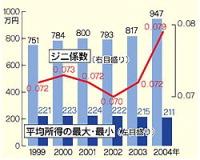
地域間格差:所得格差「小泉政権下で拡大」実証 本社集計
毎日新聞

99~04年の全国の市区町村の納税者1人あたりの平均所得に関し、格差の度合いを示す「ジニ係数」を年ごとに割り出したところ、02年を境に上昇したことが3日分かった。ジニ係数は毎日新聞が東京大大学院の神野直彦教授(財政学)の協力を得て割り出した。平均所得の最高値と最低値の差は3.40倍から4.49倍に拡大、小泉純一郎前政権の間に地域間格差が開いたことを示した。神野教授は「感覚的に論じられてきたものを初めて定量的に示せた」と指摘しており、地域間格差は4月の統一地方選の主要争点になりそうだ。
Extra! Extra!

Cuts in public works reduces incomes in areas without meaningful industries!

High cost, luxury housing construction in high cost-of-living areas tends to attract high income earners!

Economic recovery tends to favor areas where there is meaningful economic activity!

Where there are few children and most of the adults work, per capita incomes are high!

And Prime Minister Koizumi and his sidekick Takenaka are bad people!

Please.

Less amusing is the graph of the differences in average annual incomes between the highest income municipality, Tokyo's Minato-ku, and the lowest, Akita Prefecture's Higashi Naruse Village.


However idiotic the political rhetoric, the difference in average incomes is stark--frankly, unless one lives in a paid-for home, growing a certain amount of one's vegetables and fruits, 2.11 million yen a year seems an impossibly small amount to live on.

If it were not for the caveat that many of those living in Minato-ku are fulltime workers without children (though from the visual clues the number of couples with children must be growing), I would be seriously concerned about a 5 to 1 ratio in differences in per capita annual incomes.

The government has to come to some decision on how the low-income municipalities are going to cope with the future. The problem is mind bogggling. These areas cannot continue to live parasitically off revenues taken from the core areas. At the same time, without government-derived incomes and new residents--even only temporary ones--these places will become dead zones.

The reemergence of not just relative but real rural poverty in an industrialized nation--the reversal of the arc of 20th century economic development--may be the one truly important story of the present day Japanese economy.

In the print edition (Sunday, February 4) of the article is a graphic of the top ten and bottom ten local administrations (自治体) by income. Tokyo's dominance at the top is no surprise (Minato-ku, Chiyoda-ku and Shibuya-ku are #1, #2 and #3...and Tokyo wards hold 7 of the top 10 places). The real shocker is #4, Okinawa's Ueno Township.

What the heck is in Okinawa's Ueno Township?

At the bottom, unsurprisingly, are a lot of Kyūshū local administrations (two in Miyazaki, two in Kumamoto and one each in Nagasaki and Saga Prefectures), two from perennial population loser Akita (the prefecture with the nation's highest suicide rate) and one each from Hokkaidō and Okinawa Prefectures (balance?).

From time to time I am more than a little sharp about the parasitic prefectures, as if there were something wrong with administrative units unwilling to keel over and just die already. It is hard to get individuals to leave their homes; frequently, the home is one asset a person possesses. We cannot all be happy as little consumers in our manshons on X level of sector N of a single vast, pulsating concrete metropolis.

The culprits here are the politicians. They could push matters in the right direction, any direction, if only they had a little nerve and a little vision. The rural districts are victims of a failure of the imagination at the top, not initiative at the bottom.