Good old Mainichi Shimbun. True to its moderate, working-class roots, it has published an editorial today asking a question I have been asking myself for several days now:
"What is so great about being normal?"
The editorial, entitled, "Is it bad to do it as a country of special qualities?" ("Tokushu na kuni" de wa dame ka? -- Link - J) finds that talk about Japan's need to become normal began in earnest over Japan's potential and eventually non-participation in combat in the First Gulf War. Japan's payment of 13 billion dollars in cash as its contribution to the international military campaign earned the country almost nothing in the way of thanks. Instead, demagogues and commentators, primarily in the United States, lambasted Japan for its "checkbook contribution."
In the reverberations of this seeming diplomatic catastrophe, one that had more to do with Japan's failure to open up its markets to trade than sending its troops overseas, the call arose for a "normalization" of Japan, where governments could use the Self Defense Forces more like a regular military. The most prominent outline for this transition was Ozawa Ichiro's Blueprint for a New Japan, making Ozawa, for a while, the great Japanese hope for the Americans (hard to believe that now, after the Hatoyama premiership).
Japan's struggle and need to become normal became a zeitgeist (actually, it has at times all the attributes of a cult). Just google "Japan" and "normal" or "Japan" and "normalization" to see the immense number of hits they generate.
The recent debate over the constitutionality of an exercise of Japan's UN-guaranteed right to enter into collective self defense -- a debate that is supposed to wind up today-- has highlighted more what Japan stands to lose in exercising CSD than what it is likely to gain.
And this is as it should be.
"Normal" is after all, a loaded term. Its opposite is abnormal, a state that no one would want to be in.
However, what if by historical accident, a country was at once stripped of its armed forces, like an individual ensnarled in a traffic accident who loses a limb? One can view that country or individual as being disabled, as less than normal. One would, if one completely mad, instill in that country or individual an overwhelming desire to become normal. Or, one could acknowledge that "accidents do happen" and move on, not focusing on the quantities that are lacking but the qualities that are present.
Looking upon the individual or the country as "differently abled."
There has been a perplexing disconnect between the global consensus that diversity is a positive, making organizations stronger and more flexible, and the drumbeat of those seeking a more "normal" Japan. Where is the appreciation for Japan's idiosyndratic path, the opportunities a "differently abled" Japan affords its allies? Different is supposed to be good, offering one opportunities to achieve goals in new, creative ways.
The world knowing Japan as the "the country where war is unconstitutional" means that it is possible, albeit not inevitable, for Japan and Japanese to perform functions no other nation or people can. Nakamura Tetsu, the miracle worker of Afghanistan, is adamant in believing that his Peshawar no Kai could not be the incredibly noble and effective organization it has been without locals knowing that it is run by a people that will not participate in military action. (Link)
Of course, the use of the word "normal" was facetious from the beginning. Becoming "normal" for a country with an economy the size of Japan meant becoming powerful.
And becoming powerful is the goal of Abe and Company's still tentative but nevertheless unidirectional procession down the path of toward Japanese military flexibility. Anyone who argues otherwise is being tactically mendacious.
And there is nothing wrong with Japan becoming more powerful. The United States is responsible for far more territory and far too many developments. Its commitments to its treaty allies should probably now be seen as reassuring rather than rock-solid. China seems intent on being a bad neighbor; Putin seems intent on being a villain and the Mideast, well, why would anyone want to be involved in its fratricides, except for all that lovely oil and gas?
In such an environment, a stronger Japan is desirable.
However, does Japan have to throw away its unique characteristics to cope with regional and global contigencies? The New Komeito and most honest brokers would say, "No." They have been arguing vociferously, desperately, that Japan does not have to aspire to normalcy -- just greater physical strength and flexibility.
Showing posts with label Iraq. Show all posts
Showing posts with label Iraq. Show all posts
Friday, June 20, 2014
Tuesday, November 27, 2012
The Koizumi Fetish
They cannot get over him. In a sense we all cannot.
Koizumi Jun'ichiro is the "except for" of Japanese prime ministers. Except for Koizumi, no prime minister in the last quarter century has served even 3 years in office. Except for Koizumi, the popularity of prime ministers has followed an inexorable downward course. Except for Koizumi, no Liberal Democratic Party prime minister figured out how to tame the factions, shrug off the responsibility for losses and take credit for victories.
Of course, Koizumi reigned at a special time. The economies of Europe and the United States, super-charged by too loose monetary policy, sucked in imports from East Asia, which, through the invisible hand of the supply chain, redounded to the benefit of this blessed land. Privatization was a good word and the low hanging fruit of structural reform was ripe for the picking.
However, it was Koizumi's ability to dominate public discussion that still seems to haunt the political classes. Koizumi could utter ostensible nonsense -- "I am here to destroy the LDP. So a vote for the LDP is a vote for its destruction" -- and the public would buy it.
Not only would the voters buy the Koizumi line; it took very little time for Koizumi to get them to buy it. Back in 2006, I tossed out a brief note on an interesting trio of graphs published in the Nihon Keizai Shimbun's evening edition of 22 August 2006 (Link). It is worthwhile to take a look at these graphs once again.
The top graph shows the movement of public opinion as regards the dispatch of Self Defense Forces to Iraq. In December 2003, about 33% of those polled were in favor of the dispatch with around 53% opposed. By February of 2004, the 20 percentage point gap had evaporated; equal percentages of the voters were in favor and opposed to the dispatch.
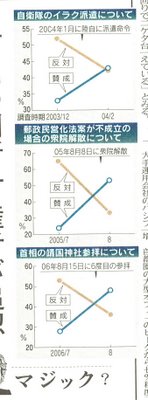 The second graph shows the popularity of a dissolution of the Diet over the House of Councillors' rejection of the postal reform bill. In July of 2005, slightly more than 20% of those polled were in favor of a dissolution over the issue, while a whopping 60%+ were opposed. Koizumi went ahead with the dissolution anyway. Within a month, percentages had shifted by 30 points each way, with over half those polled supporting the dissolution and only slightly above 30% opposed.
The third graph shows the shift, again over a single month's time, in public support for Koizumi making good on his 2001 promise to visit Yasukuni Shrine on the August 15 end-of-war anniversary. In July of 2006, over 50% of those polled did not support the visit, while just under 30% were in favor. By the time of Koizumi's visit, the percentages had reversed, with just over 30% opposing the visit and just under 50% supporting it.
I have no inside information confirming my guess, but Koizumi fetishism, with a dash of "learning from the Aso Taro experience," offers an explanation for Prime Minister Noda's otherwise ridiculous decision to dissolve the Diet. If one believed that one could move public opinion simply by displaying a flamboyant decisiveness -- and one furthermore believed that Aso Taro had, by choosing to delay an election he had been expected to call immediately after taking over as prime minister (due to a little problem in the financial markets in the fall of 2008...), doomed his party to an electoral wipeout in 2009 -- then why not, in an atypically showy fashion, confront Abe Shinzo with an immediate dissolution offer during the live national broadcast of Party Leader Debate Time?
Unfortunately for Prime Minister Noda, public opinion polls show (Link) that conjuring up a majority will take more than just the planting of a flag and the swearing one will defend the ground one is standing on. Pledges have to be credible. Koizumi's were because he chose to stand and fight on issues where he had a record of supporting change. Noda, because he had been choosing his issues out of a hat at the last minute, has no credibility. No one knows whether his stated desire to fight is genuine or not. Noda and the DPJ are failing to win the support of non-affiliated voters even when the DPJ's opponent is an Abe Shinzo-led LDP.
Noda and the DPJ have given the voters short shrift. Though the voters might find it difficult to explain themselves, they are right at taking offense at the prime minister's facile homage to Koizumi's flash. Koizumi's views, though they were contrary to the conventional wisdom, had at least been tested and honed over the decades. Koizumi never staked his or the country's fate on values no one knew he had.
The DPJ releases its election manifesto today. Expectations are for a mild document, a simple restatement of the cautious policies of the Noda administration. Prepare to hear a lot of noise about the contents of the manifesto, followed by a dull thud as the release fails to move any hearts.
If elections were decided on the fundamental reasonableness of the campaign promises, the DPJ would win big in December.
Elections are not just about a list of promises, however. Elections are also about leverage -- that which the party has on others and that which the electorate has on the individual politician. Noda and his fellow travelers in the DPJ offer neither a sense they know the way out of legislative gridlock nor that they care about their constituents.
Voters may still vote for the DPJ district candidate or for the party as the least-worst option -- if the voters bother to show up at all. Only 61% respondents to NHK's weekend public opinion poll swore they would going to the polls on Election Day.
Pushing voters into the voting stall -- and stimulating them into feeling excited about voting -- these the Noda-led DPJ must do. For the appeal to stick, the Noda DPJ must convince voters that its promises are durable commitments.
Good luck with that.
Koizumi Jun'ichiro is the "except for" of Japanese prime ministers. Except for Koizumi, no prime minister in the last quarter century has served even 3 years in office. Except for Koizumi, the popularity of prime ministers has followed an inexorable downward course. Except for Koizumi, no Liberal Democratic Party prime minister figured out how to tame the factions, shrug off the responsibility for losses and take credit for victories.
Of course, Koizumi reigned at a special time. The economies of Europe and the United States, super-charged by too loose monetary policy, sucked in imports from East Asia, which, through the invisible hand of the supply chain, redounded to the benefit of this blessed land. Privatization was a good word and the low hanging fruit of structural reform was ripe for the picking.
However, it was Koizumi's ability to dominate public discussion that still seems to haunt the political classes. Koizumi could utter ostensible nonsense -- "I am here to destroy the LDP. So a vote for the LDP is a vote for its destruction" -- and the public would buy it.
Not only would the voters buy the Koizumi line; it took very little time for Koizumi to get them to buy it. Back in 2006, I tossed out a brief note on an interesting trio of graphs published in the Nihon Keizai Shimbun's evening edition of 22 August 2006 (Link). It is worthwhile to take a look at these graphs once again.
The top graph shows the movement of public opinion as regards the dispatch of Self Defense Forces to Iraq. In December 2003, about 33% of those polled were in favor of the dispatch with around 53% opposed. By February of 2004, the 20 percentage point gap had evaporated; equal percentages of the voters were in favor and opposed to the dispatch.
 The second graph shows the popularity of a dissolution of the Diet over the House of Councillors' rejection of the postal reform bill. In July of 2005, slightly more than 20% of those polled were in favor of a dissolution over the issue, while a whopping 60%+ were opposed. Koizumi went ahead with the dissolution anyway. Within a month, percentages had shifted by 30 points each way, with over half those polled supporting the dissolution and only slightly above 30% opposed.
The third graph shows the shift, again over a single month's time, in public support for Koizumi making good on his 2001 promise to visit Yasukuni Shrine on the August 15 end-of-war anniversary. In July of 2006, over 50% of those polled did not support the visit, while just under 30% were in favor. By the time of Koizumi's visit, the percentages had reversed, with just over 30% opposing the visit and just under 50% supporting it.
I have no inside information confirming my guess, but Koizumi fetishism, with a dash of "learning from the Aso Taro experience," offers an explanation for Prime Minister Noda's otherwise ridiculous decision to dissolve the Diet. If one believed that one could move public opinion simply by displaying a flamboyant decisiveness -- and one furthermore believed that Aso Taro had, by choosing to delay an election he had been expected to call immediately after taking over as prime minister (due to a little problem in the financial markets in the fall of 2008...), doomed his party to an electoral wipeout in 2009 -- then why not, in an atypically showy fashion, confront Abe Shinzo with an immediate dissolution offer during the live national broadcast of Party Leader Debate Time?
Unfortunately for Prime Minister Noda, public opinion polls show (Link) that conjuring up a majority will take more than just the planting of a flag and the swearing one will defend the ground one is standing on. Pledges have to be credible. Koizumi's were because he chose to stand and fight on issues where he had a record of supporting change. Noda, because he had been choosing his issues out of a hat at the last minute, has no credibility. No one knows whether his stated desire to fight is genuine or not. Noda and the DPJ are failing to win the support of non-affiliated voters even when the DPJ's opponent is an Abe Shinzo-led LDP.
Noda and the DPJ have given the voters short shrift. Though the voters might find it difficult to explain themselves, they are right at taking offense at the prime minister's facile homage to Koizumi's flash. Koizumi's views, though they were contrary to the conventional wisdom, had at least been tested and honed over the decades. Koizumi never staked his or the country's fate on values no one knew he had.
The DPJ releases its election manifesto today. Expectations are for a mild document, a simple restatement of the cautious policies of the Noda administration. Prepare to hear a lot of noise about the contents of the manifesto, followed by a dull thud as the release fails to move any hearts.
If elections were decided on the fundamental reasonableness of the campaign promises, the DPJ would win big in December.
Elections are not just about a list of promises, however. Elections are also about leverage -- that which the party has on others and that which the electorate has on the individual politician. Noda and his fellow travelers in the DPJ offer neither a sense they know the way out of legislative gridlock nor that they care about their constituents.
Voters may still vote for the DPJ district candidate or for the party as the least-worst option -- if the voters bother to show up at all. Only 61% respondents to NHK's weekend public opinion poll swore they would going to the polls on Election Day.
Pushing voters into the voting stall -- and stimulating them into feeling excited about voting -- these the Noda-led DPJ must do. For the appeal to stick, the Noda DPJ must convince voters that its promises are durable commitments.
Good luck with that.
Friday, April 18, 2008
A spanner in the works
Wow, did the judges in Nagoya throw the government for a loop yesterday, ruling that the dispatch of the Air Self Defense Forces to Iraq is unconstitutional.
The response of the government? Dismisssive. "Heck, it's non-binding. So no problem." According to the Tokyo Shimbun, one legislator even said, "The lead judge just wanted his name to go down in history." (He did have a little caveat, continuing, "Even so, it's a problematic ruling.")
[Just an aside--but is it not interesting that when a judge rules that what a street criminal did is illegal, the street criminal is universally condemned, particularly by the law-and-order types in the Diet, as having been a bad, bad person. However, when a judge rules that what the politicians have done is illegal...it is the judge who is wrong!
Perhaps politicians, when they were young, were taught to not respect the law by leftist teachers who would not sing the national anthem.]
The ruling represents a shot in the arm for a lot of causes that had fallen moribund.
The ruling will revive the Democratic Party's fight to withdraw the SDF from the Mideast, the next hurdles being the renewal of the Indian Ocean dispatch in January of next year (it was for only one more year, was it not?) and then in July, the renewal of the law permitting the ASDF flights in and out of Iraq.
The ruling will also revive the constitutional revision crowd, many of whom must have been stunned at the Yomiuri poll of a week ago showing that the number of respondents thinking the constitution in need of revision fell below the number of those thinking the constitution should be kept as it is. If the constitution does not permit the dispatch of the planes, and a dispatch of the planes is indeed vital to Japan's overall security--then efforts must be made to have the constitution amended, with popular disquiet an issue that needs be dealt with by-the-by.
Another group who can take heart in the ruling is a broad coalition of folks from all points in the political spectrum who share a common, humble wish: that the courts of the land force everyone, even the powerful and the influential, to obey the law as it is written. The Nagoya court looked at the words of the law and decided that they meant something--and in this land, that is no mean achievement.
Japan Court Rules Sending Troops to Iraq Illegal, Kyodo SaysThe court ruled that the air dispatch was not just unconstitutional, but illegal, the flights into Baghdad violating the provision of the Special Measures for Humanitarian and Reconstruction Assistance Law limiting the activities of the Self Defense Forces in Iraq to "areas outside of a zone of conflict".
Bloomberg
By Naoko Fujimura April 17 -- A Japanese court said the country's dispatch of troops to Iraq was unconstitutional, becoming the first court to rule the mission illegal, Kyodo news service said.
Airlifting activities by Japan's Air Self-Defense Force in connection with the U.S.-led war in Iraq violate Japan's constitution, which renounces war, Presiding Judge Kunio Aoyama at the Nagoya High Court in central Japan said, according to Kyodo.
Even though the court declined to suspend the mission or award damages, plaintiffs won't appeal the ruling, the report said. Prime Minister Yasuo Fukuda told reporters the decision won't affect Self-Defense Force activities in Iraq, Kyodo said.
The response of the government? Dismisssive. "Heck, it's non-binding. So no problem." According to the Tokyo Shimbun, one legislator even said, "The lead judge just wanted his name to go down in history." (He did have a little caveat, continuing, "Even so, it's a problematic ruling.")
[Just an aside--but is it not interesting that when a judge rules that what a street criminal did is illegal, the street criminal is universally condemned, particularly by the law-and-order types in the Diet, as having been a bad, bad person. However, when a judge rules that what the politicians have done is illegal...it is the judge who is wrong!
Perhaps politicians, when they were young, were taught to not respect the law by leftist teachers who would not sing the national anthem.]
The ruling represents a shot in the arm for a lot of causes that had fallen moribund.
The ruling will revive the Democratic Party's fight to withdraw the SDF from the Mideast, the next hurdles being the renewal of the Indian Ocean dispatch in January of next year (it was for only one more year, was it not?) and then in July, the renewal of the law permitting the ASDF flights in and out of Iraq.
The ruling will also revive the constitutional revision crowd, many of whom must have been stunned at the Yomiuri poll of a week ago showing that the number of respondents thinking the constitution in need of revision fell below the number of those thinking the constitution should be kept as it is. If the constitution does not permit the dispatch of the planes, and a dispatch of the planes is indeed vital to Japan's overall security--then efforts must be made to have the constitution amended, with popular disquiet an issue that needs be dealt with by-the-by.
Another group who can take heart in the ruling is a broad coalition of folks from all points in the political spectrum who share a common, humble wish: that the courts of the land force everyone, even the powerful and the influential, to obey the law as it is written. The Nagoya court looked at the words of the law and decided that they meant something--and in this land, that is no mean achievement.
Subscribe to:
Posts (Atom)