Left out
Oh gosh--this does not look good.
There has been some talk recently--oh, let us say here , here, here, and...dammit, why couldn't the moderator just think of just one thread subject for the whole damn dispute--about the (possible) rise in intolerance of improper thought in publicly-funded research institutions.
Now it might be possible to argue that it should not matter too much what happened over at JIIA--and Amaterasu knows an unfortunate number of persons seem to have convinced themselves that "nothing is wrong"--except that the morning edition of my Asahi Shimbun of August 30 tells me that Komori Yoshihisa is one of Abe Shinzo's two closest advisors from within the punditocracy.
The other is--I wish I were making this up--Okazaki Hisahiko.
Whatever one may feel about the quality of the JIIA Commentary essays--and I thought the last one was horrible--Komori's use of the phrases "Anti-Japanese" and "radical leftist scholar" in his now infamous Sankei op-ed had no purpose other than to mark his targets as worthy of destruction.
That Komori succeed in having JIIA Commentary expunged from the public record (if not from the cybersphere) is bad enough.
What made the whole matter intolerable was the rank dishonesty of Saito Yukio's mea culpa. Whatever Saito-san did, he did not "reflect deeply" on his responsibility. Whatever it was that was so offensive, it certainly not the "misuse of technical terms."
Were I the skeptical kind, the insincere Saito "apology" would make me wonder about the worth of the identically phrased apologies drafted by Saito's former employer.
Furthermore, the identification of Komori and Okazaki as confidants feeds into a gnawing worry --that Abe and his Cabinet ministers are about to make a real hash of things.
Koizumi took years to develop his keen grasp of the fracture line in the Japanese polity, the point where persons of good faith will rally around a leader who chooses to make a stand. Intellectually honest, Koizumi has never been sure at the outset where the rallying point might be. The variety in the kinds of Yasukuni visits he made over the years demonstrated his willingness conduct a dialogue with the populace over where he could eventually draw the line.
Abe and his people are cut from a different cloth. So many of those hovering in the wings seem to share an adamant conviction in the correctness of their views.
Unfortunately, when the dead certain go beyond what the public can accept, falling on their faces in the process, they tend not to blame themselves for overreaching. Instead, they blame the public's perfidity--or dark, disloyal forces undermining the State, the dignity of the Government, the national character...whatever unquestionable good they decide has been besmirched.
In sum, I would be a lot more sanguine about Abe had he a few more bon vivant flakes trailing in his wake.
Wednesday, August 30, 2006
In case you missed it...
...we have a new politics blog in English (yeah!).
Tokyo's favorite ex-MITI, ex-METI, fun-loving misanthrope is offering his unvarnished (unsanded, undrilled and unplaned) opinions about all your favorite Nagata-cho miscreants at
http://son-of-gadfly-on-the-wall.blogspot.com/
I wish him well.
...we have a new politics blog in English (yeah!).
Tokyo's favorite ex-MITI, ex-METI, fun-loving misanthrope is offering his unvarnished (unsanded, undrilled and unplaned) opinions about all your favorite Nagata-cho miscreants at
http://son-of-gadfly-on-the-wall.blogspot.com/
I wish him well.
If this is part of the transition the post-Koizumi Era...
...this is going to be one hell of a weird ride.
Egawa's willingness to take responsibility for this child shows once again--it's such a fine line between "eccentric" and "totally out of your bloody mind."
I guess that after having been on the cult's death list for nearly two decades Egawa figured, "Oh well, what the hell--what is the absolutely worst thing that could happen?"
Still, is there any indication where this child will be living? In Egawa's residence perhaps?
Uhhh-Ooooohhhhh...
...this is going to be one hell of a weird ride.
Asahara daughter seeks new guardian"Some hesitation?"
Japan Times
Journalist who covered cult agrees to be replacement for 17-year-old
The fourth daughter of condemned Aum Shinrikyo founder Shoko Asahara has filed a request with the Saitama Family Court to have journalist Shoko Egawa, who exposed the cult's crimes, appointed as her legal guardian.
The 17-year-old daughter took the move Monday after she dismissed her current legal guardian, Takeshi Matsui, a defense lawyer for her 51-year-old father, whose real name is Chizuo Matsumoto.
In June, Asahara's defense counsel filed a special appeal with the Supreme Court seeking to overturn the Tokyo High Court's rejection of his appeal against the death sentence he was handed for his involvement in Aum's crimes, including the 1995 sarin attack on the Tokyo subway system.
"I had some hesitation about becoming a legal guardian, but I want to offer my support, if only a little, for the daughter, who wants to do her best in society and to be helpful to others," Egawa said at a news conference later in the day.
Egawa's willingness to take responsibility for this child shows once again--it's such a fine line between "eccentric" and "totally out of your bloody mind."
I guess that after having been on the cult's death list for nearly two decades Egawa figured, "Oh well, what the hell--what is the absolutely worst thing that could happen?"
Still, is there any indication where this child will be living? In Egawa's residence perhaps?
Uhhh-Ooooohhhhh...
Wednesday, August 23, 2006
I Put A Spell On You...Because You're Mine...
Apologies, but only the most frivolous and shallow of posts today (Editor - Who but you could possibly tell the difference?)
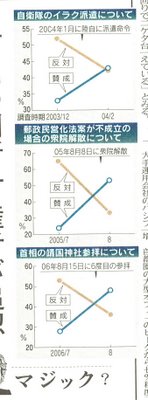
Yestereve's Nihon Keizai Shimbun published a series of graphs that should give pause to political scientists and Japanophiles/phobes in general.
The graphs show the course over time of public opinion polls on the three crucial inflection points of the Koizumi prime ministership:
-the dispatch of SDF to Iraq,
- the decision to dissolve the Diet over the failure of the postal reform bill in the House of Councilors and
- the visit to Yasukuni this year on August 15.
In all three cases, public opinion polls showed a clear majority of voters opposed to the plans of the government. In all three cases, shortly after Prime Minister Koizumi made public the decision to go forward as he saw fit, the positions of the public reversed, with the majority of the public supporting the prime minister's decision.
The writers of this brief article do not even dare try to speculate what the hell is going here. Instead, they opt for a breezy cop-out. They ascribe the phenomenon to -- and I am not making this up -- "magic."
Indeed, how can public opinion be so malleable that the prime minister can sway it by over 20 percentage points in less than a month, according to these graphs, by the mere expression of his will?
Does anyone want to go there?
------------------------------------
Graphs courtesy: Nihon Keizai Shimbun
22 August 2006 - evening edition
Click on the image of the graphs to enlarge

Yestereve's Nihon Keizai Shimbun published a series of graphs that should give pause to political scientists and Japanophiles/phobes in general.
The graphs show the course over time of public opinion polls on the three crucial inflection points of the Koizumi prime ministership:
-the dispatch of SDF to Iraq,
- the decision to dissolve the Diet over the failure of the postal reform bill in the House of Councilors and
- the visit to Yasukuni this year on August 15.
In all three cases, public opinion polls showed a clear majority of voters opposed to the plans of the government. In all three cases, shortly after Prime Minister Koizumi made public the decision to go forward as he saw fit, the positions of the public reversed, with the majority of the public supporting the prime minister's decision.
The writers of this brief article do not even dare try to speculate what the hell is going here. Instead, they opt for a breezy cop-out. They ascribe the phenomenon to -- and I am not making this up -- "magic."
Indeed, how can public opinion be so malleable that the prime minister can sway it by over 20 percentage points in less than a month, according to these graphs, by the mere expression of his will?
Does anyone want to go there?
------------------------------------
Graphs courtesy: Nihon Keizai Shimbun
22 August 2006 - evening edition
Click on the image of the graphs to enlarge
Tuesday, August 22, 2006
Then again, it would be just piling on...
... to note that two days after posting this, The Asahi Shimbun had the following as the lead story of its morning edition:
While the GOJ's trying to cajole students from Continental Asia into staying in Japan post-graduation--and the inner city retail sector's salvation from its employment of large numbers of Chinese students---presents something of an apples and oranges problem (skilled vs. unskilled labor)--both stories reflect a shift toward a greater acceptance, indeed desire, for non-Japanese participation in the national workforce
(Take that, robots! Back! Back!)
Something of a corrective for the very public fiasco over the opening up nursing positions for qualified Filippina applicants.
... to note that two days after posting this, The Asahi Shimbun had the following as the lead story of its morning edition:
Incentives aim to lure top Asian students to stayJapanese version of the story here.
Asahi Shimbun
The government plans to offer scholarships for Asian students to study at universities and graduate schools in Japan to encourage them to stay and work for domestic companies after graduation.
According to sources, the Ministry of Economy, Trade and Industry and the Ministry of Education, Culture, Sports, Science and Technology will launch the scholarship system in fiscal 2007 in cooperation with domestic firms interested in recruiting students from China, South Korea and other Asian countries.
The idea is to raise the number of skilled foreign nationals working in the corporate sector, the sources said.
While the GOJ's trying to cajole students from Continental Asia into staying in Japan post-graduation--and the inner city retail sector's salvation from its employment of large numbers of Chinese students---presents something of an apples and oranges problem (skilled vs. unskilled labor)--both stories reflect a shift toward a greater acceptance, indeed desire, for non-Japanese participation in the national workforce
(Take that, robots! Back! Back!)
Something of a corrective for the very public fiasco over the opening up nursing positions for qualified Filippina applicants.
And sometimes I just get lucky
I am not going to say that I told you so (re point #2) but I told you so:
With the increase in marriages, we should we start hoping for (expecting?) a further stabilization in population--with the consequent diminution of the predicted destruction wreaked in the Götterdammerung of "too many retirees supported by too few workers"?
I am not going to say that I told you so (re point #2) but I told you so:
No. of January-June births in Japan increases for 1st time in 6 yrsSo much for a nation in perpetual decline.
Kyodo News
The number of babies whose births were registered with local government offices in Japan between January and June increased for the first time in six years, according to a health ministry report released Monday.
A total of 549,255 babies were newly registered at municipal offices in the first half of this year, an increase by 11,618 from the same period last year, according to the ministry's preliminary figures.
An official at the Health, Labor and Welfare Ministry said Japan's overall fertility rate, which hit a record low of 1.25 last year, could turn upward in 2006 if the trend of increase in the number of births continues.
Japan's fertility rate, or the average number of children born to a woman aged between 15 and 49, hit an all-time low for the fifth year in a row in 2005, with fewer people getting married, marrying young and giving birth soon after marriage, the government announced in June.
The latest report also showed that the number of marriages registered between January and June was 367,965, up 10,936 cases from the same period last year, with cases registered in February reflecting an increase of about 5,000 from the same month last year.
With the increase in marriages, we should we start hoping for (expecting?) a further stabilization in population--with the consequent diminution of the predicted destruction wreaked in the Götterdammerung of "too many retirees supported by too few workers"?
Sometimes what I write is crap*
An informed reader begs to differ with something I typed up a few days ago:
So there.
The Russian occupation of the Northern Territories keeps the Sea of Okhotsk free of pesky intruders--and, of course, the islands themselves free of golf courses.
* A recent fair and balanced assessment from a regular Shisaku reader.
An informed reader begs to differ with something I typed up a few days ago:
"* Yes, yes, I am aware that a return of the Southern Kuriles to Japan would be a real blow to the commanders of the Pacific Fleet, reducing the ability of Russian submarines to slip in or out of the Sea of Okhotsk undetected."
Actually, the Soviet subs transit to the Sea of Okhotsk via the La Perouse or Soya Strait between Hokkaido and Sakhalin Island. And it's so shallow and dangerous they typically have to do it on the surface, w/ an escort ship.
In fact, supposedly the USS Wahoo, a very famous WWII sub, was just found where it was thought to have been sunk, during a transit through the Soya Strait into the Sea of Japan.
Probably sunk during a night transit, on the surface, under a half moon. Caught by shorebased seaplane bombers.
See Amazon.com for "Wake of the Wahoo: The Heroic Story of America's Most Daring WWII Submarine, USS Wahoo"
and this is why Stalin wanted at least the northern half of Hokkaido.
The Kuriles help seal the bastion in the Sea of Okhotsk from outside
intruders.
So there.
The Russian occupation of the Northern Territories keeps the Sea of Okhotsk free of pesky intruders--and, of course, the islands themselves free of golf courses.
* A recent fair and balanced assessment from a regular Shisaku reader.
Monday, August 21, 2006
The Nihon Keizai Shimbun runs the numbers...
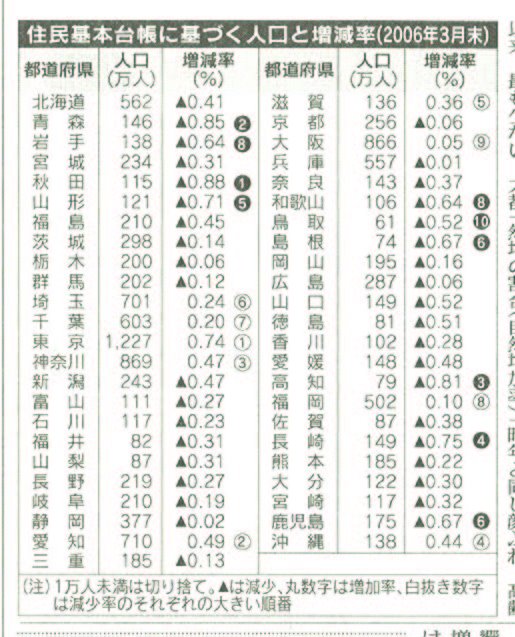 ...and finds some inequalities of more than casual interest.
Two weeks ago, the Ministry of Internal Affairs and Communications* released its annual Analysis of Internal Migration in Japan Derived from the Basic Resident Registers (in J: 住民基本台帳に基づく人口・人口動態及び世帯数の調査).
The survey provides one of the three official population figures of Japan, the other two being the results of the personal interview surveys done every five years and the Ministry of Health, Welfare and Labor's population clock.
The Basic Resident Register Survey is just that--the sum of the number of registered residents as reported annually to the Ministry by every local government.
Now the survey reconfirmed what a lot of people knew already:
1) the country's on the downhill slide--the total number of registered residents in Japan fell by 3,505 persons
2) if you live around Tokyo or Nagoya--or in Shiga or Okinawa Prefectures--and you feel as though the world is crowding in on you, you are not imagining things.
The population of Metro Tokyo grew by 0.74% in 2005 (highest growth in the nation); Aichi Prefecture by 0.49%. The immediate area around Tokyo grew by an aggregate 0.47%. The long-lived and loose-living Okinawans had the greatest rate of biological increase (births minus deaths). Shiga grew purportedly because some geniuses are building vast highrise suburbs there for the Kyoto-Osaka market.
3) If you lived anywhere else your neighbors were getting scarcer (OK, OK - Fukuoka grew a 0.10%--so sue me). The worst to go looking for new customers for whatever it is you want to sell was perennial loser Akita, where last year 0.88% of the population either died or moved away. Aomori shrunk by 0.85%; Kochi by 0.81%; Nagasaki by 0.75%.
Akita, Aoki Mikio's beloved Shimane and Abe Shinzō's stomping grounds of Yamaguchi are tied in the contest for the longest losing streak--all have been losing population for 14 straight years.
4) Your neighbors, in addition to getting scarcer, were getting older (just before getting scarcer, one should guess). In Akita, Shimane and Kochi, the percentages of persons over 65 years of age are 27, 27 and 26, respectively--way over the national rate of 20.3%
5) Osaka--where not a hell of a lot has gone right for a while--lost its place as the second most populous todōfuken. Kanagawa is now number two in the rankings, having added 40,000 persons over the last year (all those Kawasaki towers filling up, you know) .
Now these and a lot of other fun facts for marketers and super store locators can be found on the MIC website and the morning newspapers of August 5.
What the Nikkei did with the figures that was clever was run a cross check of the population shifts in the local government registers against the representation of those areas in the Diet.
The most over-represented district in the Diet is Kōchi Prefecture District #3 (population 264,014), whose Representative is Yamamoto Yūji (LDP - 6 elections).
 The most under-represented district is Hyōgo Prefecture District #6 (the city of Takarazuka--among other things) whose Representative is Kobiki Tsukasa (Who? Never heard of him. Oh, Koizumi Kid...LDP - 1 election).
Now what is interesting is the ratio of inequality. From the Nikkei's calculation every vote in Kōchi #3 is the equivalent of 2.177 votes in Hyōgo #6.
I was under the impression the top level of inequality was much higher, above 3-to-1.
2.177 sounds almost...mild, really.
It is still pretty depressing that the voters in these 27 districts --and the least represented districts are all either urban districts (Nagano #1 is Nagano City) or in Hokkaidō (I guess that explains the Takushoku Ginkō failure)--have votes worth half as much as those of the voters of Kochi District #3 and its simulacrae in Shimane, Tottori, et al.
And dangnabbit, these underrepresented districts are the places that are growing (pax Hokkaidō), that have vibrant economies (ibid) and are where the young and the restless can be found!
All figures courtesy: Nihon Keizai Shimbun
Morning edition for August 5, 2006.
* MIC - What an embarrassingly cute acronym! MIC! MIC! I work for MIC! As in MIC...KEY...M-O-U-S-E!
Sunday, August 20, 2006
One for the Americans
George Will is one of the most perplexing writers in the American political arena.
During the Reagan years Will was a rare conservative voice of sanity, arguing for the knowable when the entire government seemed to follow the prognistications of astrologers. He remained quiescent in the Bush I years--a reasonable position, as George H. W. Bush governed with understated good sense.
However, when William Clinton won election, Will fell off the level. He developed a knee-jerk hatred of Clinton and wasted the eight years in vociferous denunciation of everything the Clinton Administration tried to do.
With the election of George W. Bush, Will was in heaven. The great era of personal responsability and limited government was dawning. When the Bush II Administration failed to deliver either of these, and indeed ran as fast as it could from either, Will defended the perfidious incompetence of the president and his advisors.
For five and half years.
Suddenly in mid-2006, after 14 years seemingly in a coma, George Will, the real George Will whom people used to read, has shaken himself awake.
Last week, in the midst of the hysteria over the breakup of a purported British terrorist cell, Will lacerated the Bush Administration for their willful blindness of the real way to fight terrorism.
All of which is a very long introduction to George Will's column in today's Washington Post. It is almost inconceivably erudite--if a bit heavy-handed on the condemnation of victimhood.
Frankly it scares the bewilickers out of me.
And where the hell has he been for the past 14 years?
George Will is one of the most perplexing writers in the American political arena.
During the Reagan years Will was a rare conservative voice of sanity, arguing for the knowable when the entire government seemed to follow the prognistications of astrologers. He remained quiescent in the Bush I years--a reasonable position, as George H. W. Bush governed with understated good sense.
However, when William Clinton won election, Will fell off the level. He developed a knee-jerk hatred of Clinton and wasted the eight years in vociferous denunciation of everything the Clinton Administration tried to do.
With the election of George W. Bush, Will was in heaven. The great era of personal responsability and limited government was dawning. When the Bush II Administration failed to deliver either of these, and indeed ran as fast as it could from either, Will defended the perfidious incompetence of the president and his advisors.
For five and half years.
Suddenly in mid-2006, after 14 years seemingly in a coma, George Will, the real George Will whom people used to read, has shaken himself awake.
Last week, in the midst of the hysteria over the breakup of a purported British terrorist cell, Will lacerated the Bush Administration for their willful blindness of the real way to fight terrorism.
All of which is a very long introduction to George Will's column in today's Washington Post. It is almost inconceivably erudite--if a bit heavy-handed on the condemnation of victimhood.
Frankly it scares the bewilickers out of me.
The Uneasy Sleep of Japan's DeadHow can Will write so knowledgeably about the subject of Yasukuni in the context of East Asian power politics, a subject he could hardly ever have the time to research while perched upon his pundit's swivel chair in Washington DC? And what is Will doing in Tokyo--in August? And who has he been talking to while he's been here?
Washington Post
Sunday, August 20, 2006; -TOKYO -- The past is present everywhere, but Japan is an unusually history-haunted nation. Elsewhere the Cold War is spoken of in the past tense. Japan, however, lives in a dangerous neighborhood with two communist regimes -- truculent China and weird North Korea. For Japan, the fall of the Berlin Wall did not close an epoch. Even World War II still shapes political discourse because of a Shinto shrine in the center of this city.
Young soldiers leaving Japan during that war often would say, "If I don't come home, I'll see you at Yasukuni." The souls of 2.5 million casualties of Japan's wars are believed to be present at that shrine. In 1978, 14 other souls were enshrined there -- those of 14 major war criminals.
Between that enshrinement and 1984, three prime ministers visited Yasukuni 20 times without eliciting protests from China. But both of Japan's most important East Asian neighbors, China and South Korea, now have national identities partly derived from their experience as victims of Japan's 1910-45 militarism. To a significant extent, such national identities are political choices...
And where the hell has he been for the past 14 years?
Saturday, August 19, 2006
One guy gets his house burned down...
...and an ass has a brain fart.
This, this is so offensive and/or dangerous we cannot have the children/foreigners reading it?
Nothing to be done, no way to fight back.
...and an ass has a brain fart.
This, this is so offensive and/or dangerous we cannot have the children/foreigners reading it?
Oh well, the institution has acted. The milk is spilled; the bag is catless.Series: Is Japan Re-Entering the World of International Power Politics?
Japanese Discovery of Democracy
Masaru Tamamoto
26 April 2006
If civilizations tend to clash, is there among nations within the bounds of civilization a propensity toward affinity? Japanese Foreign Minister Taro Aso writes, "I welcome China's return to center stage-as long as China evolves into a liberal democracy. And I believe it will." (Wall Street Journal, March 13, 2006) The Chinese foreign ministry spokesman says China is intent on isolating Japan until its neighbor shows sincerity and wisdom in handling their mutual history. Democratic evolution and historical justice are generally laudable goals. Still, given the cold diplomatic relations between Japan and China at the moment, there is certain competition for moral superiority couched in terms of democracy versus historical justice.
South Korea, which Aso heralds as one of the world's most vibrant democracies, is casting its vote on the side of historical justice. A more democratic South Korea emerging from decades of military dictatorship tends toward populism and encourages attitudes critical of Japan. Memory of the Japanese empire remains significant in the formation of both South Korean and Chinese national identities. Of late, Japan's diplomatic relations with South Korea have turned almost as cold as that with China. And arguably, a democratic China today would be markedly more anti-Japanese than the China under strict Communist Party control; much more than a tool of official manipulation, popular anti-Japanese sentiment runs deep. Irredentism-an age-old source of international conflict and fuel for nationalistic passion-over tiny islands divides Japan and South Korea, as well as Japan and China, and is making the headlines. Between Japan and South Korea, shared democratic values are not yet proving to be a source of affinity.
Trumping the History Card
Talk of democratic Japan facing dictatorial China is commonplace in the Japanese foreign policy circle today-it is difficult to conduct reasonable discussion with a dictatorial regime. Such talk is used to explain the cold diplomatic relations of the past five years with China. Worryingly missing is any elaboration of the policy implications of framing Sino-Japanese relations in terms of an ideological divide. It is as if many believe that dismissing China as a dictatorship is in itself sufficient. But, surely, such a dismissal does not make a viable strategy. And yet, it is also true that the Japanese talk of democracy versus dictatorship became commonplace only after diplomatic relations with China had turned thoroughly cold, so the talk is more an expression of frustration and helplessness than a thought out policy.
Officials in the limelight perhaps may be excused for making such a talk, for Prime Minister Junichiro Koizumi has been adamant about taking the history card out of China's hand, even at the cost of creating a diplomatic impasse. Since assuming office in 2001, Koizumi has not wavered in his promise to make an annual visit to Yasukuni, a Shinto shrine in central Tokyo where the spirits of modern Japan's war dead are enshrined. His predecessors had trodden with caution around the issue of Yasukuni, for among the 2.5 million spirits enshrined are those of 14 judged to be war criminals by the allied powers following the Second World War. Beijing's point of contention is the 14, and Yasukuni has become the central issue symbolizing Sino-Japanese friction.
While Koizumi clearly states that he has no intention of honoring the 14, and that his visits are pledges of no more war, plurality of opinion in Japan finds the diplomatic cost too high, or that Koizumi has chosen the wrong symbol to trump China's history card. The major national dailies-Yomiuri, Nikkei, Mainichi, and Asahi-have come to take a critical stance against the Yasukuni visits; Sankei newspaper is the exception. There is no consensus in Japan on the status of the 14, though they are far from admired-Were they responsible for starting the war? For the wartime atrocities? For prolonging a losing war? Or, for losing the war? What are the 14 guilty of? Postwar Japan's failure to satisfactorily sort out these questions lies at the root of the nagging history problem. Beijing understands well the Japanese situation and takes advantage.
Both Tokyo and Beijing are waiting for next September, when Koizumi is scheduled to step down, to try new diplomatic initiatives. Meanwhile, the Japanese dismissal of China as a dictatorship is a way of biding one's time.
A More Assertive Japanese Foreign Policy
Those familiar with post-1945 Japanese foreign policy will readily notice that bringing ideological difference to the fore is new. After the collapse of its empire by the defeat in war, Japan had refrained from expressing value judgments on how other nations organize themselves-empires are exactly about organizing the lives of other nations. Today's new talk of democracy is one manifestation of the debate as to whether Japan should begin to adopt a more assertive foreign policy. Supporting the emergence of new democracies has become a part of the foreign policy agenda, though not central.
Elevating democracy above totalitarianism, liberty above tyranny, of course, had been the language of the United States in the Cold War. Cold War thinking and habits linger in the way Tokyo and Beijing frame their security structures with each other. And Japanese pundits who pit democratic Japan against dictatorial China surely have in mind the United States as audience. Emphasizing democracy is their way of reaffirming the bond of Japan's alliance with the United States in the face of rising China. But the United States is not quite buying the Japanese rhetoric. Washington's China policy is engagement, and its slogan is turning China into the world's "responsible stakeholder." While Washington has not entirely given up on "transformational diplomacy," there is increasing impatience with the way Japan handles China; there is even concern that the U.S.-Japan security treaty might turn into a burden if Japan's alienation in East Asia were to worsen.
Many Japanese analysts agree that Japan now faces a fluid and unstable strategic environment-the issues are the rise of China and nuclear brinkmanship of North Korea. Throughout the Cold War and beyond, Japanese foreign policy has had a simple architecture. How to maintain the American relation was key, and most all else flowed from that relationship.
Following the defeat in war in 1945, Japan recoiled from the harshness of international power politics. The American victors offered vanquished Japan a deal, which was sealed with the U.S.-Japan security treaty: The United States extended a security umbrella over Japan in exchange for the use of Japanese territory as America's forward military base. The United States acted as Japan's buffer to international power politics, while Japan happily pursued the life of economism. In this way, the security treaty became Japan's highest source of authority, the functional successor to the prewar emperor, "sacred and inviolate."
The Cold War provided Japan with a stable strategic environment, the threat of nuclear annihilation of humanity notwithstanding. And there was nothing much that Japan could or was willing to do to affect the deadlock of mutually assured destruction. This Japan could not make any value judgments about the world, according to Kiichi Miyazawa who would be prime minister in the 1990s. So the goal of Japanese foreign policy was to establish friendly relations with as many countries as possible, while under the protection of the United States, the final guarantor of Japan's willful innocence of international politics.The question today is: To what extent should Japan continue to depend on the United States to frame its place in the world? While there is a handful of younger parliamentarians espousing the brave vision of a Japan independent and responsible for its own security, the bulk and core of the Japanese foreign policy establishment sees no wisdom in imagining a world without American protection. The current dispatch of Japanese troops to Iraq as part of the American "coalition of the willing"-Japan's first military venture abroad since 1945 without United Nations cover-is not unrelated to the Japanese calculation of the rise of China; the American insurance premium has gone up.
Japan is out of practice of thinking about international politics, and it shows. A course in strategic studies could hardly be found in universities in the Japan of willful innocence. It is only recently that those trained in strategy, mostly at American and British graduate schools, are beginning to find university and think tank jobs. They are on the whole injecting the realist assumption of conflict into Japanese discourse, introducing notions like balance of power, deterrence, land and sea powers, pre-emptive and preventive wars. They see that China poses the classic security problem of a rising power upsetting the status quo relations among great powers, which historically has tended toward conflict. They are pushing the idea that Japan should become a "normal country" and reacquire the use of force as an instrument of state policy. They are at the moment getting attention for their novelty, still the nascent field of thought requires more time and experience to achieve a desirable level of sophistication and balance.The Politics of Status Affirmation
China is a source of existential angst for Japan's political class. While Japan floundered through economic deflation beginning in the early 1990s, the Chinese economy made unimagined strides. China's gross domestic product calculated by purchasing power parity is now bigger than the Japanese. And according to the Economist Intelligence Unit, China's gross domestic product will outstrip that of the United States in fifteen years, making China the largest economy in the world. China's rise has robbed Japan of its identity as the world's economic miracle.
Japanese national identity had been about catching-up with the achievements of the West. The Japanese celebrated and took their country's advances for granted as Japan's economic performance outstripped those of France, Britain, then Germany. This Japan had never been the object of catch-up, until now-and by so close a neighbor. The Japanese political class is having a difficult time mentally adjusting to China's rise; some are even sulking.
Underlying much of the discussion about China in the Japanese political class is the effort-and the psychological need-to affirm status differentiation. Status affirmation is key in the way Japanese society functions, found in everyday manners and rituals, and in restrictive rules and endless intrigues. Japan's status affirmation has its origin in Chinese tradition, of course, and China also continues to see the world in hierarchical terms. The Japanese on the whole are comfortable with "knowing one's place."
This Japan is in the midst of searching for a post-economic identity in the international world, especially in Asia. The search is for a new hierarchy in which Japan can claim leadership status. There is even talk of identifying Japan as a leader in having experienced and dealt with horrendous industrial pollution, meaning Japan has the answers to the problems of industrialization China and others are facing. Organizing the world in terms of a hierarchy of democratic evolution is another way of awarding Japan leadership status in Asia. But, in the end, the real question of Japanese national identity is whether Japan in Asia can develop a sense of equality.
CodaThe source of affinity in East Asia is not civilization but the degree of engagement with world capitalism and middle class development-economic interdependence. China is Japan's largest trading partner, and Japan is China's second largest foreign investor. The Japanese economic class manages to cut deals and make profit, despite the cold diplomatic relations, taking little notice of any ideological divide. And the Japanese public, in contrast to the somewhat jittery political class, remains sanguine about Japan and its future with China.
Mr. Tamamoto is editor of JIIA Commentary.
The views expressed in this piece are the author's responsibility and should not be attributed to JIIA Commentary or The Japan Institute of International Affairs
Nothing to be done, no way to fight back.
Subscribe to:
Posts (Atom)